The 2026 Paralympics Games in Milano-Cortina are just more than 100 days away and the excitement is palpable. Thousands of talented and hopeful Para athletes will take to the world’s stage to compete, proudly representing their countries.
This country boasts an incredibly talented roster on Team Canada — from wheelchair curling to Para nordic skiing and the athletes are expected to medal in many of the 79 events.
But there is one event that won’t be represented by Canadian athletes: women’s Para hockey (WPH).
Although Canada has an immense amount of talent in Para hockey, the women’s game is still not part of the events in the Paralympics program. The Canadian WPH website has an explainer video of the players getting ready and stating: “When we hit the ice, we don’t just play hockey. We are breaking barriers and pushing boundaries, and proving that women belong in every corner of sport.”
But while this team remains dedicated and ambitious, it is missing from the greatest theatre of Para sport in the world, and to complicate matters, is not being fully funded by Hockey Canada, the sport’s governing body Canada.
It begs the question: why is women’s Para hockey being iced out?
This past August, Slovakia played host to the first women’s world Para hockey championships. Every game was sold out and the event was well-executed. The tournament included five national teams: Australia, Canada, USA, Great Britain and Norway. A sixth team called “Team World” was made up of players from seven different countries in Europe, plus Japan and South Korea.
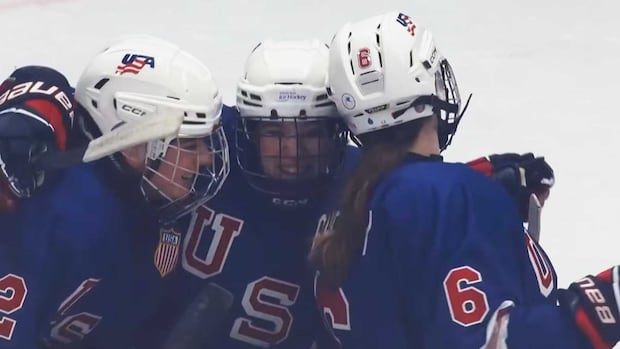
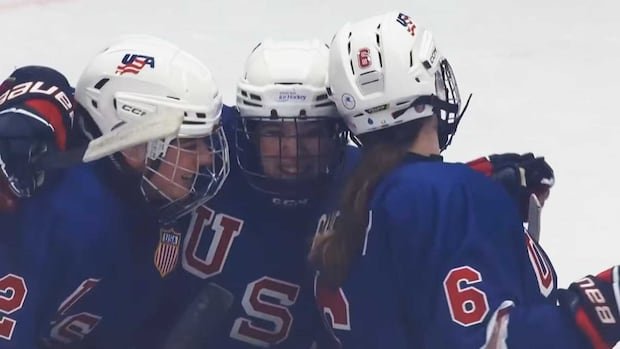
Kelsey DiClaudio scored four times to lead the Americans to a 7-1 gold medal win over Canada at the inaugural World Para Ice Hockey Women’s World Championship.
Canada lost in the final, 7-1, to a strong American team. I spoke with Canadian head coach Tara Chishom after the world championships about the experience and what the opportunity means to this team and for the growth of Para hockey.
“What stood out most was how quickly people who had never seen Para hockey before became true fans, not just of the sport, but of the athletes themselves,” Chisholm told me via e-mail. “It was exactly what we’ve been hoping for: a moment where these women were celebrated for the years of dedication, skill, and effort they’ve poured into growing the game.”
Women’s Para hockey is currently not part of the Paralympics, but women’s Para hockey organizations are vying for inclusion at the 2030 Paralympics in the French Alps. To be eligible, the women’s division must play two sanctioned world championships prior to 2027. With the success of this year’s event, they have now achieved the first requirement and the Chisholm said the collective effort is focused on delivering a strong follow-up in 2026 to solidify the pathway toward Paralympic inclusion.
The current Paralympic hockey event is mixed and so, technically, women can compete. No woman has ever been named to the Canadian Paralympic team although two players, WPH captain Christina Picton and Raphaëlle Tousignant, were named to the development team. Tousignant became the first Canadian woman to play with the men when she participated in the 2023 world Para hockey championships in Moose Jaw, Sask.

CBC Sports sits down with Raphaëlle Tousignant, teammate Tyler McGregor, and head coach Russ Herrington, ahead of the 2023 World Para Ice Hockey Championships in Moose Jaw, Sask.
This past summer, Tousignant was one of Canada’s assistant captains at the WPH championship. She had declared her intention to be part of Canada’s Paralympic hockey team (historically it has only been men) in Milano-Cortina, but last month the 23-year old made the heartbreaking announcement that she had been diagnosed with breast cancer.
“Who knows how it will all unfold, but I will know that I tried until the very last second to make my dream reality,” she said on an Instagram post.
Not only was the news devastating, it feels unjust. I interviewed Tousignant before she disclosed her diagnosis and asked her about the Hockey Canada funding issue.
“I can’t help but feel that it’s unfair that we don’t have the same opportunities and support as the men’s side,” she said in an e-mail. “I know that the men also had to fight for years to earn their place at the Games, and I truly respect that. I just wish that by now, the women’s game would receive the recognition it deserves. That being said, I do have frustrations about the amount of barriers that have been in our way — or even added along the way.”
Claire Buchanan, 38, has played 11 seasons with Canada’s WPH team and also volunteers her time on boards and mentoring younger players.
Before the world championship, Buchanan told me that sometimes the lack of funding from Hockey Canada feels like “a vicious cycle.” Buchanan said the men’s Para hockey team was only funded after their first Paralympics appearance. She recognized their sacrifice and their efforts.
So do the women have to win a gold medal before they get funding? But in order to get a gold medal, they will need that funding in order to adequately train and compete. It is, as Buchanan explained, a vicious cycle.
“We do have a comfortable relationship with Hockey Canada. Over the last two years, we’ve collaborated on events and camps, and there has been that support in that regard,” she said. “But fully taking us under their umbrella, and with all of the support that comes with that, we’re not there yet.”
Buchanan said that the team doesn’t spend a lot of energy grappling with the why not because it really doesn’t seem that complicated. Attending the WPH world championship costs about $10,000 per player.
Buchanan works at CBC Sports and is a colleague. When she returned from Slovakia, she brought her silver medal to the office to show us.

I reached out to Hockey Canada to find out the why. Spencer Sharkey, Hockey Canada’s manager of communications sent me the following response: “As a national sport organization, Hockey Canada’s mandate from the federal government is to operate national teams that compete internationally for sanctioned World Championships and participate in the Olympic and Paralympic Winter Games, and we continue to work intently with World Para Ice Hockey and the International Paralympic Committee as they navigate the path towards inclusion of women’s Para hockey in the Paralympic Games programme.”
Sharkey pointed out that Hockey Canada gave the WPH team a $150,000 grant, plus equipment and team gear, ahead of the WPH world championships.
He confirmed that Hockey Canada would “continue to advocate for the growth of women’s Para hockey in Canada and around the world.”
Women’s Para hockey has often been underfunded but also has allies that come up with creative opportunities for collaborations.
There are times when rules of sport and bureaucracy seem necessary. This is not one of those times. A talented squad that is racially diverse, has LGBTQ players, and represents many different regions in Canada, seems like the perfect team in which to invest. Fully funding Canadian WPH could help them achieve inclusion in the next Paralympics. Isn’t that what we all want?
“Our team’s time is coming,” Chisholm said. “We have a young crew of women who are putting in the work not only to make themselves better, but to smash long-held notions of what women can do in the sport of Para hockey. They embody what it means to be proudly Canadian: hardworking, humble, and relentless in the pursuit of something bigger than themselves.”
Canada has a legacy of greatness on the ice but it’s past the time to fully support women’s Para hockey. It could be one of the greatest assists in Canadian hockey history.
Source link