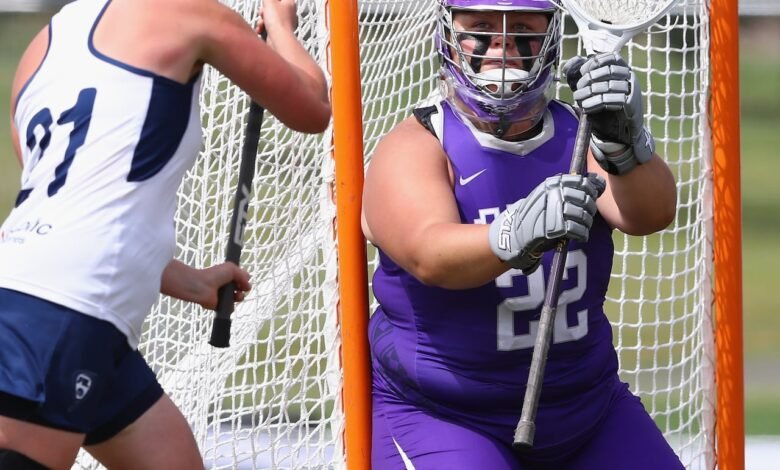
The Haudenosaunee Nationals lacrosse team is committed to taking up space in the game their ancestors created.
Both men’s and women’s teams are competing in the Sixes Cup in Puerto Rico this week; their sixth PALA competition. The tournament is organized by the Pan-American Lacrosse Association, one of three Continental Federations under World Lacrosse. The tournament runs Wednesday to Sunday.
The women’s team won bronze at the previous PALA Tournament in Florida this year and qualified for the 2026 World Lacrosse Women’s Field Championships in Tokyo.
“Talent is quickly rising in the Nationals league,” said Jalyn Jimerson, 25, who plays for the Haudenosaunee Nationals and is a member of the Cayuga Nation in southern Ontario within the Haudenosaunee Confederacy.
The Haudenosaunee Nationals are also campaigning to be included in the 2028 Olympics in Los Angeles under their own flag when the Sixes sport makes its Olympic debut. The board of directors has been working with World Lacrosse to make it possible.
“You want to see that purple and gold there. And I think that’s what should happen,” Jimerson said.
Jalyn Jimerson said that despite the trauma her people have endured in their history, their community and their sport remains strong.
The Nationals organization said there have been informal conversations between them, World Lacrosse and the International Olympic Committee (IOC), and they hope eventually to meet with IOC president Kirsty Coventry
“We’re trying to be strategic, but [also] mindful of the state of the IOC…,” said Claudia Jimerson in recognition of the IOC preparing for the Milano Cortina Winter Olympics in February. Jimerson, Jalyn’s mother, is a board member, director of operations for the Nationals and a former player for the team.

World Lacrosse has recognized and supported The Haudenausee as a national team, including them in international competitions and advocating for their participation on the world’s biggest athletic stage.
“World Lacrosse shares the Haudenosaunee’s passion and commitment to their participation in the Olympic Games,” the organization said in a statement. “We are fully committed to collaborating with the IOC and other key stakeholders to find creative solutions to showcase the sport’s history and explore a potential pathway for the Haudenosaunee to participate in LA 2028 while respecting the Olympic Games framework.”
This is no easy feat. The Haudenosaunee Confederacy is not recognized as a sovereign nation by the United Nations and does not have a National Olympic Committee (NOC). An NOC is required for Olympic participation under the Olympic Charter.
In a statement, the IOC said: “Only [NOCs] recognized by the IOC can enter teams for the Olympic Games in accordance with the Olympic Charter. This means it is up to the two NOCs concerned (USA and Canada) – in coordination with World Lacrosse and the National Federations concerned – to decide if they include athletes from Haudenosaunee in their respective teams depending on the passport they hold.”
Regardless of Olympic eligibility, as members of World Lacrosse, the Nationals can enter the PALA Championships next year. The tournament is a qualifier for the 2027 World Sixes Championships.
Bean Minerd, 30, a Nationals player, head coach for Buffalo State Women’s Lacrosse and member of the Onondaga Nation, has imagined herself and her teammates walking through the Olympic tunnel with their flag waving above them. She said the thought of it gives her chills.
“We are just going to keep fighting [for participation], and we’re good at that, because we’re still here,” Jalyn Jimerson said.
Both the U.S. and Canadian governments have released statements supporting Haudenosaunee inclusion in the Olympics.
You’re there to play for good medicine and play with joy.– Jalyn Jimerson
Support from major entities has helped amplify the team’s voice, giving the players hope. Claudia Jimerson said this sends a powerful message about these organizations’s commitment to truth and reconciliation.
Lacrosse is growing globally and gaining widespread recognition. But will the creators of the game receive Olympic recognition?
Before the modern version of the game existed, lacrosse was used ceremonially within Haudenosaunee culture. Although women do not participate in ceremonial lacrosse, they carry its principles onto the field for the Nationals.
“You’re there to play for good medicine and play with joy,” Jalyn said.
Claudia Jimerson believes the game helps people reconnect with their roots after all the generational trauma. Her job is more than building a competitive team and organization. The community is still trying to heal, so incorporating healing into this process is essential. This is the essence of the sport to the Haudenosaunee, and why they call it medicine.
“Lacrosse has given the HC a voice, and a platform for the world to recognize their history,” Jalyn Jimerson said.
The women’s roster for the PALA Sixes Cup includes about 12 players ranging from 18 to 30 years old. Each athlete must provide evidence of maternal lineage or be enrolled in the Haudenosaunee Confederacy of Nations to play.
The women’s team was re-established in 2006 after it was disbanded in 1988. Since then, they’ve experienced everything from heartbreaking travel restrictions by airport authorities, to gaining international recognition. Jalyn’s team was denied entry to Scotland in 2015, accepted by London the following year and recently became the first to travel to Asia with their Haudenosaunee passports.
With every obstacle the team faces, Jalyn Jimerson said, they manage to surpass it.
Jalyn Jimerson and Minerd described their team as a family whose presence they enjoy and whose work ethic they respect. After years of friendship, the pair discovered they were cousins, a reflection of the familial ties within the team.
When Jalyn Jimerson puts on the Nationals jersey, she feels empowered standing with her teammates and representing her ancestors who never had the chance to play.
“You are representing a lot of history that hasn’t been told,” Jalyn Jimerson said. She acknowledged the atrocities her ancestors endured after the arrival of European settlers and said the game is also played for those who never made it back home because of the devastating residential schools system.
This tournament is one of many more opportunities for players like Minerd and Jalyn to honour their culture and people. They hope the Olympics will soon follow suit.
Source link