This is an excerpt from The Buzzer, which is CBC Sports’ daily email newsletter. Stay up to speed on what’s happening in sports by subscribing here.
Since curling returned as an official Olympic sport in 1998, Canada is the most successful country by the two most important measures, winning a global-high six of the 16 golds (two more than second-place Sweden) and 12 medals overall (also two ahead of the Swedes).
But, despite remaining the world’s No. 1 producer of elite curlers, Canada has not won an Olympic men’s or women’s title since 2014, when the teams skipped by Brad Jacobs and Jennifer Jones swept the golds in Sochi.
In 2018, Canada’s John Morris and Kaitlyn Lawes teamed up to win the inaugural mixed doubles gold, but their success was tempered by Kevin Koe’s loss in the men’s bronze game and Rachel Homan’s failure to qualify for the women’s playoffs.
The Beijing Olympics in 2022 seemed like a golden opportunity for Canada to rebound with a star-studded lineup featuring Homan and Morris in mixed doubles, Jones in the women’s event and Brad Gushue in the men’s. But Gushue was the only one to advance to the medal round, coming away with a bronze.
So, is this the new normal? Or can Canadian curling regain the dominance it enjoyed from 1998 to 2014, when it won five of the 10 Olympic gold medals and every single one of its teams came away with at least a bronze?
That will be in the hands of the four-person teams skipped by Jacobs and Homan, who return to the Olympics after winning the Canadian trials in late November, and the mixed doubles pairing of Jocelyn Peterman and Brett Gallant, who won their trials in January 2025. Gallant will actually contend for two medals as he throws second stones for Jacobs.
To help gauge Canada’s chances at the upcoming Olympics in Italy, we asked our math-whiz friends at Shoreview Sports Analytics to crunch the numbers. Using the same methodology that correctly predicted Jacobs’ and Homan’s victories at the trials, they arrived at a 63.2 per cent chance that Canada wins at least one curling gold medal, and a 58.7 per cent chance that it captures its first four-player Olympic title since 2014.
Informed by Shoreview’s projections, let’s take a look at each of the three events:
Women’s

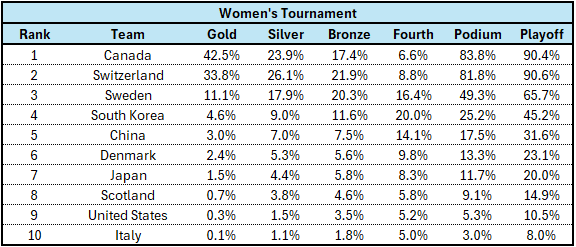
The rankings here match what every curling fan knows: Canada’s Rachel Homan is the front-runner for the women’s gold. Along with teammates Tracy Fleury, Emma Miskew and Sarah Wilkes, Homan captured back-to-back world titles in 2024 and 2025 and has won five of the 10 Grand Slam tournaments over the last two seasons. The 36-year-old skip also has boatloads of high-end international experience, having played in the world championship five times, including the first of her three title wins in 2017 with Miskew and two other teammates. This will be Homan’s third straight Olympics.
However, the Winter Games have been a house of horrors for Homan. As the reigning women’s world champion in 2018 in South Korea, she went a terribly disappointing 4-5 in the round robin and did not make the four-team playoffs. She also failed to advance in mixed doubles in 2022 in Beijing, finishing 5-4 with Morris.
There’s reason to believe things will be different this time as Homan has really taken off since adding Fleury, a former skip, to her lineup at the third position before the 2022-23 season. In addition to their back-to-back world titles, Homan’s upgraded team went undefeated at the Scotties Tournament of Hearts the last two years and reached their eighth consecutive Grand Slam final this November before winning the Canadian trials with a two-game sweep of upstart Christina Black in the final series. They’re currently ranked No. 1 in the world.
But some cracks are showing in the Homan Empire of late. After beginning the season with three straight Slam titles, the team lost in the quarterfinals at the Canadian Open last month and in the semifinals at the Players’ Championship last weekend. There were some troubling games along the way: during the trials round robin, Homan fell to little-known Kayla Skrlik (currently ranked 42nd in the world) for her first loss to a Canadian opponent in more than a year. In the Canadian Open preliminaries, Homan’s rink got blanked 8-0 by Kerri Einarson, who beat them again in the Players’ semifinals.
Meanwhile, Homan’s main rival is gaining steam. Switzerland’s Silvana Tirinzoni, who captured four straight world championships before Homan defeated her in the final in 2024 and ’25, won the Players’ Championship for her second Grand Slam title in a row.
The 46-year-old Tirinzoni, who throws third, skipped her team to the final of all five Slams this season. But she’s never won an Olympic medal either, missing the playoffs at 4-5 in 2018 (the same record as Homan) before losing her semifinal and the bronze game after an 8-1 round robin in 2022.
The upshot of the recent Slam results, says Shoreview analyst Mike Heenan, is that Homan’s gold-medal odds have fallen by a couple of points, to 42.5 per cent. It’s also worth noting here that while Homan is the “favourite” in terms of having the highest win probability, the Shoreview model still thinks she’s more likely to not win gold. This perhaps speaks to the increased parity in international curling these days.
Having said that, the Shoreview numbers suggest this is pretty much a two-horse race between Canada and Switzerland. Combined, they have a better than 3-in-4 chance of winning the gold. And Homan’s odds of earning her first Olympic medal are close to 84 per cent.
Potential spoilers include Sweden’s Anna Hasselborg, who won Olympic gold in 2018 and beat Tirinzoni for the bronze in ’22; South Korea’s Eun-ji Gim, who took bronze at the 2024 world championship; and China’s Rui Wang, the bronze winner at last year’s worlds.
Men’s

Canada has not won a major men’s curling title since Brad Gushue’s victory at the 2017 world championship in Edmonton. But the country has a solid contender to end that drought in Brad Jacobs.
The 40-year-old fitness fanatic won Olympic gold in 2014 and nearly made it back in 2022, losing to Gushue in the final of the Canadian trials. Jacobs then stepped away from curling for a bit before returning and eventually joining up with Marc Kennedy, Brett Gallant and Ben Hebert (no strangers to the gym themselves) in the spring of 2024. The veteran foursome had a great first season together, winning the Brier and taking bronze at the world championship in Moose Jaw, Sask., last spring after a semifinal loss to eventual champ Bruce Mouat of Scotland.
At the Canadian trials in November, Jacobs and his boys went 6-1 to earn a bye to the final, then swept Brier runner-up Matt Dunstone in the best-of-three series to send their skip back to the Olympics for the first time in 12 years. According to the Shoreview model, Jacobs’ rink has a better than 3-in-4 chance of winning a medal.
However, they’re clear underdogs for gold to Mouat, who plays under the Great Britain banner at the Olympics. After taking silver at the 2022 Games in Beijing, the now 31-year-old Scotsman went on to win the world title in both 2023 and 2025 and is currently ranked No. 1 in the world. In both the Shoreview projections and the betting markets, he’s about even money to win the Olympic gold.
Mouat has also been dynamite on the Grand Slam tour, winning four of the five events last season and another two this season before losing in the semifinals at last month’s Canadian Open and in the quarters at last week’s Players’ Championship. Jacobs, meanwhile, has not won a Slam with his current teammates, and they went no further than the semis in any of their four starts this season, including a quarterfinal exit in their final Olympic tuneup at the Players’.
Just as there’s a pretty big drop-off from Mouat to Jacobs in Shoreview’s odds to win gold, there’s another large gap between Jacobs and No. 3 contender Yannick Schwaller. But don’t write him off: the 30-year-old skip was the runner-up at last year’s world championship, where Mouat beat him by one point in the final, and he took bronze at the 2023 worlds.
That brings us to my biggest disagreement with the projections. I think the 3.8 per cent chance of winning gold for Sweden’s Nik Edin is way too low. Sure, he’s getting up there in age at 40, but this is the reigning Olympic champion and the winner of a record seven world titles, including one in 2024.
So what gives? To help us understand how these probabilities are calculated, Mike from Shoreview explains that his company produces a statistical rating for each team using what’s known as the Bradley-Terry model, which estimates each team’s underlying strength based on pairwise comparisons — in other words, who would beat who in individual matchups. The model puts the highest weight on the most recent results, with the weight of each game decreasing until it falls out of consideration after two years. Using those ratings, Shoreview simulated each of the upcoming Olympic tournaments 10,000 times and looked at all of those simulations to see how often each team finished in each position.
Once you know this methodology — particularly the way that results “decay” in value until they’re disregarded entirely after two years — you can understand how Edin’s medal chances could fall short of his reputation. His last world title came at the end of the 2023-24 season, and he lost in the first round of the playoffs last year. Over the last two seasons on the Grand Slam circuit, he did not advance past the quarterfinals in any of his appearances, and this season he failed to make the playoffs in four out of five.
And yet, look what happened when the chips were down at the European championships in late November. After going 6-3 in the round robin, Edin upset Mouat in the semifinals and then beat Schwaller in the final to capture his eighth continental title and show that he’s still a major threat to win his fourth consecutive Olympic medal — and maybe even his second straight gold.
“We’ve been pretty cold these last couple of years,” Edin admitted after the Euros victory. “This is pretty good timing. We’re in really good form, so things will be looking interesting for the Olympics.”
Mixed doubles

Here’s a wild fact: Canada has never won the mixed doubles world championship, which has been played 17 times since its inception in 2008. In fact, the planet’s No. 1 curling nation has earned just four medals, and none since 2019.
Granted, Canada did not really take mixed doubles seriously until the newer, quirkier game became an Olympic event in 2018. But, in recent years, the country has sent some of its very best curlers to the mixed doubles worlds. The superteam of Kerri Einarson and Brad Gushue finished fourth in 2021, while the great Jennifer Jones and her husband, Brent Laing, also ended up fourth in 2023.
Meanwhile, Canada’s results in the Olympics have been, well, mixed. As mentioned earlier, Kaitlyn Lawes and John Morris won the inaugural gold in 2018 before Morris and Rachel Homan missed the playoffs in 2022. Both partnerships were sort of shotgun marriages as Curling Canada held its 2018 mixed doubles trials just a month before the Olympics and then simply selected Homan and Morris in 2022 after the pandemic made it impractical to do the trials.
This time, the decision to hold the trials more than a year before the Games resulted in an actual married couple earning the right to represent Canada. Jocelyn Peterman and Brett Gallant first got together in 2016 when Gallant asked her to be his partner for the Canadian mixed doubles championship. They were married in 2022 and had a son the following year.
So, chemistry shouldn’t be an issue. Nor should a lack of Olympic experience: they both competed in 2022 in Beijing with their four-person teams at the time — Peterman with Jennifer Jones, Gallant with the Brad Gushue rink that won the men’s bronze. They also happen to be the last Canadian duo to win a medal at the mixed doubles world championship, taking silver in 2019.
However, Peterman and Gallant have come up empty-handed in their last two trips to the worlds. In 2022, they went 8-1 in group play before losing in the first round of the playoffs to Norway. Last spring in Fredericton, they went 7-2 before getting knocked out right away by Estonia and then losing a ranking game to the United States to finish sixth.
The Shoreview model thinks they’re better than that. But it still projects Peterman and Gallant will miss the podium again at the Olympics, giving them a 46 per cent chance for a medal and only about an 11 per cent shot for the gold.
The favourites are host Italy’s Stefania Constantini and Amos Mosaner, who are the reigning Olympic and world champions. Two other teams are ahead of Canada in the projections: the British duo of Bruce Mouat and Jennifer Dodds, who were the runners-up at last year’s world championship; and Americans Cory Thiesse and Korey Dropkin, the 2023 world champs.
It’s worth noting here that, just like in the women’s and men’s events, the “favourite” has less than a coin flip’s chance of winning the gold. In other words, it’s more likely that some other team takes it than the one the model projects.
And, if history is any guide, we should expect the unexpected in mixed doubles. That’s not just a gut feeling in reaction to past surprises like Homan and Morris failing to make the playoffs. Mike from Shoreview explains that mixed doubles is the hardest event to predict because there are far fewer results to feed into the model compared to the four-player events.
As an example, he notes that Homan’s team played 149 games and Jacobs’ team played 132 during the two-year rating period. Peterman and Gallant had just 57, and only five of those were against teams they’ll face at the Olympics. “I still feel good about the general order,” he says. “But we would expect a bit more uncertainty here.”
Source link