Stellato-Dudek cautious in return from injury, but figure skater again prepared to challenge her fears

Chris Jones reports from Milan.
It was a glorious Friday in Milan. The skies were blue. The mountains north of the city, obscured by cloud since the start of the Winter Olympics, finally came into spectacular view.
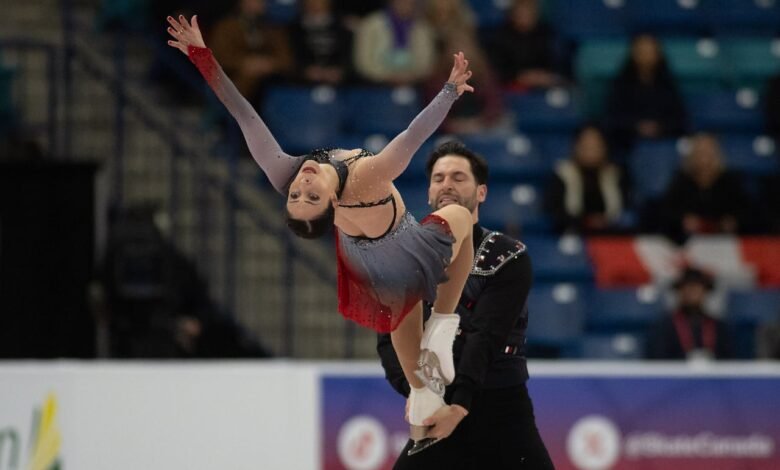
Deanna Stellato-Dudek and Maxime Deschamps, the Canadian pairs skaters, arrived together to the same dream — the counteragent to 10 days of pain, fear, and worry.
Stellato-Dudek struck her head on the ice in training in Montreal on Jan. 30, threatening her decade-long quest to skate at the Olympics.
“The last week and a half has been a living nightmare that I would not wish on anybody,” she said, after she and Deschamps practised in Milan for the first time, the day after their belated arrival.
At 42, Stellato-Dudek was poised to become the oldest female figure skater to compete at an Olympics in nearly a century. Then disaster struck.
She would not get into the specifics of her accident, which caused the pair to miss the team event. “It has been less than 10 days. I, myself, have not processed what happened. Since the moment the accident occurred the only focus was tunnel vision: How can I get here?”
There are other mysteries. She claimed that she did not suffer a concussion. “That would have been difficult to recover from,” she said, and she talked about doing exercises, not normally part of post-concussion protocol.
But she declined to explain what sort of head injury she did sustain if not a concussion, citing, oddly, privacy laws.
“Those laws exist for a reason,” she said. “I don’t deserve to know anybody else’s personal medical information, nor do you deserve to learn mine.”
She also said that she was off the ice for only three days, even though Deschamps said he’d been training alone while waiting for her to recover.
“I still believe in Deanna the whole time,” he said. “I’ve been training super hard during that time and support her. We were still hoping and everything and that was important to keep that.”

Stellato-Dudek also talked about her fear getting back on the ice in a way that suggested she was off for more than three days.
“If I were to take a 10-day vacation and then come back, I’m afraid to do anything,” she said, before she quoted Eleanor Roosevelt: You should do something every day that scares you. “And I’m like, well, I check that box, no problem.”
Stellato-Dudek’s return will be cast as triumphant because it is.
It is also, more quietly, worrying. Watching her skate Friday — tentatively, nervously — roused discomforting reminders of Lindsey Vonn, who, at 41, broke her leg in a horrific crash at Cortina after attempting to ski on a ruptured ACL.
Stellato-Dudek made veiled reference to Vonn and other athletes who’ve suffered catastrophic injuries at these Winter Olympics.
“When there tend to be a lot of accidents at Games, it’s this weird, contagious thing through all of the disciplines,” she said. “As I was seeing people getting injured on everything, we were like, maybe I should think about what’s best for my personal health going forward.”
As I was seeing people getting injured on everything, we were like, maybe I should think about what’s best for my personal health going forward.– Deanna Stellato-Dudek on risks of competing
Her concession was to remove a signature element of their short program: Stellato-Dudek has been performing a back flip, never done in pairs skating. She will not attempt it when she and Deschamps begin competition Sunday.
“Obviously, we don’t want to do anything that’s going to hinder, like, the rest of my life in terms of my health,” she said. “We just wanted to take out any unnecessary risk.”
There is still risk involved in her return. Pairs skating is dangerous skating: There are jumps, lifts, twists, and death spirals. Stellato-Dudek and Deschamps ended their first training session with a death spiral, in fact, her head spinning an inch above the ice.
“Athlete health and safety remain our top priority, and the decision to compete was made under the guidance of medical professionals,” the Canadian Olympic Committee said in a statement. Stellato-Dudek was cleared on Monday after what doctors, she said, described as a “remarkable recovery.”
This is not her first comeback. She retired from figure skating at 17 because of a hip injury, but 16 years later, at a work retreat, she was playing a “get-to-know-each-other” game and pulled a card that changed the course of the rest of her life: “What would you do if you knew you couldn’t fail?”
Her answer led her to return to skating at an age when most skaters have retired.
Perhaps, then, it’s not surprising that she’s willing to skate so soon after another injury, in her last chance to become an Olympian.
“To know me is to know that I wasn’t going down without a fight,” Stellato-Dudek said. “You have fear but you have to go through it. That’s it. There’s no other option.”
Not for her, at least.
Source link