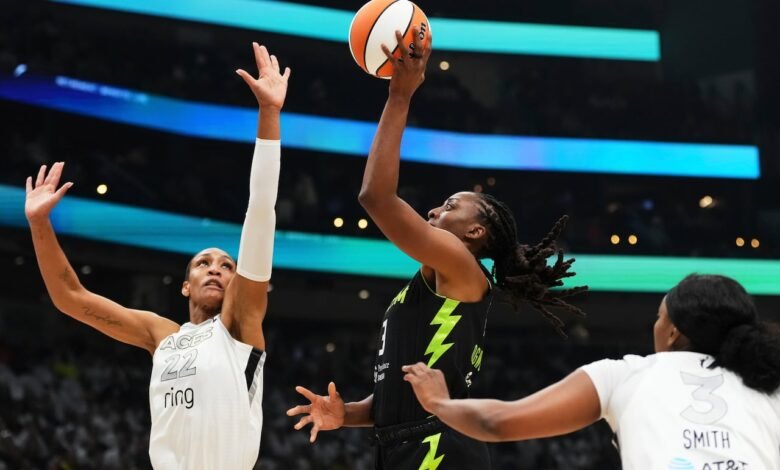
It was a moment of pure, unfiltered joy.
Or the closest possible approximation you could get at 2:30 a.m. after more than a week of marathon negotiations.
“Happy smiles,” the WNBA’s Nneka Ogwumike said in a video posted to her Instagram account showing the cheering, slightly tearful, champagne-glass-raised moment the league reached a deal in principle with its players that would quadruple their salaries and increase their share of revenues.
If the players looked as relieved and exhausted as they did happy, it might be because the deal was struck in the early hours of Wednesday after more than 100 hours of intense in-person negotiations over eight days.
But it could also be because the win was actually years in the making, the end of an increasingly acrimonious battle over salaries and revenue-sharing that has seen players campaigning to be paid more basically ever since the basketball league’s 1997 inception.
“This journey has been well worth it,” Ogwumike, president of the Women’s National Basketball Player’s Association (WNBPA), told Good Morning America on Thursday.
“It’s a deal that’s changing lives in real time and also for generations to come.”
It comes 17 months after the players opted out of their previous collective bargaining agreement (CBA) and five months after the previous deal was set to expire. Training camps are set to open in just a month, on April 19 — six days after the college draft.
The minimum base salary for players in 2025 was $66,079 US. Under the new agreement, the minimum salary would be more like $300,000 US, the average would be $585,000 and the maximum would be $1.4 million, with a team salary cap of $7 million, according to The Associated Press.
Specifics still need to be finalized over the next few weeks as lawyers on both sides work on the new CBA.

Spike in popularity of women’s basketball
The deal that will give the league its first million-dollar players comes after women’s basketball experienced a dramatic rise in popularity over the past few years. The emergence of superstars like Caitlin Clark, the WNBA’s expansion, and a surge in March Madness viewership certainly haven’t hurt.
Salaries had remained a sore point, with top players like Clark having to take a pay cut in order to turn pro after playing in the college-level NCAA.
The WNBA’s 2025 No. 1 draft pick Paige Bueckers was projected to earn just $78,831 US for her rookie year — less than the real median household income in the U.S.
The No. 1 draft pick for the NBA, by comparison, can expect to earn $13.8 million US in his rookie year, according to sports salary reporting site Spotrac.
“We’ve always believed that as this game grows, the players that power it must grow with it,” Ogwumike, who plays with the Seattle Storm, said in a written statement Wednesday.
“This is historic for women’s sports … it’s not just for the players that are entering the league or the players that aren’t already here,” she later told reporters.
The WNBA is a relatively young league and doesn’t have decades of contract negotiations behind it like the NBA does. It also has a history of under-investment, and with less sway and worse outcomes in media rights deals.
By 2000, some of the WNBA’s top players left the league to earn more by playing overseas. More recently, WNBA stars Breanna Stewart and Napheesa Collier launched their own three-on-three league to give players a domestic option to supplement their income.
In the warm-up for the 2025 All-Star Game, players wore shirts that said “pay us what you owe us.”

On Wednesday, union leaders said they were proud of themselves for fighting.
“The deal is going to be transformational,” Stewart, a union vice-president, told reporters.
“It’s going to build and help create a system where everybody is getting exactly what they deserve and more from on-the-court and off-the-court aspects.”

After the WNBA and player union failed to agree on a new CBA by their Jan. 9th deadline, a moratorium has been placed on free agency. Less than four months from the start of the 2026 season, could a lockout be on the horizon?
Could this affect other leagues?
WNBA Commissioner Cathy Engelbert said in a statement that the league and the union had “aligned on key elements,” noting that they still need to finalize a formal term sheet.
“But the progress made in these discussions marks a transformative step forward for players and the league,” she said.
A strong, player-focused CBA isn’t just a win for the WNBA — it’s a win for all women’s professional sports as well as the public’s perception of their legitimacy, said Michele Donnelly, an associate professor in the department of sport management at Brock University in St. Catharines, Ont.
She’s hopeful it could benefit athletes in more recently established professional leagues, like the Professional Women’s Hockey League (PWHL) and the National Women’s Soccer League (NWSL).
The minimum salary in the PWHL this season is $37,131 US. In the NWSL it’s $50,500.
“At the same time, I think it is important to maintain realistic expectations of women’s professional sport leagues with respect to revenue and viewership,” Donnelly told CBC News, a nod to the WNBA’s skyrocketing growth and popularity.
Attendance, viewership and investment from stakeholders has increased to historic levels over the past few years. Other leagues can’t expect to achieve those same numbers as they aim to negotiate higher salaries and better conditions, Donnelly explained.
“A league’s success is due, in large part, to being able to recruit and retain the sport’s best athletes,” she said.

In an exclusive interview with CBC Sports, the Toronto Tempo’s new head coach talks about how CBA negotiations are impacting the teams recruiting plans for its inaugural season, her mentality less than four months out from tip-off, and her excitement to be a part of the Toronto sports scene.


