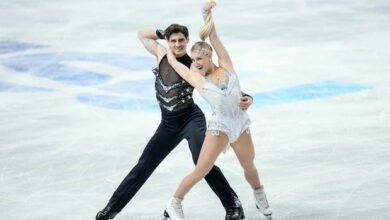
As the World Figure Skating Championships begin today in Prague, many of the season’s most memorable Olympic programs — and their standout costumes — are about to take the ice again.
In figure skating, the program always comes first, but the costumes have long defined how athletes translate music, movement and emotion into visual storytelling. From hand-stitched chiffon dresses in open-air rinks to today’s couture-engineered Lycra constructions in indoor arenas, skating fashion reflects both athletic evolution and cultural change.Inspired by this year’s Olympic looks, we trace six decades of unforgettable looks and discover the stories behind the style.
Here’s the full schedule, how to watch and which Canadians to follow at Worlds.
1960s–1970s: The colour-television transition
Figure skating’s first major fashion shift came with the rise of colour television. Costume designers and skaters began thinking not only about technique, but also about how garments read on screen, leading to bold colours, clean silhouettes and balletic minimalism.
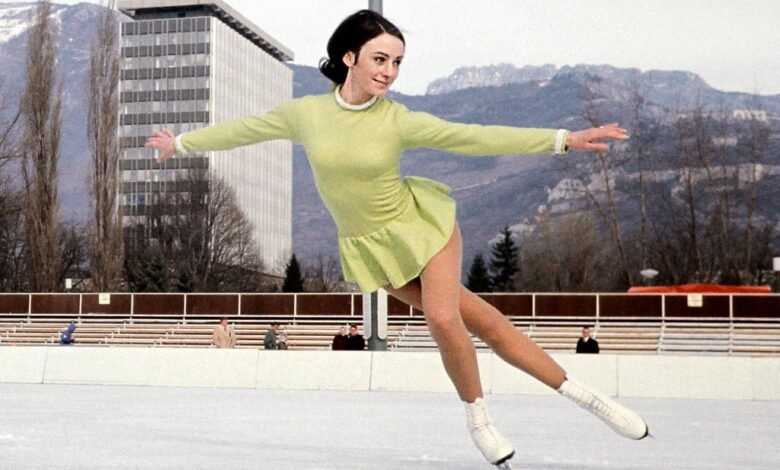
Peggy Fleming (United States)
Grenoble 1968

Fleming seized on the cultural moment by skating in glowing chartreuse chiffon. The colour was also chosen to match the green liqueur produced by monks near Grenoble (and thus elicit subliminal support from the French). Fleming won the United States’ only gold medal at the 1968 Games – a particularly redemptive achievement considering the entire national team had perished in a tragic plane crash just a few years earlier.Fleming seized on the cultural moment by skating in glowing chartreuse chiffon. The colour was also chosen to match the green liqueur produced by monks near Grenoble (and thus elicit subliminal support from the French). Fleming won the United States’ only gold medal at the 1968 Games — a particularly poignant achievement, coming seven years after the country’s entire figure skating team died in a tragic plane crash.
Dorothy Hamill (United States)
Innsbruck 1976

Olympic style rarely crosses over into mainstream fashion, but Hamill’s gold-medal moment was a notable exception. She became a cultural phenomenon thanks to her precision-cut wedge hairstyle, which flared out during her signature “Hamill camel” spin. Her costumes (one pink, one red) were simple and attractive, but it was her haircut that ignited a nationwide craze and made her an early beauty influencer.
1980s: The rise of razzle-dazzle
The 1980s ushered in a sparkly new era of rhinestones, glamour and the beginnings of fashion-house influence. Costumes became more theatrical and more revealing, prompting new International Skating Union (ISU) regulations.
Kira Ivanova (USSR)
Sarajevo 1984

Ivanova became the first Soviet figure skater to win an Olympic medal, earning bronze in Sarajevo. Her midnight-blue, long-sleeved dress was dotted with sequins and featured ripples of blue chiffon at the skirt, creating an elegant, sophisticated silhouette. Unfortunately, Ivanova’s career and personal life deteriorated soon after this achievement, and she retired from competition in 1988. She struggled with alcohol abuse and made several attempts at rehab, but never fully recovered, and was tragically found murdered in her Moscow apartment in 2001.
Katarina Witt (East Germany)
Calgary 1988

At the 1984 Sarajevo Winter Olympics, Witt looked like a princess from a German folktale in a tiara, high-necked, puffy-sleeved top and pink skirt. In Calgary, her Broadway-inspired, high-cut, blue-feathered dress was less prim. In fact, it was considered so scandalous that it prompted new modesty guidelines — dubbed the “Katarina Rule” — from the ISU. The ban was eventually reversed, but not until 2003. At these same Games, she also wore a baggy white T-shirt and a cowboy hat. Six years later, in Lillehammer, she skated in a masculine Robin Hood costume — a tongue-in-cheek challenge to those who had written her off as too seductive.
1990s: Ice-cold couture
Fashion designers began partnering with skaters, elevating competition looks to runway-level artistry.
Surya Bonaly (France)
Albertville 1992

Bonaly made headlines after deliberately performing an illegal one-blade backflip at the 1998 Nagano Olympic Games. The gravity-defying move was made legal again in 2024, and the U.S.’s Ilia Malinin recently wowed crowds by pulling it off himself. But before Bonaly risked it all for the flip, she was also a pioneer in bringing couture to the rink. At Albertville, she wore a glamourous ice-blue, gemstone-encrusted costume with a shoulder pouf, designed by Christian Lacroix, who also created a matador-inspired look for her. Figure skating has historically lacked diversity, and Bonaly also faced scrutiny for not wearing tights — which were reportedly difficult to find in a shade that matched her skin tone.
Nancy Kerrigan (United States)
Lillehammer 1994

Just seven weeks after she was notoriously attacked by the partner of rival skater Tonya Harding, Kerrigan arrived in Lillehammer wearing couture-level costumes by Vera Wang, who had also dressed her for the 1992 Albertville Olympic Games. The designer, a former figure skater herself, outfitted Kerrigan in designs that have stood the test of time: a matte-white mini with black velvet panels and sheer sleeves and a champagne-toned number glittering with thousands of rhinestones.
Late 1990s–2000s: Minimalism, modernity and narrative
Costumes became more streamlined, intentional and in more closely aligned with program narratives.
Michelle Kwan (United States)
Nagano 1998

Evening wear designer Marc Bouwer was behind Kwan’s iconic powder-blue dress, which she wore in a free skate set to the concerto Lyra Angelica. A simple silhouette, cut from crushed blue velvet and nude chiffon panels and trimmed with ice-white crystals, allowed the emotional resonance of her performance to shine through. Kwan wore a simple bun and a gold dragon pendant strung on red silk around her neck, a good luck charm from her grandmother.
Sasha Cohen (United States)
Turin 2006

For her silver medal–winning performance set to the film score of Romeo and Juliet by Nino Rota, Cohen wore an exquisite costume that combined classical romance with modern minimalism. Cohen worked closely with her dressmaker to design the soft, burgundy-velvet look accented with pleated chiffon and intricate beading. She refers to it as her favourite figure-skating dress.
2010s–2022: The ascent of the global skating superstar
Costumes became more technically ambitious and deeply tied to cultural heritage, aided by designers who specialized in skating couture.
Maé-Bérénice Méité (France)
PyeongChang 2018
This was the first Olympics in which skaters were allowed to perform to music with lyrics. Méité delighted the audience with her selection of a Beyoncé mashup, including a cover of Halo and Run the World (Girls) for the women’s short program. Viewers also raved about her outfit choice of sleek black leggings paired with a heavily rhinestoned top. Female skaters don’t often wear pants to perform, but Méité was following forebears Debi Thomas of the U.S., who wore a black sequinned unitard at the 1988 Calgary Winter Olympics, and Irina Slutskaya of Russia, who wore a black jumpsuit encrusted with jewels laid out like exploding fireworks at the 2006 Turin Winter Olympics.
Yuzuru Hanyu (Japan)
PyeongChang 2018

Designed by Satomi Ito (who also designed Ilia Malinin’s costumes at the 2026 Milano-Cortina Olympic Games), Hanyu’s Seimei costume is widely considered his best – and he has many ethereal looks to choose from. Featuring a stunning purple, white and gold design with intricate detailing, it perfectly matched the traditional Japanese theme of his free skate, which secured the skater his second consecutive Olympic gold.
Shoma Uno (Japan)
Beijing 2022

Uno won his first Olympic medal, a silver, at PyeongChang in a regal sapphire-blue costume designed by Satomi Ito that made him look like an emperor on the ice. In Beijing, he wore another exquisite outfit, this time by Quebec-based designer Mathieu Caron. Performing to an oboe concerto, Uno wore a sheer, sequinned turtleneck layered under a storm-coloured, asymmetrically draped cowl-neck top. He helped Japan win two more medals (a bronze and a silver) at these Games.
2026: The new couture Olympians
As we saw at the 2026 Milano-Cortina Winter Olympics, figure-skating fashion has fully merged athletic performance with couture-grade design. High-fashion ateliers and star skaters collaborated on pieces engineered for movement and spectacle.
Ilia Malinin (United States)

Though he missed out on an Olympic gold medal, Malinin remained a visual standout of 2026. His gladiator-gamer short-program look and couture-beaded free-skate design by Satomi Ito earned him fashion victories on the ice that made audiences flip out.
Piper Gilles and Paul Poirier (Canada)

Many ice-dance teams wowed with their costumes as much as their routines. The red-black ombré skirt-cape worn by the U.S.’s Madison Chock when she performed with her husband, Evan Bates (a look she designed herself), is a serious contender for best in the category. But in the end, it was Gilles and Poirier’s 1989 Thierry Mugler– and Van Gogh’s Starry Night–inspired looks that shone brightest among the competition.
Kaori Sakamoto (Japan)

For her last Olympics, silver-medal winning Sakamoto wore a pink-and-maroon costume accentuated with a pearl neckline for her free skate to Edith Piaf’s Non je ne regrette rien, as well as a vivid blue dress with a twisting, sculptural trim for her short program. Other notable women’s looks included Deanna Stellato-Dudek of Canada’s Oscar de la Renta dresses, Anastasiia Gubanova of Georgia’s Schiaparelli-inspired dress and, of course, Alysa Liu of the U.S., with her punk-inspired bleach-and-black striped hair.
Source link