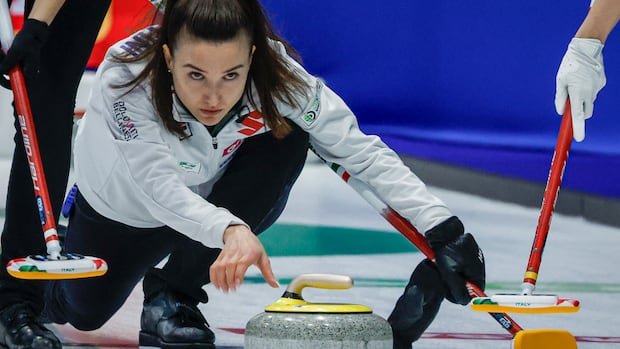
Frontier’s Stefania Constantini returned to Rock League Thursday in Toronto after a 16-hour trip home to Italy.
It was like she never left.
“We had her jersey out with us [while she was away],” teammate Grant Hardie said. “Anyone who was struggling with draw weight touched Steffi’s jersey. So it’s good that she stepped up and kind of answered that as well.”
Indeed, Constantini returned at just the right time for Frontier, which improved to 2-3 on the week thanks to a 2-1 win over Northern United on Friday that came down to the women’s game.
Constantini entered the seventh end down 6-2, but things stacked up in her direction. Armed with hammer, the Italian stared down a draw to the button for four — thanks in part to a rule making any stone covering the pinhole in the final end worth two.
All the while, longtime rivals Bruce Mouat and Yannick Schwaller — now teammates with Northern — gathered on one side of the sheet to talk strategy. Across the ice, Hardie and GM Chris Plys put their heads together.
Constantini nailed the shot, forcing a draw-to-the-button tiebreaker. Then, she nailed it again. The crowd of hundreds roared louder than it has all week.
And just like that, Frontier flipped a potential loss on its head, picking up a critical victory to keep its playoff hopes alive.
“When you’re asked to be part of this league, it’s moments like that you’re playing to try to enjoy. Myself and Chris were there, trying to give advice tactically as well and we just had that feeling that Stef was going to put it in the right place,” Hardie said.
Nic Sulsky, CEO of The Curling Group, which owns Rock League, agreed.
“Those are the types of things you want to see when you go to a great sporting event, when you go to a great concert, when you go to any live event,” he said.
“You want to see something that you’ll remember, that emotional experience. And everyone who was there and everyone who was watching just experienced something pretty freaking cool.”
That the game meant something to fans, to the curlers and to the standings was a realization of the concept Sulsky first launched one year ago.
Even while not everything has gone according to plan through five days — there have been broadcast bumps and multiple variations of the in-arena videoboard, which finally settled on Thursday — Sulsky has leaned on the action as the biggest success so far.
“You can fix tech, you can fix broadcast, you can fix in-venue, you can fix product. If the format wasn’t awesome and if the curlers hadn’t completely bought in to this format and structuring the new teams, it wouldn’t have worked. Well, guess what? Format’s awesome. And the curlers, I mean, you’re talking about them, the curlers love it. They’ve bought in,” he said.
The standings got even tighter in the afternoon draw, when Typhoon Curling Club also improved to 2-3 with wins in men’s and mixed doubles over Alpine Curling Club, which dropped to 3-2.
More curling to come
On Saturday, teams will be seeded for mixed fours games, which will be worth one point each.
Then, the top four teams will advance to the semifinals Sunday, with the championship match later in the day. The winning Rock League team will depart with $100,000 US, with descending payouts from there.
Sulsky called his week all of exhilarating, exhausting, exciting and thought-provoking. In the end, though, he said success will be defined by the boardroom.
“We haven’t been shy around the fact that we’re raising capital,” Sulsky said.
There have been some solid behind-the-scenes indicators, including a three-times increase in new American followers on the Rock League Instagram account, perhaps thanks to the action streaming on ESPN+.
On the flip side, the seats haven’t been as full as hoped or expected.
“The naysayers pick up on that and they’re like, ‘Oh, look, no one’s going, it’s flopping.’ No, they take things out of context. If you watch the Scotties, you watch the Brier, you watch the worlds, early draws on Tuesday, Wednesday are not full, right?” he said.
“It’s the unfortunate reality of expectations and perception versus reality.”
Any concern about a lack of competitiveness after an Olympic season — and directly after the world championships — has largely been quelled.
“The curling world doesn’t give a crap about the worlds after the Olympics. You know how much money curlers win by winning the world championships? Zero. So it’s at stake, fine. For a big piece of cheese and to be world champion. Being a world champion is pretty awesome. But there’s money at stake here, and it’s something new and something fresh. And it’s short,” he said.
At the end of the day, however, raising social capital among curlers — earning their buy-in — was Step 1 toward garnering a true financial investment.
And, despite a long season and a trip to Cortina, Maple’s Rachel Homan said she’s “here to win.”
“Practising as much as we can, trying to learn each other’s throws and tweaking a few things and trying to take a little bit out of every game,” she said. “I expected all the top athletes to come in here and want to win every game they’re in.”
It’s played out just like that. Instead of a sole focus on their own sheet, curlers are constantly checking the other games on the ice. Some, like Alpine’s Alina Patz, have had the strange experience of winning her Olympic gold-medal rematch against Anna Hasselborg individually but losing as a team.
“It feels different. First you’re like, ‘Yeah, you won.’ Then, you’re like, ‘Oh no, we didn’t.’ We’re learning, we’re improving, every teammate is doing their best this week. … I think at this stage, we can beat any other team,” Patz said.
With just six draws remaining, we’re about to find out.
“The puzzle pieces are all here and fitting into place,” Sulsky said, “and I think the early numbers are indicative of evolution, of growth, of change.”
Source link


