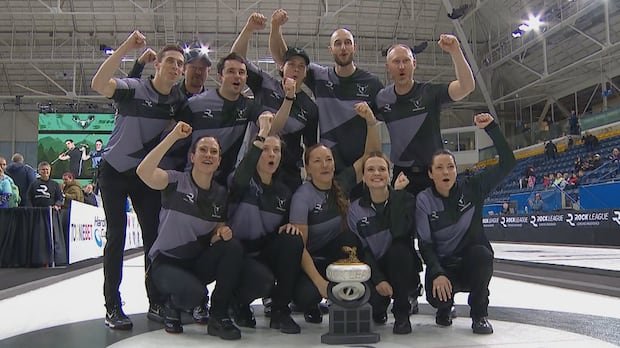
For seven days, Nic Sulsky roamed Toronto’s Mattamy Athletic Centre.
He shook plenty of hands while entertaining friends, family, potential investors and curlers alike throughout the inaugural go-round at Rock League, billed as a preview season for the first-ever professional curling venture.
Speaking to CBC Sports on Friday, Sulsky, who is CEO The Curling Group, which runs Rock League, said he was looking forward to Sunday around 6:05 p.m. ET, when the trophy would be handed out and the week would be concluded.
But come Monday morning — perhaps after a cup of coffee or two — it would be right back to work.
“The big success is actually showing people,” Sulsky said. “People love the story, love the idea, love the talk, but a lot of people wanted to see it. Well, wake up Monday morning and we get to engage with the folks that we’ve been in conversations with and get this thing across the finish line, right? Like, job ain’t done.”
While the week was historic in its own right — it’s not often you get to see Canadian legends in Brad Jacobs and Rachel Homan face each other in fours — the greater success indicator, from a macro level, was whether it would show enough potential to garner the fan and financial interest necessary to sustain itself.
Sulsky said as much, while noting that he did not spend a single dollar on marketing.
“People ask me, what’s the metric, what’s the [key performance indicator] that you are most focused on? I believe there’s only one KPI that any CEO and, candidly, any employee of a private company has to say, or even a public company. It’s shareholder value,” he said.
Rock League will return next year for a lengthened Season 2, with four weeks of regular season from Jan. 7 through Feb. 7 including three stops in Canada and one in the U.S. The playoffs will run April 8-18 at a location still to be determined.
Throughout the week, organizers seemed more than willing to adapt and tinker around the edges while keeping the format — a hit among curlers — intact.
But greater changes can be expected moving forward as Sulsky and his team look to build each franchise into its own brand while further professionalizing Rock League.
That could even mean a waiver system or trades at some point.
“Hey man, I’m a fantasy sports guy, true and true. I love trades, the idea of trades, like that’s pretty fricking cool. So those are the types of things that we really get to dialing in, but now we need to figure out how to build each of these franchises into individual business units,” Sulsky said.

Shield Curling Club wins the men’s match 8-6, Typhoon Curling Club takes the women’s match 7-5 and Shield secured the Rock League title with a victory in a shootout
Bigger inspiration
Sulsky, who was previously the chief commercial officer of PointsBet Canada, added that he’s also looked to recent pro sports startups from golf’s TGL to the PWHL to the CEBL to pick and choose what’s worked and what hasn’t from each.
He pointed to a different golf event, however, as an even bigger inspiration.
“The Waste Management Phoenix Open completely changed the perception of what going to a golf event was and who the golf fan is. And yeah, are we trying to bring a little bit of an energy like Waste Management into curling? Absolutely,” he said.
Part of that effort was a sheet-side bar stationed in between the three games during each session throughout the week.
However, while the vibe in the bar was neat, it provided awkward sightlines for fans in the stands who had to strain to see the other side.
“Maybe there’s a better way to do it. Maybe it’s you put all three sheets together and you have two of those sheetside bars on each side. Maybe, right? There’s going to be a lot of things that we’re going to test in the new year,” Sulsky said.
As for the curling itself, those who spent time throughout the week at Mattamy nearly unanimously agreed that the format — mixed teams, three games (men’s, women’s and mixed doubles) per match — was largely successful.
There was a bit more debate about some of the rules for each game. Curlers almost all loved the no-tick rule which kept teams on the offensive — to the point that Jacobs said Sunday he had already emailed the World Curling Federation to have it implemented across all competition.
Mixed fours on Saturday was perhaps the most exciting day of action, with the learning curve for every player among new teams clear and obvious. In Season 2, teams will have more time to practice and tinker, and the format could reach a new level.

CBC Sports takes a closer look and explain exactly how curling’s first professional league called Rock League works.
Other rules duds
Other rules were duds. Only one in-game lineup change or substitution was made all week as general managers were unwilling to bring in curlers cold off the bench for mixed fours or make sudden adjustments during fast-paced seven-end games. Meanwhile, there were no hog-line challenges and the cameras appeared to be gone by the weekend.
Elsewhere, the rule making any stone covering the pinhole in the final end worth two points forced curlers to adjust their strategies and kept them on their toes — especially combined with the speed of the game.
“You just gotta adapt,” said Canada’s Tracy Fleury, who was part of the victorious Shield Curling Club. “As somebody who’s been playing curling forever, this two points in the last end, it’s not even a thought in terms of strategy, and now, all of a sudden, it’s here.”
Much the same could be said about Rock League, which tacked itself onto the end of an Olympic season and attempted to ride the momentum.
Given the international team flavours, Sulsky listed ESPN+, DAZN, BBC and Korea’s Naver TV that streamed Rock League live in addition to CBC. Perhaps thanks to ESPN, there was significant pickup among the younger American audience throughout the week.
Which, combined with the mixed nature of the league, Sulsky refuses to be lumped in with the other recent sports start-ups.
“We’re not trying to invent a team sport out of an individual sport. This already is a team sport,” he said. “All we’re trying to do is create a structure that a new fan, that a casual sport fan will be more willing to engage with than conventional curling.”
Source link