Can the Enhanced Games prove it’s more than just an infomercial for performance-enhancing drugs?

After the bloodwork and the medical screening, a month of hard training naturally, after one last meeting with doctors to review the do’s and don’ts of the regimen he was about to start, Boady Santavy hustled from a conference room to his suite at Earth, a luxury resort in suburban Abu Dhabi, clutching his drugs. Testosterone, human growth hormone, and another anabolic agent.
And after a lifetime of competing without pharmaceutical help, Santavy, a Sarnia, Ont., native who won weightlifting gold at the 2021 Commonwealth Games, plunged a needle into a small bottle of testosterone, pulled back the plunger and filled the syringe. Doctors gave him the option to mix substances, but Santavy, who owns national records in the 89 and 96-kilogram weight classes, opted to keep them separate, a first-time steroid user’s guardrail against mixups.
A year ago, if you had handed Santavy a two-month supply of steroids, he’d have handed them right back. Yes, he competes in weightlifting, a sport once so plagued with doping cases that it was almost dropped from the Summer Olympics. And yes, he finished fourth in the 2020 Tokyo Games, losing the bronze medal by a single kilogram, to a lifter who flunked a drug test later that year. But the disappointment of missing the podium didn’t match the pride Santavy felt knowing his 178kg snatch and 208kg clean-and-jerk were drug-free.
As a two-time Olympian, and most decorated member of Canada’s first family of weightlifting, Santavy also shoulders the weight of the legacy his forbears established. His great-great uncle, Joe Turcotte, was a record-setting lifter in Manitoba, Michigan and Ontario, while Boady’s grandfather, Bob, competed in the 1976 Olympics. Dalas Santavy, Boady’s dad, has been an athlete and coach on various Canadian national teams, and guided Boady to that fourth-place finish in Tokyo.
He readied his needle, feeling nervous about jabbing himself, but with no guilt or shame over breaking a taboo. Mostly, he felt eager. He had competed against roided-up lifters in the past, and wanted to see what performance–enhancing drugs (PEDs) would do for his body and lifting totals.
This Sunday in Las Vegas, Santavy will take to the platform at the inaugural Enhanced Games, where he will attempt to surpass the current world record in the snatch, and perform alongside swimmers and sprinters attempting similarly audacious feats, with a big assist from customized PED programs. A $250,000 US bonus goes to athletes who eclipse existing world records in some events, and $1 million to runners who surpass 100-metre world records – 9.58 seconds for men and 10.49 for women.
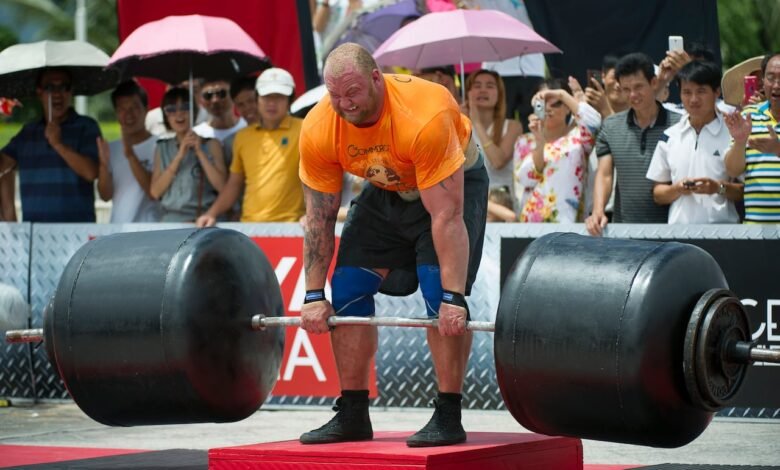
The event will showcase a one-on-one deadlift contest between the gargantuan strongman Hafthor Bjornsson and the Canadian stalwart Mitchell Hooper. And it also figures to feature plenty of references to the products available on the company’s website.

Critics deride event
Critics deride the event as a publicity stunt, and a cynical mixture of sports, medicine and marketing that sends all the wrong messages about drug use and fair play. Sunday’s competitions might showcase new levels of human performance, but they also, conveniently, serve as a splashy, three-hour-long ad for Enhanced Brand supplements and prescription PEDs.
Enhanced Games advocates counter that this competition could propel elite sport into a future in which drug use is up-front, supervised and destigmatized. It’s less about luring athletes across a bright red line than re-drawing that boundary and inviting them to compete under a new rule set. If banning PEDs levels the playing field, Enhanced Games organizers and athletes maintain that allowing performance enhancers simply moves the action to a new arena.
But the field is still level.
“How is it cheating if it’s not going against the rules,” Santavy says. “This is not traditional sport. This is not the Olympics. This is a brand new competition. Traditional sport, you’re not supposed to be doing that stuff. That’s what cheating is.”
WATCH | CBC Sports reacts to Fred Kerley’s participation in Enhanced Games:
Athletes who opted into the Enhanced Games doping program were relocated to a luxury resort on the outskirts of Abu Dhabi, where their daily routine included catered meals and training sessions at fully equipped facilities. It also featured regular medical checkups, and consultations with doctors tasked with guiding them through a PED regimen that doubled as a clinical trial, logging short-term effects for a study that was published this past Wednesday.
All participants earn a salary, and will receive follow-up medical monitoring for five years.
Back at his suite, Santavy sterilized a patch of skin on his left glute, plunged the needle through it and shot the drug deep into this muscle, the first dose of the first PED cycle of his life. Two days later he would hit the gym feeling renewed and weighing 92kg. Five weeks after that he would still feel fresh, despite heavy training sessions that would normally leave him feeling drained.
And his bodyweight? He added three kilos in his first five weeks on PEDs. All solid muscle.
1st Enhanced Games trailer in 2023
If you remember the first trailer for the Enhanced Games, which hit the internet in 2023, then you might recall the protagonist, a white sprinter with dark hair and a face he never turns toward the camera. He wore black lycra shorts and a matching moisture-wicking t-shirt, and his triceps bulged as he crouched into a set of starting blocks. Whoever this athlete was, he had invested time in the weight room.
A sharp-eyed viewer would have noticed those blocks. They were set up at the finish line. Imagine a hockey ad depicting two players primed to face off at centre-ice, but they’re both decked out in goaltender gear. Equipment that far out of place signalled how little the people in charge of the video shoot understood about the sport they were spotlighting.
As the camera followed the runner around the track, we heard a voice, presumably the athlete’s, making outrageous claims.
“I am the fastest man in the world, but nobody knows who I am,” he said in English that sounded bland and broadly North American.
“I have broken Usain Bolt’s 100-metre world record, but I can’t show you my face.”
WATCH | Enhanced Games, 2023 trailer:
Cut to an in-stadium timing display, the stopwatch frozen at 9.49 seconds. If that’s a 100-metre dash time, it puts him more than a metre ahead of peak Bolt.
“I am a proud enhanced athlete,” he said, as the visual switched to him sprinting along a park path. “The Olympics hate me. I need your help to come out. I need your help to stop hate.”
As the commercial ended, he invited us to watch him break the world record at the Enhanced Games, then scheduled for 2024.
If the idea of an unknown white North American sprinter beating Usain Bolt by nearly a tenth of a second feels like a figment of a marketing team’s fantasy, bookmark that thought. We’ll return to it.
And if that first ad left you with the impression that the Enhanced Games would be a PED free-for-all, you’re not hallucinating. It’s a fair conclusion to draw, but we’ll come back to that point, too.
But first, let’s try to unravel facts from speculation about the Enhanced Games and the publicly traded company behind it.
Yes, performance-enhancing drugs are permitted and encouraged, and central to the event’s premise.
Yes, a form of doping control exists at the event that some critics have labelled the Steroid Olympics. Athletes are contractually bound to follow the drug protocols their doctors prescribe. Any freelance PED use would likely show up in their weekly medical screenings, and would get them expelled from the event.
But no, steroids, even the ones recommended by the event’s medical team, are not mandatory.
U.S. sprint star Fred Kerley committed last September, marking the Enhanced Games’s highest-profile signing. He’s the only sprinter in history to run faster than 9.8 seconds in the 100 metres twice in the same day, and his bronze medal at the Paris Olympics hinted that he can still lay down top tier times in 2026.

He’s been posting photos of his new armour-plated physique, but has also made clear that he’ll compete drug free. Since then, three other athletes have signed up as PED-free “natural” competitors.
Freestyle swimmer Kristian Gkolomeev is not one of them. He’s competing with pharmaceutical help, and a year ago the Enhanced Games published a video of him, wearing a full-body wetsuit that World Aquatics has banned, shaving .02 seconds off the existing 50-metre world record. At the time Australian swimmer Cam McEvoy dismissed the legitimacy of Gkolomeev’s mark, and earlier this year McEvoy covered 50 metres in 20.88 seconds to set a new, official, asterisk-free world record.
Given that Gkolomeev’s performance included prohibited equipment, and possibly PEDs, two questions arise.
How do we know Enhanced Games results are powered by their drug regimens, and not fake weights or shortened race courses?
And can we even trust what we’re seeing on Sunday night?

Martin insists every weight and measure will be legitimate, and that, drugs aside, rules will mirror those in place at world-class competitions. Weightlifters will have to weigh in, sprint races will include a wind gauge, and the track, supplied by Mondo, the best-known manufacturer in the sport, is a full 100 metres.
“I don’t think Mondo would necessarily give us a 98-metre track and then be a proud partner,” says Maximillian Martin, CEO of the Enhanced Group, the company behind the sports event. “We want the benefits to be from the enhancements.”
As for the doping programs the athletes follow, it’s not an all-you-can eat buffet of steroids and stimulants. Each athlete’s regimen is tailored to the person and their event, but every PED in use is approved for human consumption by the U.S. Food and Drug Administration.
Anyone who follows online fitness culture has heard of Trenbolone. It’s a steroid sometimes used on feedlots to bulk up cattle for slaughter, the PED behind U.S. sprinter Erriyon Knighton’s four-year doping ban, and a go-to substance for a lot of Gen Z gym rats. It’s known to boost muscle mass and aggressiveness, and it’s banned at the Enhanced Games, just as it is in mainstream sport.
Same goes for drugs like Cardarine, the PED at the centre of a doping scandal at Florida’s Montverde Academy, and for non-FDA-approved peptides, a popular class of experimental drugs available via legal loopholes that purport to boost recovery.
All off-limits.
So now that we know what Enhanced Games athletes aren’t taking, what do doping protocols look like in an event that touts “full transparency”?
For the most part, we won’t know. Organizers encourage participants to keep their drug regimens private, to discourage people from thinking they can copy-and-paste an elite athlete’s highly personalized PED routine. Clinical trial results report that 91 per cent of Enhanced Games competitors are using testosterone, 79 per cent take human growth hormone, and 41 per cent are on erythropoietin, the blood-boosting hormone.
But no matter how impressed you are with Boady Santavy’s physical transformation and lifting totals, you can’t log on to the Enhanced website and order a “Santavy Stack.”
“It sets the wrong example. Just because it works for person A doesn’t mean it works for person B,” Martin says. “There is a personalized protocol that can help you be the best version of yourself.”
Enter Canadian strongman Mitchell Hooper, 6-foot-4, 330 pounds and built like a bank vault. He’s the winner of the most recent World’s Strongest Man competition, and a prolific poster to his YouTube channel, where he earns as much attention for his transparency as he does for his Paul Bunyanesque feats of strength. Earlier this month he published a video of himself in a call room at a World’s Strongest Man contest in Texas, injecting a painkiller into his aching knee so he could finish the competition.
WATCH | Mitchell Hooper wins World’s Strongest Man 2026:
On Sunday he’ll seek to break the deadlift world record – currently Bjornsson’s 510kg – with help from a PED protocol whose doses he laid out recently on YouTube.
*Testosterone: 750mg weekly
*NPP aka Nandrolone: 300mg weekly
*Adderall: 16mg daily
*Halotestin: 50mg daily
*Anadrol: 100mg daily
As a professional strongman, Hooper inhabits a world with even fewer rules against PED use than the Enhanced Games has. Competitors in his sport are tested for narcotics but are free to take a wide range of other performance enhancers. But he says limiting him to government-approved drugs doesn’t feel like a restriction at all.
“That’s a pretty appropriate ethical line for the Enhanced Games to draw: Is it approved for human consumption?” he says. “Everything that moves the needle, I’m allowed to take.”
♦♦♦
Traditional sports governing bodies’ reactions to the Enhanced Games tend to land on a narrow spectrum. One end, we can label “unimpressed,” and it summarizes Athletics Canada’s opinion on sanctioned PED use.
“We do not endorse involvement in the Enhanced Games by any member of Athletics Canada,” the organization said in a statement published last November.
At the other end, we’d find “repulsed.” That reaction characterizes World Aquatics, the organization in charge of world-level swimming. When swimmers began signing with Enhanced Games, World Aquatics announced that those athletes, and any others who joined the event, would be prohibited from future competitions the organization oversaw. In response, the Enhanced Games filed an $800 million US antitrust lawsuit in U.S. court, arguing that the federation’s decree was an unfair use of monopoly power.
A judge dismissed the lawsuit last December, but the tension between established sport and the market disruption threatened by the Enhanced Games remains.
It’s not that mainstream sports are drug-free. Last month the Athletics Integrity Unit issued 18 suspensions and one warning related to banned substances, and that’s just in track and field.
It’s that rules against doping are, for sport governing bodies, foundational as start lines, finish lines, 10-foot-high rims or 90-foot basepaths. People stretch, bend or break them, but the rules themselves are considered central to the sport, both as competition and commercial product.

“The positive impact that so many of our role models in Canada are having is jeopardized by this spectacle,” says Evan Dunfee, a bronze medallist in the 50-kilometre race walk at the Tokyo Olympics, and an outspoken advocate for drug-free sport. “I think it’s dangerous to call it sport … It’s entertainment designed to sell you supplements.”
Dunfee gained social media fame last September when he posted screenshots of a text message exchange with a friend who worked for the Enhanced Games. It started with a greeting, and her harmless query about the event, and ended with Dunfee rejecting the entire premise.
Two words in his reply stand out, and sum up the two-time world championship medallist’s opinion on the competition.
“Valueless spectacle.”
♦♦♦
Except there’s a dollar value attached to every move the Enhanced Games makes.
On May 8, The Enhanced Group went public on the New York Stock Exchange, with an opening share price of $10.00. The company encompasses the sports event, a business that sells nutritional supplements, and an online pharmacy where patients can access many of the same PEDs fuelling the performances we’ll see on Sunday.
Those products aren’t incidental to the Enhanced Group’s business model. They’re essential, and the company’s website offers several points of entry to people looking for their own performance enhancers. One button on the main page says “Get Enhanced,” while another reads “START MY PROTOCOL.” Clicking “CONTINUE” at the bottom of the home page will also take you to a portal offering a variety of testosterone products, longevity elixirs, weight loss drugs, and legally-approved peptides.
Viewed through the prism of that rapidly expanding online health optimization business, Sunday night’s athletic event begins to resemble a three-hour marketing activation. Maybe “advertorial” is too strong a word, but maybe not.
“I don’t agree with it 100 per cent,” Martin says when asked if the Enhanced Games is an infomercial for the company’s drug and supplement sales. “I would say partially. The sports event is an amazing business in itself. The consumer business didn’t exist when they started the company in 2023.”
Current corporate messaging is heavy on concepts like longevity, health span and personalized care. Where that first trailer teased the idea of an athletic freak show, and the company’s Instagram feed features training clips and rippling physiques, its website now includes a link to create a telehealth account.

For his part, Hooper says the company’s pivot toward personalized medicine aligns with his own philosophy on health care – moving beyond mere longevity to health span, and using medication to head-off age-related breakdowns instead of chasing cures after conditions develop.
“It’s a great opportunity for transparency, for preventative health instead of reactive health,” says Hooper, an accredited exercise physiologist who runs a physiotherapy clinic called Longevity Nexum. “We can draw the line between what of this is performance-enhancing drugs, and what of this is health-enhancing drugs. Just as Advil has a line, and Adderall has a line, we need to discover that line.”
If you’ve paid attention since 2023, you’ve seen the company’s focus expand and the marketing message evolve, and maybe you’ve questioned what’s genuine and what’s advertising sleight of hand.
Which brings us back to the sprinter from the debut trailer. White, male, North American, and within hailing distance of Usain Bolt’s world record. A deep dive of track and field stats doesn’t unearth anyone fitting that profile.
So who is he?
“I have not met that person,” Martin says.
Does he even exist?
“I have never met that person,” he says.
The bigger business question is whether a sports event where PEDs take centre stage can catapult Enhanced past a crowd of competitors offering medications aimed less at treating illness than at optimizing your life. Noom, Felix, Phoenix, Sovereign Male … the list of clinics feels endless. Search any of them online, and ads for even more of them will pepper your Instagram feed. The roster is deep and so, apparently, is the pool of potential customers.
Eventually, the stock market will tell us what the public thinks of the Enhanced Games and its online pharmacy cousin. As of Friday morning, the share price was more than $5.00.
Martin insists he has a long-term plan for the Enhanced Games. Events like Sunday’s might happen annually, he says, but the schedule could grow to include single-sport competitions, and we might see Enhanced marathons and triathlons.
And the idea that we can use performance-enhancing drugs to optimize our everyday lives?
Martin says that trend is only heading in one direction.
“We’re really in this for the next decades to come,” he says.
Source link