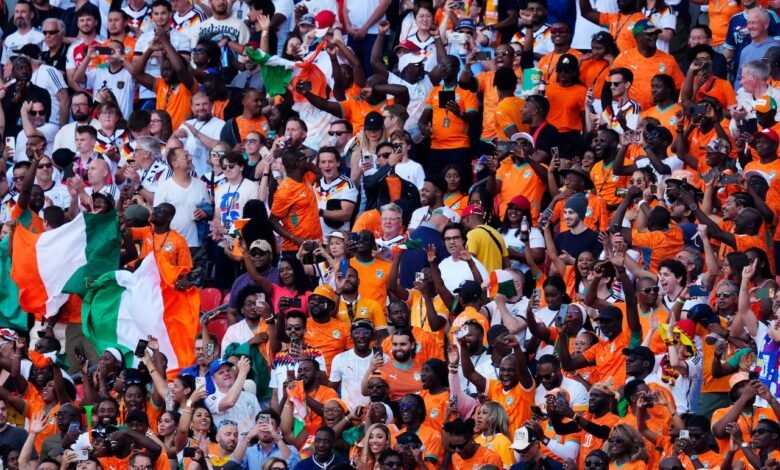
The roar of the crowd hit 100 decibels at kick off — the equivalent of being in a nightclub in an open air stadium — as Germany went on the attack in its Saturday clash with Ivory Coast.
The booing was even louder in the 38th minute as referee Juan Gabriel Benitez Mareco called back a German goal for the second time.
But the German fans, who outnumbered their rivals at Toronto Stadium to the extent it felt like a home game, were not to be denied a win.
Germany stormed back and striker Deniz Undav scored twice, including the final blow in the dying minutes of extra time, to lead his team to a 2-1 win.
“Every fan was behind them. Every single fan was cheering on every single pass,” German fan Sarj Das said moments after the game.
Germany’s triumph marked the halfway point for the FIFA World Cup 2026 in Toronto and soccer fans lucky enough to get a ticket have been treated to three games packed with drama.
Off the pitch, the city appears to be holding up well. There’s been no traffic calamity nor widespread chaos — or at least, not the bad kind. The city has seen plenty of explosions of soccer-inspired joy, from Canadian fans firing off red flares during their march to Ghana fans taking over Sankofa Square to today, as German fans danced in the stands and their heroes saluted them from the pitch.

Toronto police do say they have charged several people caught flying drones near the stadium.
The biggest transit disruption on Saturday? It was caused by 5,000 German fans marching along the waterfront from Amsterdam Brewhouse to Toronto Stadium.
Traveling fans enjoying the city
Plenty of Germans made the trip to Toronto for the game, many saying they’ll follow their squad wherever it goes.
Toronto offers a rare chance to see the national team (ranked 9th in the world) in a small venue. When Germany hosted the 2006 FIFA World Cup, all but one of the stadiums was larger than the site of today’s match.
Felix Holtgrav, here to watch his first World Cup match, gave the city a glowing review.
“I love Toronto. I love the people, I love the different cultures coming together, celebrating together,” he said.

He and Henning Weber, another traveling fan, are also becoming Canadian soccer fans. Holtgrav wore a Canada Soccer chain, while Weber praised Canada’s 6-0 win over Qatar.
“Our favourites are now the Germany team and the Canadian team,” he said.
Ivory Coast came close
Germany has won four World Cups, making it a perennial favourite. However, fans like Marius Roll downplayed the expectations ahead of Saturday’s match.
“No, no, no, we are not the favourite,” he said.
“I think both can win.”
Roll’s prediction seemed prescient early on in the game, as Ivory Coast scored first, sending its fans in bright orange kit into a frenzy.
Ivory Coast’s fans entered the game unshaken. A group from Montreal told CBC Toronto they were enjoying the city — they’d had good food, a good sleep. But now, it was time to win.
“We’re very confident and we’re very happy,” Yannick Logbo told CBC Toronto ahead of the match.
Even on the way out, Ivorians were proud of the effort.
“I’m sad but I’m still really really happy,” said Emmy Kouassi, noting her team’s late chances to take a lead.
She’s hoping the team now refocuses ahead of the next match.
“Don’t give up guys, we got this,” she said.
Ivory Coast still has a good chance to advance to the Round of 32 out of Group E after it opened with a win against Ecuador. The team is headed to Philadelphia to take on Curaçao next.
From here, Germany heads to New York City — the site of July ’s championship match — where they’ll play Ecuador in front of almost twice as many fans as today.
Transit system sees fan surge
Toronto bolstered its transit lines near the stadium ahead of the tournament, and so far that service appears to be holding up.
The transit commission reported the four routes serving the nearby fan festival saw a 30 per cent increase in use during the tournament’s first game.
On Dufferin Street, where the city painted red bus-only lanes, there was light traffic a few hours ahead of game time. In Centennial Park, just west of the cordoned-off stadium zone, four Germany fans quietly sat at a picnic bench in the shade — a calm moment before the nail-biter ahead.
Toronto’s six games will cost an estimated $380 million in taxpayer money to put on, with about $179 million of that coming directly from the municipality, according to a 2026 budget note.
There’s hope the tournament will generate $780 million in “topline economic activity” and about $10 million in tax revenue as some 185,000 tourists visit for the event.
Toronto’s initial business case notes the games here will be watched by hundreds of millions of viewers — and certainly today, a good chunk of Germany’s population.
Source link