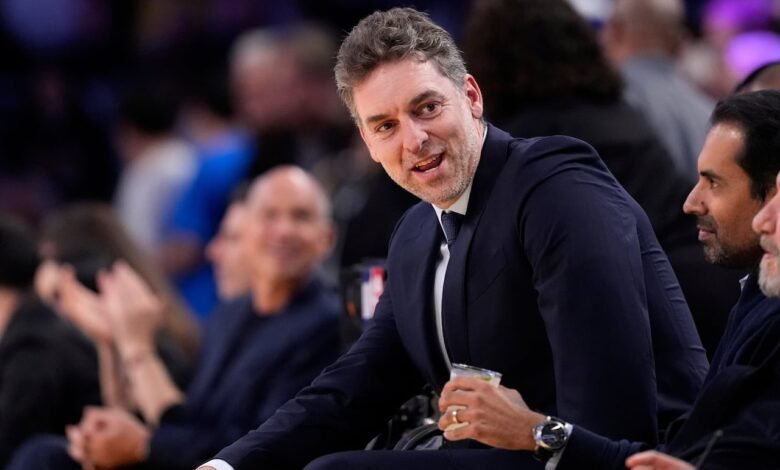
On Wednesday morning, the International Olympic Committee went public with its plans to edge toward the 21st century in terms of athlete compensation, so it’s fitting that it chose retired basketball player Pau Gasol as a spokesman.
As an NBA player, Gasol earned more than $220 million US in salary over 18 seasons, and as an Olympian he brought home three medals and precious memories as a star on Spain’s national team.
So yes, the IOC is now set to pay Olympic athletes.
At last.
Details are as follows:
The IOC has allocated $100 million to a fund established to pay athletes who competed at the 2026 Winter Games in Milano Cortina. To access the cash, which the IOC will hand out in $10,000 grants, athletes will need to submit an application. The eligibility window opens post-Games to ensure all applicants passed their drug tests at the Olympics.
After laying out the particulars, Gasol, who is now an IOC board member, clarified that the payment plan is “not prize money,” but described the development as “a big win for all of us.”
I wouldn’t go that far. It’s progress, for sure. Until this year, the IOC was paying the athletes who make the Olympics appointment viewing the same amount it pays folks like us, who sit at home and watch on our preferred screen.
Zero dollars, zero cents.
A big win would mean some combination of appearance fees and prize money, without requiring athletes to fill out an application. Qualifying for the Olympics is application enough.
Wednesday’s development is a step forward, but it’s not a resounding victory for athletes. If this were a soccer game, it’s the late goal that salvages a draw. Not a loss, but still not a victory. A result, and mere results suffice sometimes.

Context is key
As always, context is key. So first, note that the IOC, according to its own records, pulled in $7.7 billion in revenue for the 2021-2024 Olympic cycle.
Second, keep in mind that the IOC is rivaled only by FIFA in its ability to extract financial concessions from host cities. Cities assume the risks and FIFA or the IOC reap the monetary rewards. It’s a lucrative business model, but it also explains why big cities are increasingly averse to even bidding for the Olympics.
Third, think back to the 2012 Games in London, where the IOC enforced the infamous Rule 40, which prohibited athletes from shouting out their personal sponsors during interviews at Olympic venues. And, yes, note the irony that most athletes depend on sponsors to fund the training and competition that propels them to the Olympics, where payment for participation is prohibited.
Earlier this spring, IOC President Kristy Coventry reiterated her position that the Olympics shouldn’t provide paydays. At least not for athletes.
“I don’t believe in paying athletes,” said Coventry, a retired Olympic swimmer whose job atop the IOC pays a reported $350,000 a year.
“I come from a small country. I came from a sport that doesn’t necessarily pay athletes very well, and I still don’t think we should be paying athletes at the Olympic Games.”
It’s a strange stance to take, given the all-consuming commitment required to become an Olympian. Athletes who come over from established pro circuits like the NBA or even track and field are already professionals in the sense that they sign contracts, and earn money based on what they deliver in competition.
But athletes who are amateurs in the more traditional sense are professionals already. Doesn’t matter if weightlifting and wrestling and Olympic-style boxing don’t lavish athletes with money. Cash isn’t the only thing separating amateurs from pros. Commitment does, too. If you treat your sport as a craft, build your life around it and reach Olympic-level skill, you’re a professional.
And if your sport still doesn’t pay you, maybe it should start.

No correlation
If you’re wondering what Coventry’s specific experience in a low-paid sport has to do with the general principle of paying athletes who train and compete full-time, and who make the Olympics a multibillion-dollar spectacle, the answer is “nothing.”
It’s like telling your kids they don’t deserve to fly to England because back in your day you could only cross the Atlantic in a steamer. Times change, and there’s value in allowing young people to enjoy advantages older folks never had.
And there’s also a gigantic dollar value attached to each Olympic Games.
For example, media rights to Paris 2024 totalled $3.3 billion. In mainstream leagues, that money forms part of the Sport-Related Revenue that helps management and unions calculate salary caps. But in the Olympics it’s a pool of money that doesn’t trickle, drip or even mist down to the athletes that people pay to see.
Of course, the Olympics aren’t the only commercial sports outfit to address a glaring athlete compensation problem with a half-measure.
When the people running big-time U.S. college sports realized athletes deserved money for the revenue they generated, they gave us Name/Image/Likness deals, leaning on sponsorships because pay-for-play somehow still felt illicit. From there, they added “revenue-sharing” agreements, because, for some reason, “salary” is still a dirty word.
And with the IOC we have $10,000 grants for successful applicants. The new setup represents tremendous progress, but the flaws are obvious.
First, there’s the paperwork, which people love to avoid, even when money or punishment is on the line. Hatred of paperwork helps explain why civilians file their taxes late, and why some athletes fail to update their whereabouts forms for doping control authorities.
Also, I didn’t notice Gasol or anybody else mention an important word: Guarantee.
Any artist or academic can tell you that applying for a grant isn’t the same as receiving one, and most entrepreneurs are painfully familiar with the gap between the prospect of payment and money in the bank.
So the new plan is a step forward, but all steps aren’t equal. On a stride-length scale that runs from 5-foot-3 Muggsy Bogues to 6-foot-5 Usain Bolt, this week’s IOC announcement lands near the retired Raptors point guard. An encouraging development, but I won’t call it a win until the IOC conquers its fear of prize money, appearance fees and guarantees.
Source link