Throughout this World Cup, benches have been adorned with banners bearing each country’s name and colours. They’ve traveled, like the teams, arriving just ahead of them. The same banner has been used for every game, like a battle flag. They are more than bunting. They have become talismans.
On Saturday, Canada’s banner was there again, stretched across the Houston Stadium dugout beside fearsome Morocco’s deeper shade of red. Forty-eight banners had been made for this World Cup; by kickoff, only 16 still saw the light. Germany’s had been packed away. Croatia and Uruguay and the Netherlands no longer needed theirs, either.
Now, Canada’s, too, will be folded up one last time. A 3-0 loss to heavily favoured Morocco ended our men’s use for it, along with their wildest dreams.

From the beginning of this epic, sprawling tournament, the Round of 16 felt like this team’s high-water mark. It is very good, better than it is has ever been by an unfathomable margin. Canada’s men were ranked 120th as recently as 2017. They were ranked 30th at Saturday’s kickoff, an incredible climb.
But the gap between them and Morocco, who slipped from sixth to seventh in FIFA’s rankings overnight, remained as undeniable as gravity. This team made history, and it was all the history it was likely in them to make.
Canada opened the game almost shockingly composed. For the entire tournament, head coach Jesse Marsch has prescribed urgency, pace, haste. He wanted everything done in a hurry, refusing to give the opposition a chance to organize. Canada couldn’t compete with technique; its avenues were athleticism and desire.
Against Morocco, a new Canada began to emerge. Our men remained driven. They also looked patient, probing, analytical.
Tani Oluwaseyi opportunity stopped
They conceded possession, and the Moroccans were much more efficient in their movements on and off the ball. But the Canadians made the better early chances, including Tani Oluwaseyi’s golden first-half opportunity, saved by a charging Yassine Bounou.
It was a little hard to imagine it, but Canada should have been in the lead at halftime.
By then, the game had settled into a nervier rhythm of attack and counterattack. Michael Oliver officiated tightly, keeping the action stuttering. There were six yellow cards in the first half alone, four for the frustrated Moroccans. That the game was still scoreless was perhaps victory enough.
The second half started less optimistically for the Canadians. It felt as though one mistake might settle things.
In the 50th minute, one mistake did.
Luc de Fougerolles made a hard, necessary tackle deep in Canadian territory, leading to a free kick not far from the corner flag. Most of the players crowded into the box, Canada’s men expecting a lash toward goal. Instead, a perfectly designed bit of deception came: a low, soft ball into the penalty arc.
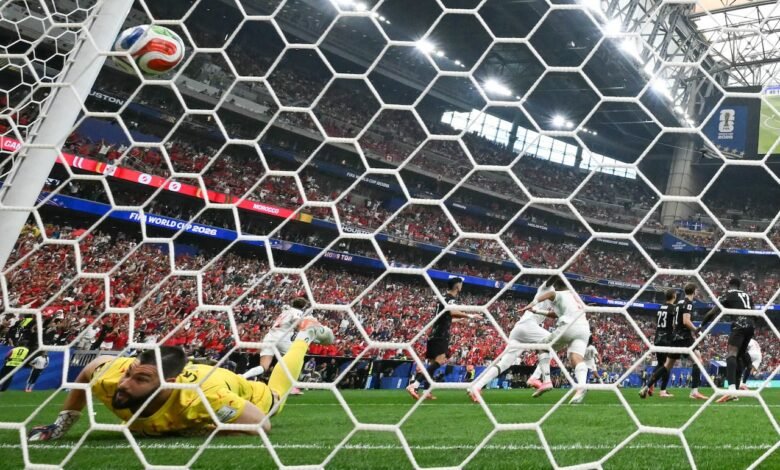
Jonathan David, caught a little flat-footed, nearly intercepted it, but Azzedine Ounahi found it instead. He sent a terrific shot low and to a diving Maxime Crépeau’s left. He had no chance to make the save.
That goal proved the difference. Canada pressed for an equalizer, reverting to their baser, frenzied selves, but Morocco, confident and experienced, wouldn’t allow it. The minutes ticked away, each one evaporating more quickly than the last.
Ounahi scored his second on the counter in the 82nd minute, and that really was it. One more at the death didn’t much matter, except to the record books.
Morocco’s men were already headed to the quarterfinal in Boston. Canada’s men were going home.
In the weeks and months ahead, a collection of agonizing what ifs will hang in air, waiting to be turned over.

David was not as good as he needed to be. Alphonso Davies, Canada’s oft-injured captain, barely played and looked unsure of himself when he did. Ismaël Koné broken leg robbed him of his childhood wishes and Canada of its best creative threat. Several other players — Stephen Eustáquio, Ali Ahmed, Alfie Jones — were wounded, too.
But after the immediate sting has faded away, Canada’s performance against Morocco and across this unforgettable tournament should be remembered with pride, not shame. It should be remembered with joy, not regret.
Canada’s banner was first bathed in sunshine more than three weeks ago in Toronto, where it sheltered our men in their blistering opener with Bosnia-Herzegovina. It was shipped to Vancouver for two more games, including Canada’s dismantling of Qatar. Los Angeles came next, where it was a silent witness to more history: Canada’s first knockout round game and win, over South Africa.
Our men outlasted exactly 32 other teams before running into a better one. That is a forever fact.
They also did this: They wrapped themselves in our flag everywhere they went, and in a World Cup for the ages, they proved that Canada’s shade of red belonged beside every other.
They have made that a forever fact, too.
Source link