This is an excerpt from The Buzzer, which is CBC Sports’ daily email newsletter. Stay up to speed on what’s happening in sports by subscribing here.
With the Winter Olympics in northern Italy now just two months away, alpine skiing’s World Cup tour hits another gear this week as Colorado’s Beaver Creek hosts the first downhill race of the season along with a speedy super-G. Meanwhile, the lone Canadian stop on the circuit is taking place at Quebec’s Mont Tremblant, which will stage a pair of women’s giant slaloms.
Since Canada’s best hopes for an Olympic alpine medal are on the men’s side, let’s start there.
Crawford, Alexander eye Olympic podium
The downhill and super-G are known as the “speed” disciplines. They’re the fastest, the most dangerous and, for the average fan, the most exciting. Though the World Cup season began six weeks ago, every race but one so far has been either a slalom or a giant slalom — the “technical” disciplines. The lone exception was a men’s super-G last Thursday at Colorado’s Copper Mountain.
Following that soft launch, the speed season really gets going this week at Beaver Creek, which features a men’s downhill on Friday and a super-G on Saturday before closing with a giant slalom on Sunday.
The Canadians to watch in the speed races are Jack Crawford and Cam Alexander, who are expected to challenge for medals at the Olympics this February in the Italian Alps village of Bormio, which will host all of the men’s alpine races.
Crawford, 28, was a great surprise at the 2022 Games in Beijing. Despite having never won a medal at the Olympics, the world championships or even on the World Cup tour, he raced to a bronze in the (now defunct) individual combined event, placed sixth in the super-G and was fourth in the downhill, where he missed the podium by just 0.07 of a second.
After his big breakthrough, Crawford went on to win gold in the super-G at the 2023 world championships and now owns six World Cup medals — four in the downhill and a pair in the slightly more technical super-G. The highlight of those was his victory last January in the famed Kitzbuhel downhill — the most prestigious, and dangerous, race on the World Cup circuit.
Alexander, also 28, earned a bronze in the downhill at the 2023 worlds and has won five World Cup medals, all in the downhill. His lone victory came back in March 2022 in Norway, but he shared the Kitzbuhel podium with Crawford last January and has won a pair of bronze medals on the Olympic hill in Bormio.
Unfortunately, Alexander’s Olympic medal hopes took a hit when he suffered a season-ending knee injury during a practice run at the world championships last February. He was able to return for last week’s super-G opener at Copper Mountain but finished 52nd.
Crawford had a disappointing worlds too, finishing 27th in defence of his super-G title and 23rd in the downhill. Last week, he was 16th at Copper Mountain.
The winner there was Swiss superstar Marco Odermatt, who remains the man to beat this season on the World Cup tour and at the Olympics. The versatile 28-year-old has won four consecutive World Cup overall titles and is also the reigning champion in the downhill, super-G and giant slalom. He won Olympic gold in the giant slalom in 2022 and has captured a world title in each of his best three disciplines.
Here’s more on the Canadian men who will challenge Odermatt.
Grenier battles Shiffrin on home snow
Bad news: It’s been nearly two years since a Canadian woman reached an alpine World Cup podium. Good news: it happened at Cortina d’Ampezzo, which is hosting all the Olympic women’s races. Val Grenier grabbed a bronze in the downhill there in January 2024, completing a remarkable comeback from a major injury before Cortina dealt her another devastating blow.
Grenier won a junior world title in the downhill in 2016, but a terrible crash at the 2019 world championships in Sweden caused her to drop the event in favour of the less dangerous alternatives. After winning two golds and a bronze in World Cup giant slaloms, she decided to give the downhill another shot in 2024 and immediately won the bronze at Cortina, only to suffer another season-ending crash there two days later.
This time, Grenier did not quit the downhill. But she wasn’t much of a contender last season, failing to crack the top 20 in four starts. She fared a bit better in the super-G, topping out with an eighth-place finish. But her bread and butter remains the giant slalom: in eight starts last season, she had a pair of top-five finishes and four top-10s.

CBC Sports’ Andi Petrillo recaps the women’s and men’s combined events at the FIS Alpine world ski championships in Meribel, France.
Grenier finished 12th in the World Cup giant slalom standings last season — the highest by a Canadian in any of the women’s disciplines — and ranks 13th so far this season. She’ll likely be Canada’s best hope for a medal at the Olympics and this weekend at Mont Tremblant, which is hosting giant slalom races on Saturday and Sunday.
Another Canadian to watch is 22-year-old Britt Richardson, who won the junior world title in the giant slalom in 2024 and was 18th at the senior worlds last season. She finished 16th at Copper Mountain last week, three spots behind Grenier.
All eyes will be on American superstar Mikaela Shiffrin, who’s still trying to find her footing in the giant slalom more than a year after a crash during a World Cup race caused a nasty puncture wound in her side and knocked her out of action for a couple of months. She returned in time for the world championships but opted not to defend her giant slalom title because the race was still too difficult for her mentally and emotionally. She finished fifth in the slalom, her signature event.
Appearing fully healed now, Shiffrin has won all three slalom races so far this season to extend her all-time World Cup wins record to 104. But she has yet to reach the podium in the giant slalom, finishing fourth and 14th in her two starts. Those will likely be her only two individual events at the Olympics as she’s sworn off the downhill and is questionable to return to the super-G after skipping it last season. The solo combined event, which she won at the 2021 world championships, has been dropped in favour of a team version.
Shiffrin won Olympic gold in the slalom in 2014 and in the giant slalom four years later before a disastrous 2022 Games in Beijing. Gunning for five individual medals, she left empty-handed after finishing no better than ninth in those races and DNF’ing in three of them, including the slalom and giant slalom.
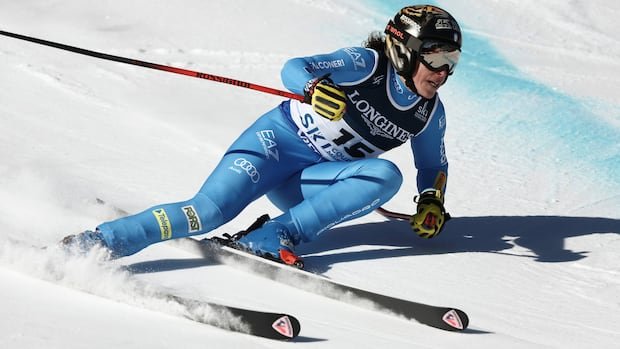
Shiffrin’s path to redemption this winter in Italy is looking clearer after major injuries to two of her biggest rivals. Reigning World Cup overall champion Federica Brignone of Italy just returned to training on snow last week after breaking multiple bones in her left leg eight months ago. Two-time overall champ Lara Gut-Behrami, the runner-up to Brignone last year, is out for the season after suffering a major knee injury last month.
Meanwhile, Lindsey Vonn’s comeback could take some attention (and pressure) away from Shiffrin. The 41-year-old Vonn, alpine’s all-time wins queen until Shiffrin took her crown, is trying to qualify for the Olympic downhill and super-G after returning to the World Cup tour last season following an absence of nearly six years.
Vonn plans to make her season debut next week in St. Moritz, Switzerland for the first women’s speed races of the season. Here’s more on her.
Source link