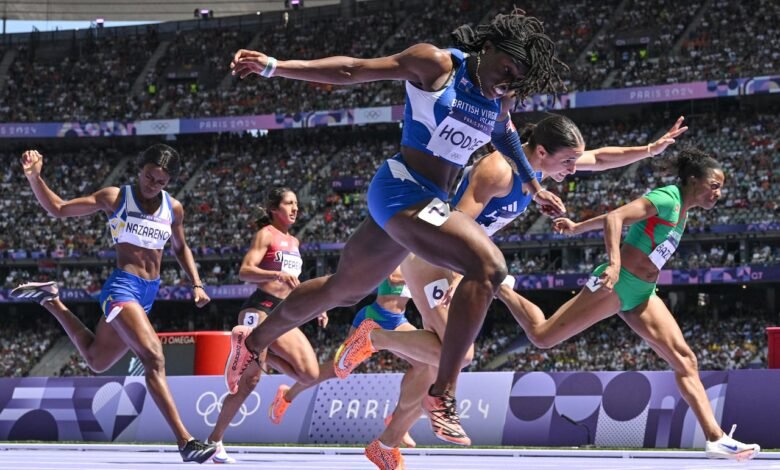
If you’re wondering whether the banned substance cardarine was the secret sauce fuelling Adaejah Hodge’s audacious 2024 season, when she won gold and silver at world juniors, and reached the Olympic semifinal, the 19-year-old from the British Virgin Islands erased any uncertainty in 22.22 seconds.
That’s how long it took Hodge, completing her first indoor season since a heretofore unexplained absence last year, to win the 200-metre final at NCAA Indoor Championships last Saturday, competing for the University of Georgia. The time established a new personal best and a 2026 world lead, and earned a second trip to the podium for Hodge, who finished second in the 60 metres, and who is a former world junior champ at 200.
I say “former” here for the same reason I raise the spectre of illicit performance enhancers in the opening paragraph.
Two days after Hodge’s NCAA gold medal sprint, the Athletics Integrity Unit (AIU) announced that she had tested positive for cardarine back in the summer of 2024. The test result and the two-year suspension it triggered were logged in real time, but the other consequences — the scrubbing of results from 2024 world juniors, and the elevation of every finalist who finished behind her — didn’t arrive until this week, when the AIU finally made its ruling public.
The AIU only announced Hodge’s suspension after she had finished serving it, and it’s not clear whether they would have spoken up at all if Fitzroy Dunkley, the retired hurdler, hadn’t posted on Twitter wondering out loud about whether Hodge had been serving an unpublicized doping ban. So now we know why Hodge missed the entire 2024-25 NCAA season, along with world championships last summer.
For the record, seven months of the original two-year ban were suspended because Hodge co-operated with investigators, and authorities concluded that the teenager had never knowingly doped.
We’ll address how the banned substance got into her system, but if you’re wondering why the AIU sat on this information for a year and a half, add that to the list of questions the anti-doping body raised with an announcement that was supposed to settle doubts.
What took so long? Were they ever going to tell us?
If we consider the 18-month silence a lie of omission, who does the misdirection serve?

Not Torrie Lewis, the new U20 200m world champion from 2024. If Hodge’s DQ meant a promotion for Lewis, she’d likely have appreciated the info in real time. No logic or integrity in allowing results to stand for 18 months after officials learned they were compromised.
Not track fans, who want confidence their sport is trying to root out doping, but have to place their trust in the AIU, which sat on these findings until this week.
And not even Hodge, whose two NCAA medals now have to share headlines with old tests, and the collapse of a rickety doping scheme that she didn’t mastermind, buried her in wreckage nonetheless.
Recall this time last year, when Gerald Phiri, then the head track and field coach at Montverde Academy in Florida, was hit with a provisional suspension from the AIU, which alleged that he possessed banned substances including cardarine, administered them to his athletes, then misled investigators about it. The announcement didn’t mention Hodge’s name, but we knew she had been one of his standout athletes at Montverde, the ritzy prep school whose powerful sports programs have produced pros like Francisco Lindor and RJ Barrett.
Phiri’s other star, we already knew, was Issam Asinga, the Surinamese phenom who ran a wind-aided 9.83 to defeat Noah Lyles in the spring of 2023, and followed it up with a wind-legal 9.89 later that summer. He looked like a medal threat heading into worlds, but a positive test derailed him. Now he’s serving a four-year suspension, and leading a social media campaign to overturn his ban.
The substance in question?
You already know.
Cardarine.
WATCH | Asinga runs 9.83, beating Noah Lyles in 2023:
So with this latest revelation the AIU isn’t giving us a clear picture as much as it’s tasking us with assembling a puzzle. The image taking shape looks a lot like a coach who doped his teenage superstars.
For all the questions it raises, Monday’s AIU announcement does help us understand why Hodge and Asinga received different punishments after testing positive for the same performance-enhancer. Where Hodge co-operated with authorities, Asinga, acting on some sketchy advice, misdirected investigators, famously blaming his positive test on tainted Gatorade gummies. His team even produced a container of the product that they claimed had been laced with the drug, and later sued Gatorade.
That strategy was fated to fail, and not just because Gatorade has no incentive to infuse an everyday product with a performance-enhancer that may cause cancer, and will get serious athletes banned. The lawsuit was tossed out of court last spring.
A year after Asinga’s initial positive test, here came Hodge, his high school teammate, with the same substance in her system. With those facts in place, we’re left to consider a few scenarios.
In one alternative, Gatorade is the culprit, and Hodge, along with her coaches, kept using the forbidden gummies even after they torpedoed Asinga’s promising career. If that happened, Team Hodge didn’t just flunk a drug screening; it failed an IQ test.
Or we can line up the facts and conclude that Gatorade is a variable in this equation. The constant is Phiri, who had a series of athletes test positive for cardarine, who was booked for possessing the same performance-enhancer as an active athlete back in 2018, and who, according to the AIU, obstructed the people investigating his involvement with banned drugs.
If we have benefits of doubt to hand out, mine goes to Hodge. She appears to have been placed in an impossible position by her former coach, who either oversaw, facilitated, or simply permitted her inadvertent consumption of a PED we now know was redundant.
Whether cardarine actually delivers steroid-like effects is still open to debate, but a sprinter with Hodge’s talent doesn’t need drugs to win in high school. As she showed last weekend, she doesn’t need them to succeed in college, either.
So her success raises yet another question about the doping caper her old coach appears to have spearheaded.
What was even the point?
Source link