This is an excerpt from the book, Breakaway: The PWHL and the Women Who Changed the Game by Karissa Donkin, published by Goose Lane Editions. It’s available now wherever you buy books.
April 20, 2024
Montreal, Quebec
You could feel the excitement pulsing through the arena even before the Montreal players took the ice.
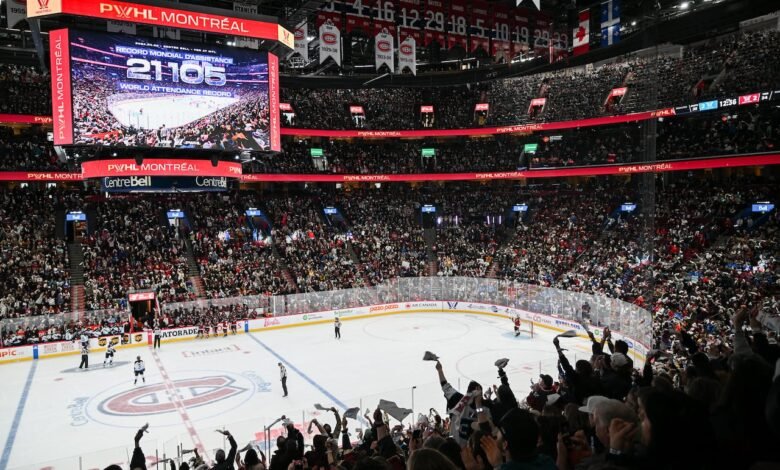
With a capacity of more than twenty-one thousand, the Bell Centre is the largest hockey arena in North America, and it’s typically home to the NHL’s Montreal Canadiens. But this day was all about PWHL Montreal, the team that had been the hottest ticket in town since the Professional Women’s Hockey League launched in January.
It was Montreal against Toronto on a Saturday afternoon, and even though these two teams had existed for only four and a half months, the rivalry already felt deep. Montreal had yet to beat Toronto in four games head-to-head, and this was the last regular-season meeting between them.
On this day, their audience was the largest crowd to ever watch a women’s hockey game in person, breaking a record set just two months earlier when these two teams faced off inside Toronto’s Scotiabank Arena. Beyond attendance records, playoff positions in the six-team league were at stake.
The league was so new that neither team had a logo or even a name yet, things that got put aside in the rush to get players on the ice as fast as possible in January. But none of these fans seemed to care. Tickets to this game sold out in twenty minutes. The crowd was full of maroon-and-cream jerseys that simply read Montreal, an ode to their team and city. Those jerseys had been sold out online for months, and lines to get one at a rink could be long.
The arena glowed maroon mixed with tiny purple lights, thanks to the light-up wristbands handed out to every fan. The DJ blasted a remix of Celine Dion’s “The Power of Love,” the team’s skate-out song throughout the inaugural season. When a shot of the players in the tunnel appeared on the jumbotron, with some of them vibing to Celine, the crowd roared.

First out of the tunnel was Ann-Renée Desbiens, the goaltender from Clermont, a small Quebec city that the Malbaie River runs through. She grew up dreaming of playing in big games. And to be clear, big games weren’t new to her. She’d thrived in plenty of those as the starting goaltender for Team Canada, the team she’d backstopped to three world championships by that point and an Olympic gold medal. But this was a different stage. It was home. Desbiens was one of Montreal’s first three signings when general manager Danièle Sauvageau started building this team brick by brick, and she was, and is, PWHL Montreal’s backbone.
Farther behind, forward Catherine Dubois grinned from ear to ear as she skated out onto the Bell Centre ice. A few months ago, she was spending her days hauling heavy cement bricks on construction sites two-and-a-half hours away in Quebec City, where she worked in the family masonry business. At the time, Dubois was convinced her hockey career was over, and it wasn’t the first time she’d had that feeling. Who could have imagined she would be here?
Last out was defender Erin Ambrose, whose eyes wandered through the stands as she moved forward, taken aback by the sight of twenty-one thousand white towels waving. It felt surreal to her. Unlike Desbiens and Dubois, Ambrose grew up cheering for the Toronto Maple Leafs. But Montreal had been her sanctuary in 2018 after getting cut from the Canadian Olympic team. Ambrose came to this city to run away from that disappointment and shame, but it became a place where she found joy playing hockey again. It had felt like a full-circle moment when Sauvageau picked her in the first round of the draft the previous September.
The players skated laps around their half of the ice before huddling around Desbiens in the net, a routine they did before every game. Across from Desbiens inside the huddle, in the middle of it all, was number 29: the captain, Marie-Philip Poulin. If Desbiens is the backbone of this team, Poulin is its heartbeat. When Montreal was announced as one of the first six PWHL teams, there was no question who would be the captain. It had to be Poulin.
Nicknamed Captain Clutch for her ability to score big goals for Canada in the most important moments on the international stage, she’s even more than that here in Montreal. She’s the face of women’s hockey. She’s the name on half the signs in the stands, the player who always takes an extra second to speak to a wide-eyed child, who always remembers a girl who attended her annual summer hockey camp. She’s the captain always eager to deflect attention to her teammates. That’s never changed, no matter how many big goals she’s scored.
The players skated to the blue line as the public address announcer began introducing the Toronto roster. The crowd cheered for the opposition, and it was so loud that players on the ice struggled to hear their names called. Standing on the blue line, Poulin couldn’t imagine how loud the crowd would get for them if this was how loud they cheered for Toronto.
The volume started to go up when Montreal players began hearing their names. Number 9, defender Kati Tabin. Number 23, defender Erin Ambrose. Number 43, forward Kristin O’Neill. Number 7, forward Laura Stacey. The cheering hit a crescendo when the announcer got to the captain.
“Number twenty-nine,” he said. The crowd nearly drowned him out before he could say her name. “Marie-Philip Pouuuuuuuulin!”
Poulin, with a smile on her face, took a deep breath as she looked up at the crowd. She smiled and seemed to let the emotion fully hit her. It was an outpouring of love for the captain, for all the gold medals, for every autograph she’d ever stopped to sign, and for everything she means to Quebec. When the cheers continued for a solid twenty seconds, Poulin saluted the crowd with her stick and applauded them. Is this for real? Poulin asked herself as she stood on the blue line. Never a fan of the spotlight, she felt the moment lingered on her for a bit too long.
You could say Poulin had dreamed of that day her entire life, but that wouldn’t be entirely true. The young girl who grew up playing with boys in Beauceville, a small city between Quebec City and Maine, never dreamed a women’s hockey game could sell out the Bell Centre. She didn’t think it was possible when, at sixteen, she came to this arena to watch her first Montreal Canadiens game, around the same time she moved to the city so she could follow her hockey dreams.
She still didn’t think it was possible a decade later in 2017, when she played a Canadian Women’s Hockey League (CWHL) game here with Les Canadiennes. Fewer than six thousand people had shown up. She had looked up at the empty seats and let herself wish they’d be full someday. That league folded in 2019 and for a while, a scene like this seemed very far away.
Farther down the blue line, Ambrose managed to hold it together during Poulin’s ovation. Poulin is her captain, but she’s also one of her best friends. If you ask Ambrose, the hardest part about not playing in a league for four seasons wasn’t just that she missed four years of the prime of her own career, finding herself without a place to play just after being crowned the CWHL’s Defender of the Year with Les Canadiennes. It was that the world missed four years of watching Poulin play in a league, four years we’ll never get back.
There will never be another player like Poulin, someone who blends her talent on the ice with her dogged work ethic and her unmatched ability to connect with her teammates. The creation of this league meant people could see Poulin play on a regular Tuesday night and not just when she put on a Team Canada jersey. Having the world see Poulin more often is something Ambrose thinks could grow the game to a whole new level.
On the Montreal bench, head coach Kori Cheverie held back tears, knowing the TV cameras would probably catch her crying. When she was growing up in Nova Scotia, Cheverie would get her mom to wake her up at five a.m. to catch replays of games from the old National Women’s Hockey League, which operated from the 1998–99 season until 2007. She knew back then that she wanted to play professionally. She went on to play in the CWHL, winning a championship with the Toronto Furies in 2014. But the game at the Bell Centre was something entirely different than what she’d experienced in her playing career.
On the opposing bench, Toronto defender Lauriane Rougeau fought back tears, too. Poulin had lived with Rougeau’s family when she moved to Montreal as a teenager. Rougeau had watched Poulin thrive at every level and watched her become the person she was today. They played together on Les Canadiennes, won an Olympic gold medal together a decade ago, and on this day, found themselves sharing this moment together on opposite sides of the rink, in what would be Rougeau’s final season playing hockey.

Host Karissa Donkin and The Athletic’s Hailey Salvian give their predictions for what Canada’s women’s hockey roster could look like at the upcoming Olympic Winter Games.
High above in the press box was Isabelle Leclaire, working as an analyst with French sports network RDS. Leclaire had coached a shy, fifteen-year-old Poulin with Team Quebec at the Canada Games in 2007. Even as a teenager, Poulin could do things with the puck that no one else could. She was just special. Finally, Leclaire now thought, there’s a league to give the best players in the world the spotlight they deserve, and thank goodness it came during Poulin’s career.
Poulin is a magician with the puck, the type of player who can get you out of your seat. No one has been more consistent when it matters most on the ice than Poulin. She’s one of the best to ever play the game. People have tuned in to see her every four years at the Olympics, and maybe once a year for the world championship. But she’s had just as many magical moments wearing a Montreal sweater in the CWHL.
Poulin’s big goals at the Olympics and world championships, sure, those are easy to find on the internet. But what about all the magic on past Montreal teams? Some of those games aired on low-quality streams. Some weren’t broadcast at all and are lost forever. Poulin scored thirteen goals over two stints at the Under-18 Women’s World Championship. Try to find a video of just one of those goals on the internet. You might need to call the FBI. It’s sad to think of what’s been lost, what we’ll never get back.
Women’s hockey has lacked visibility for years, but finally that’s starting to change.
It’s been a long time coming.
Breakaway: The PWHL and the Women Who Changed the Game by Karissa Donkin, Goose Lane Editions, paperback, $26.00
Source link