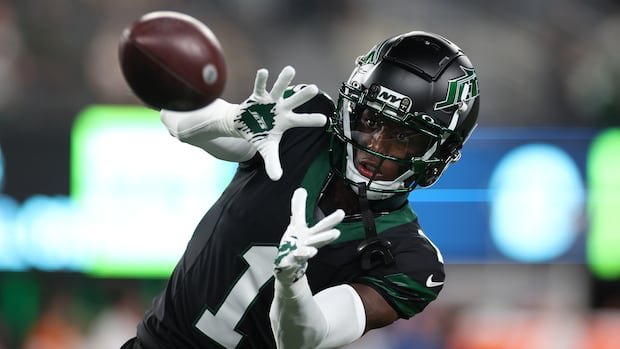
Sauce Gardner went from last place to first and teammate Quinnen Williams also is on the move in separate blockbuster trades.
The New York Jets agreed to trade two star defensive players for draft picks and players in an effort to rebuild a franchise that has the longest active playoff drought in the NFL.
Gardner, a two-time All-Pro cornerback, goes to the Indianapolis Colts on Tuesday for two first-round draft picks and wide receiver Adonai Mitchell.
The Jets will receive the Colts’ first-round selection in 2026 and in 2027.
Williams is heading to the Dallas Cowboys for a second-round pick in 2026, a first-round pick in 2027 and defensive tackle Mazi Smith, two people with knowledge of the deal told The Associated Press on condition of anonymity because the teams hadn’t announced the trade.
The Jets will get the better of the Dallas’ two firsts in 2027. They acquired a pair of first-rounders when they sent two-time All-Pro pass rusher Micah Parsons to Green Bay before the season. The Cowboys (3-5-1) have the second-worst defence in the NFL and made two moves to bolster that unit ahead of the NFL’s trade deadline at 4 p.m. EST.
Other moves on busy deadline day
The Cowboys acquired linebacker Logan Wilson from the Cincinnati Bengals for a seventh-round pick in early Tuesday.
In other moves, wide receiver Jakobi Meyers goes to Jacksonville from Las Vegas for draft picks in the fourth and sixth rounds.
The Seattle Seahawks got wideout Rashid Shaheed from the New Orleans Saints for picks in the fourth and fifth rounds, a person with knowledge of the deal told the AP on condition of anonymity because the teams haven’t announced.
Gardner, an All-Pro selection in his first two seasons, signed a four-year, $120.4 million contract extension with the Jets in July. He was the AP Defensive Rookie of the Year in 2022. He joins the AFC South-leading Colts (7-2) after spending his first 3 1/2 seasons with the losing Jets.
Williams is a three-time Pro Bowl pick and 2022 All-Pro. Williams is signed through 2027 on a contract averaging $24 million per season.
Shaheed goes from the 1-8 Saints to the 6-2 Seahawks, giving Sam Darnold another option along with Jaxon Smith-Njigba.
Meyers, who requested a trade, gives the Jaguars (5-3) depth. Travis Hunter will miss at least three more games and Brian Thomas Jr,. Dyami Brown and Tim Patrick are dealing with injuries.
Wilson had requested a trade after his playing time decreased for the Bengals, who have the league’s worst defence.
“Some guys have the ability to see a certain key and, at the same time, take a step up in the hole,” Cowboys owner Jerry Jones said on his radio show on 105.3 The Fan. “He knows how to get in the gaps right now. … For what we need right now, he can come in immediately and help us at linebacker.”
Reigning champion Eagles bolster defence
The reigning Super Bowl champion Philadelphia Eagles have been aggressive leading up to the deadline. General manager Howie Roseman continues adding players to a talented roster to improve the team’s chances for a repeat.
Since the Eagles (6-2) last played a game, they’ve acquired edge rusher Jaelan Phillips and cornerbacks Michael Carter II and Jaire Alexander.
Phillips, who came from Miami on Monday for a third-round pick, immediately bolsters the pass rush. The 2021 first-round pick had three sacks in his last five games for the Dolphins. All of Philadelphia’s edge rushers combined have three sacks this season.
Carter gives the defence a veteran slot cornerback to allow defensive coordinator Vic Fangio more flexibility to use Cooper DeJean outside. Alexander, a two-time Pro Bowl selection, is a low-risk, high-reward acquisition.
The Baltimore Ravens also added an edge rusher, getting Dre’Mont Jones from Tennessee for a conditional fifth-round pick. Jones has 4 1/2 sacks this season so he’s an upgrade for the Ravens (3-5) at a position of need.
Several trades already went down last month. The Bengals acquired Joe Flacco. The Rams got cornerback Roger McCreary. Defensive end Keion White went to the 49ers. Safety Kyle Dugger was traded to the Steelers. The Jaguars and Browns swapped cornerbacks Greg Newsome II and Tyson Campbell.
The Chargers added edge Odafe Oweh in a deal that sent safety Alohi Gilman to the Ravens.
Source link