Enhanced Games are not a science experiment. They’re a drug commercial dressed up as a series of events

Keep this in mind about the Enhanced Games, the multi-sport event in which doping is somewhere between allowed and encouraged, and which debuts in Las Vegas in May:
It’s an infomercial.
Yes, they’ve signed some accomplished sprinters in recent weeks. Shockoria Wallace has never cracked the 11-second barrier in the 100 metres, but she’s Jamaican, which makes her, in the eyes of the drive-by fan the Enhanced Games figures to attract, elite by association.
Earlier this month, Marvin Bracy-Williams joined. He left the 2022 world championship with two silver medals, so he has been elite. Full stop. No qualifiers.
But he has raced sparingly since then for various reasons, the current and most pressing is that he’s serving a 45-month ban for using testosterone and misleading investigators.
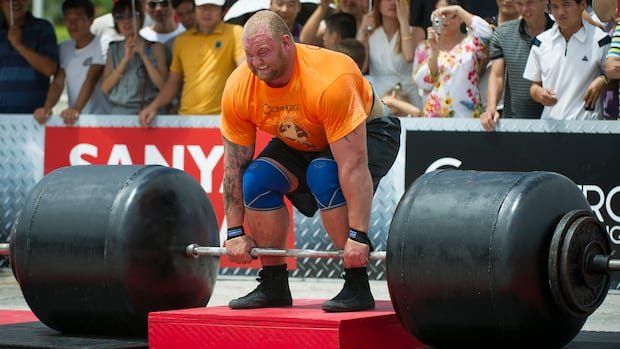
And then there’s Hafthor Bjornsson, the world champion strongman and Game of Thrones star, whose presence attracts attention but muddies the event’s premise.
If you’re trying to demonstrate what’s possible when top tier athletes start taking PEDs, what do you even prove by adding a superstar from a sport where doping is the norm?
Refer to the previous sentence. It’s the attention. He has 4.4 million Instagram followers.
And those eyeballs matter, because while the Enhanced Games is a track meet, a swim meet, and a strongman event, all those contests combine to form an advertisement for testosterone replacement theory.
That’s why two separate buttons on the games’ website land on the same page, where you can take a questionnaire that helps determine which form of testosterone – oral or injectable – is best for you, and join an online queue to order Enhanced brand hormones when they hit the market.
Problem.
It’s product positioning.
British sprinter Reece Prescod, who committed in early January, told reporters back home that he’s not taking any drugs… yet. And Fred Kerley, the 2022 world champ at 100 metres maintains that he’s a PED-free athlete, even as he preps for the kind of all-drug Olympics that was used to only exist as Saturday Night Live satire.
WATCH | SNL’s All-Drug Olympics from 1988:
But if we don’t know for sure if the athletes competing in May are taking Enhanced brand PEDs, we can’t gauge the effectiveness of the company’s TRT regimen.
Another problem.
It’s math.
Organizers are offering a $1 million US bonus to any competitor who breaks a world record, and on the sprinting side each new signing creates a deeper field. Usain Bolt ran 9.58 seconds in 2009; Florence Griffith-Joyner ran 10.49 in 1988. A detailed look at the numbers reveals nobody under contract to the Enhanced Games is in Bolt or Flo-Jo’s postal code, which raises another question:
If none of these runners threatens a world record, what have they really done for the event besides threaten its premise?
Making world records the standard
Kerley, at his absolute best, ran 9.76 for 100 metres. It’s a blazing fast time, and a few strides faster than he was last summer, but still two metres behind Bolt. If he, or any other sprinter involved, gets within a shadow of his personal best it’s a win, and proof that whatever methods they’re using – sprinting, weights, supplements, drugs, fresh country air – are working.
But Enhanced Games organizers have already made world records the standard. And if their position is that doping control keeps people from eclipsing Bolt and Flo-Jo, somebody in Las Vegas better be able to prove it, or at least hit one to the warning track.
The preliminary numbers aren’t encouraging.
Prescod’s PB, set four years ago, is 9.93 seconds. Bracy-Williams has run 9.85, but hasn’t eclipsed 9.9 since 2022.
And German sprinter Mike Bryan? He was last spotted running 10.47 in the 100 at a track meet in Florida last spring. That time might not even win him a district high school title in Dallas or Miami. He’d need a motorcycle to keep pace with Bolt. There’s not a steroid on the planet that can close those gaps, that fast.
WATCH | Trackside’s Perdita Felicien, Donovan Bailey, Kate Van Buskirk on Enhanced Games:
The women’s side of the bracket is similarly full of sprinters with personal bests that are both well behind the world record and collecting dust. Shania Collins has run 10.92 seconds, but that PB will be nearly four years old by the time she lines up in Las Vegas.
So for Enhanced Games sprinters, the prospect of a PED-aided world record scare is remote, but we can also extend organizers some credit. Signing up actual sprinters with world-level accolades is a type of progress.
Think back to that first Enhanced Games online ad, which featured an anonymous white male sprinter claiming he could outrun Usain Bolt, and bemoaning the outdated rule set that stopped him from doing it.
That wasn’t just marketing.
The reel was pure fantasy, and not because the sprinter in question was a white man.
It’s educated conjecture that if you want to run 9.5 seconds on steroids, you should be capable of 9.8 drug-free. And it’s a point of fact that the fastest white male 100m sprinter in history is Christophe Lemaitre, who ran 9.92 in 2011. Except Lemaitre is French, and the white man in the Enhanced Games ad sounded American. Lemaitre is also 15 years past his peak, with too many miles on the odometer to mount a serious world record challenge, with or without TRT.
So yes, that white sprinter that Enhanced Games organizers tried to tell us was faster than Bolt? He’s not there. He’s not under contract, and he’s not going to sign next month because he’s a work of fiction. At least now they’re dealing with sprinters who actually exist.
Except none of them are likely to approach a world record. Bjornsson might do it in the deadlift, but if we don’t have data about his drug-free ceiling, we can’t know exactly how the drugs helped him.
If organizers wanted to demonstrate the potency of their TRT plan, they’d publish every athlete’s PED start date and stats, maybe turn the journey into a coherent video series. Collect before/during/after physique photos, record their bench press and vertical jump results at regular intervals, just to show us how the process and testosterone work.
Or structure the event to pit enhanced athletes against world-class naturals. Given similar talent, the person on Enhanced brand hormones should win.
Right?
Yes, except a drug-free athlete winning would torpedo the whole event.
Plus, it’s not a science experiment. It’s a drug commercial dressed up as a series of races. The pre-event programming might not tell the truth about how well the PEDs work, but the stopwatch might.
Source link