Fast-rising Mboko meets her match in Australian Open 4th round, losing to world No. 1 Sabalenka

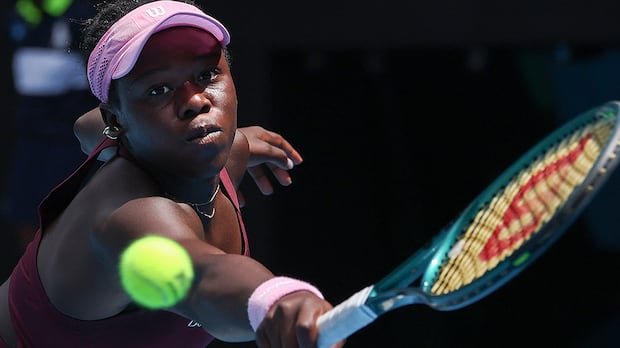
Fast-rising Canadian teenager Victoria Mboko, who has seemed unstoppable during her meteoric rise to the top of women’s tennis, found the task against world No. 1 Aryna Sabalenka a little too daunting on Sunday at the Australian Open.
Mboko reached the fourth round in her Australian Open debut but fell to Sabalenka 6-1, 7-6 (1) in a match that looked to be a blowout until the end, when Sabalenka flinched just a little and Mboko nearly took advantage.
“What an incredible player for such a young age. It’s incredible to see these kids coming up on tour,” a visibly relieved Sabalenka said during her on-court interview in Melbourne. “I can’t believe I’m saying this — I feel like I’m a kid still. She pushed me really hard today.”
Mboko thought it would be “really cool” to play on the main stadium in the second week of a Grand Slam tournament for the first time, to show the fans who are just discovering the 19-year-old Canadian everything she’s got.
What she found out, in her first-ever match against the world No. 1, was just how very much Sabalenka has. Especially in the big moments.
The sheer force of her power, will, confidence, variety, and defence combined to make it a mismatch until almost the very end.
Sabalenka was up 6-1, 4-1 and had two breaks of serve in that second set before her laser focus wavered just a little, and the nerves hit.
And Mboko, who has quickly earned a reputation as a player who never counts herself out, was able to make a run.
The Burlington, Ont., native erased the two breaks and forced Sabalenka to serve to stay in the second set at 5-6. Mboko was two points away from forcing a decider on two occasions. But she couldn’t quite get there as Sabalenka’s serve, which had been firing the entire match, saved her time and again.
And then, when they got to the tiebreak, it was game over.
‘You want to play the best’
Sabalenka rolled through it, winning her 20th consecutive tiebreak at a Grand Slam tournament in a streak dating to 2023. It is the longest such streak in the open era of tennis, breaking a tie with a 19-tiebreak streak by Novak Djokovic some 20 years ago, at the start of his career.
“Obviously, she’s No. 1 for a reason and had so much success at this tournament,” Iva Jovic, who will face Sabalenka in the quarterfinals, said of the Belarusian. “But that’s what I want — I said it last year, I hope to be able to play her this year, because you definitely want to play the best and see how it goes.”
The opening game of the match, in which Mboko had two break points she couldn’t convert, took eight minutes. The rest of that set took just 23 minutes, with Sabalenka hitting 15 winners and making just four unforced errors in all.
It was a danger match against a young, talented and fearless opponent. And Sabalenka clearly was up for it.
Her velocity on the first serve early on was 14 kilometres per hour faster than her average through the first three rounds.
That was all the more impressive given the difference in temperature from less than 24 hours before at the Australian Open, when play had to be stopped for hours because of the extreme heat and the roofs on the stadiums had to be closed.
Instead of being close to 40 C, it was below 20 C at the start of play. Sabalenka went through an entire collection of racquets of various tensions through the match to find the right recipe.
Meanwhile, Mboko was caught between two mindsets.
She spent most of the match on defence, scrambling to counter Sabalenka’s power and unable to dictate points from her side of the court.
That was all she could do; Sabalenka was playing that well.
When the finish line neared, the velocity on Sabalenka’s forehand dropped.
Mboko did her very best to try to capitalize. It just wasn’t enough.
Elite competition
A year ago, Mboko hadn’t ever faced an opponent ranked in the top 100, and only a couple ranked in the top 150.
In the last eight months she has played Coco Gauff twice (ranked No. 3 the first time and No. 2 in Montreal, when she defeated her on the way to the title), No. 7 Zheng Qinwen at Roland Garros and No. 7 Elena Rybakina in Tokyo last fall.
Last week in Adelaide, she defeated No. 9 and defending Australian Open champion Madison Keys in the quarterfinals and lost to No. 8 Mirra Andreeva in the final.
Even when she lost, Mboko was always in it — showing that despite her lack of experience she was worthy of playing against the best in women’s tennis.
She showed that again on Sunday, even in defeat.
But none of those worthy foes could match the firepower that Sabalenka consistently brings.
And despite her stranglehold on the No. 1 spot, Sabalenka is visibly improving. At 27, she’s adding variety to her game and capitalizing on the opportunities created by her powerful serve and forehand.
It was a different level, a teaching link in Mboko’s learning curve chain that hopefully won’t discourage her — rather, will give her a clearer idea of what it will take to jump to the next level.
Meanwhile, in the third round of women’s doubles, Gabriela Dabrowski of Ottawa and new partner Luisa Stefani of Brazil beat Cristina Bucsa of Spain and American Nicole Melichar-Martinez 6-4, 6-3 to advance to the quarterfinals.
Dabrowski and Stefani will face the winner of a match between the third-seeded Jelena Ostapenko of Latvia and Su-Wei Hsieh of Taiwan, and American Sofia Kenin and Laura Siegemund of Germany.
Alcaraz continues career Grand Slam bid
No. 1-ranked Carlos Alcaraz is also in the last 8 for the third straight year, continuing his bid for a career Grand Slam at age 22 with a 7-6 (6), 6-4, 7-5 win over No. 19-seeded Tommy Paul.
He’s never gone past the last eight at Melbourne Park, the only one of the four Grand Slam venues where he hasn’t won the title. That’s a statistic he’s determined to rectify, to the point where he’s reworking his serve to a look a little bit more in style with 10-time Australian Open champion Novak Djokovic.
He’s unlikely to have the crowd behind him in the quarterfinals, where he’ll meet local hope and sixth-seeded Alex de Minaur, a 6-4, 6-1, 6-1 winner over No. 10 Alexander Bublik.
No. 3 Alexander Zverev, the runner-up in Melbourne last year, beat Francisco Cerundolo 6-2, 6-4, 6-4 and will next meet 20-year-old Learner Tien, the youngest men’s quarterfinalist in Australia since Nick Kyrgios in 2015. Tien, who needed treatment for a bloody nose after the third game, beat three-time Australian Open runner-up Daniil Medvedev 6-4, 6-0, 6-3.
The 38-year-old Djokovic got a walkover into the quarterfinals after Jakub Mensik withdrew 24 hours ahead of their scheduled fourth-round match with an abdominal injury.
Source link