Chris Jones reports from Milan.
It’s impossible to pinpoint where the Olympic journey started for Piper Gilles and Paul Poirier, Canada’s ice dance champions. It had a thousand starting points.
The first time they had skates laced onto their tiny feet was a start. So was the first time a coach saw something promising in them, and the first time they won a trophy and decided they wanted to win more. The first time they met, in 2011, was a start. The first time they danced together was another.
But there will only ever be one end, indisputable in more ways than one.
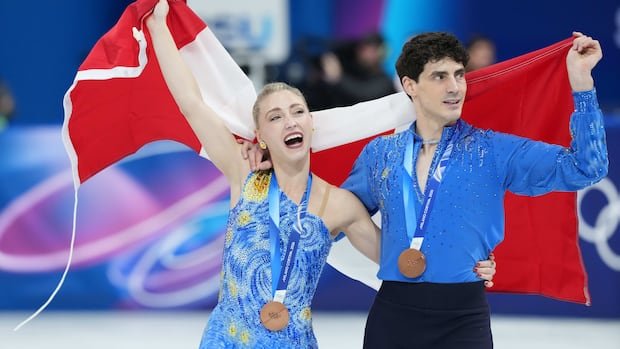
It came here, at the Milano Ice Skating Arena, on the podium that has eluded them through two previous Olympics and 15 years together, with bronze medals around their necks.
“It’s been such a rewarding journey,” Poirier said, “not necessarily rewarding in all the ways that we anticipated, but that’s what makes life so beautiful, that’s what makes sports so beautiful. It takes you on a road you can’t anticipate.”

Canadian ice dance duo Piper Gilles and Paul Poirier captured bronze for their first Olympic medal, at Milano Cortina 2026.
Ice dance is beautifully ruthless, with a theatrical process of relegation.
Twenty teams skated on Wednesday night, in reverse order of their placing after Monday’s rhythm dance. A pair of white armchairs waited for the team with a hold, however briefly, on first place. To the side of the chairs, four white cubes had been set up for the second- and third-place teams.
As the night continued and better-ranked teams finished their programs with higher scores, team after team was pushed out of the chairs, over to the cubes, and then off the cubes, before they were exiled behind a blue curtain.
Lately, ice dance has been especially ruthless to Gilles and Poirier. At December’s Grand Prix Final, many — including, vocally, the skaters themselves — felt they had been judged unfairly, slipping from third to fourth behind a British team, Lilah Fear and Lewis Gibson, for rumoured sinister reasons.
After their rhythm dance in Milan, the Canadians were again in third, and the British were again in fourth, behind by only a fraction.
Fear and Gibson took to the ice to murmurs and whispering, needing to be flawless for a chance to overtake Gilles and Poirier, even controversially.

Canadian ice dance duo Piper Gilles and Paul Poirier reaction after skating to a bronze medal, their first Olympic medal, at Milano Cortina 2026.
They were not flawless. They performed so badly, in fact, they unseated none of the watching teams from their seats and disappeared straight behind the blue curtain.
Gilles and Poirier came out next, knowing that barring disaster, a medal would be theirs.
They were gorgeous, finishing their skate by weeping in each other’s arms.
“It was very, very peaceful,” Gilles said. “To be able to soak in that moment, and the energy from the crowd and our family members and friends that were there, I don’t know. It was so beautiful. Seeing Paul getting super emotional — that doesn’t happen very often — but that’s what it takes to have an Olympic moment like that.”

Canadian ice dance duo Piper Gilles and Paul Poirier won bronze for their first Olympic medal, at Milano Cortina 2026.
They were awarded a season-best free skate score of 131.56, for a total 217.74, more than eight points clear of their nearest competitors, and took their rightful place in the white armchairs.
Madison Chock and Evan Bates of the U.S. skated next, keeping their hold on second, and Gilles and Poirier moved to the first set of cubes.
Laurence Fournier Beaudry and Guillaume Cizeron of France were the last to skate and claimed their gold.
Only Gilles and Poirier didn’t bother moving to the second set of cubes. There were no more teams to go. Their journey was over. They stayed, at last, on the right side of the blue curtain.
“A lot of moments throughout this season, it felt like we were taking on a giant in a lot of ways,” Poirier said. “I think especially after the Grand Prix Final, we had to make a conscious decision each day to believe in ourselves and to believe that what we wanted was possible. And we had to keep feeding ourselves that belief every single day even when it didn’t feel real.
“But I think that is what allowed us to have a skate like that at the Olympics.”
By the most literal measures, Gilles and Poirier began their latest Olympic journey at Pearson Airport in Toronto.
It was Feb. 1, forever and not so long ago. Gilles and Poirier were pulled through the waiting crowd at the departure gate for their overnight flights to Milan. The Air Canada agents introduced them and some members of the women’s hockey team, and their fellow passengers applauded them onto the plane.
Somewhere over the Atlantic, Gilles got up to stretch. The plane was dark and quiet. A man stood next to her, holding a sleeping baby. He asked her why she was going to the Olympics.
“I’m a figure skater,” she said.
She won’t be a figure skater forever. Gilles and Poirier are both 34 years old. They might continue to skate for a little while longer. They will almost certainly never compete at this level again. This really is the end.
But it’s also a beginning. They will look back on this moment and one day recognize that it, too, was another start.
It was the start of their lives as Olympic medallists.
Source link