First, let’s credit Casey Wasserman, the sports and entertainment power broker outed in newly published investigative files as a former associate of convicted sex trafficker Jeffrey Epstein, for issuing what, by 2026 standards, is a frank and forthright apology for his reckless emailing, and startling lack of due diligence concerning his circle of friends.
“I’m deeply sorry that my past personal mistakes have caused you so much discomfort,” he wrote in a recent memo to staffers at Wasserman announcing that he planned to sell the outfit that bears his name.
We’re used to conditional contrition, with famous people apologizing “if” their deeds caused some harm, implying that they’re not sorry if they did something wrong but managed not to inflict damage, or employing passive voice to distance the act from the actor. And we’ve grown accustomed to public apologies so wordsmithed and spin-doctored that it’s not clear who the “mea” is, and whether they’re even admitting any “culpa.”
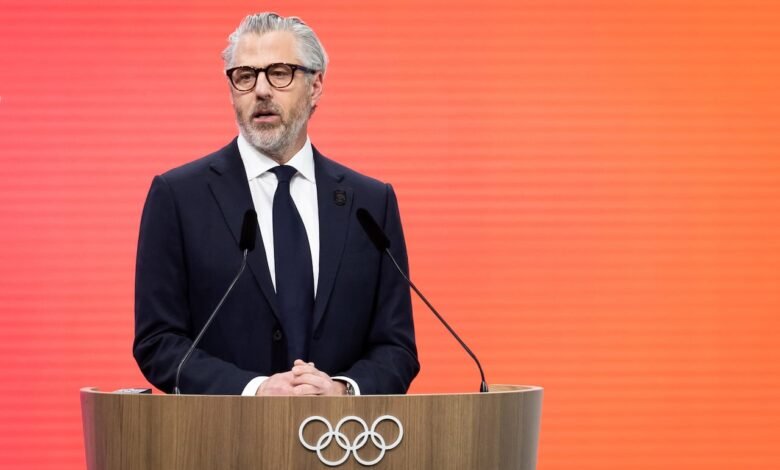
Just so we’re all on the same page: the person in question here is Wasserman, chairman of the Los Angeles Organizing Committee for the 2028 Olympic Summer Olympics. The most recent document dump by the U.S. Department of Justice included several salacious emails from the early 2000s between Wasserman, who was married at the time, and Ghislaine Maxwell, who was Epstein’s girlfriend.
The escapades and messages in question are more than two decades old, but the Epstein stain doesn’t wash off. Those emails, plus the revelation that Wasserman was among the VIPs who accompanied Epstein on a humanitarian trip to Africa in 2002, prompted the singer Chappell Roan, and other entertainers, to decide that they no longer wanted to play for TeamWass.
In response, Wasserman, 51, did the self-aware thing, and decided to sell his agency, apparently aware that his presence has become both a distraction to staff, and a drag on the firm’s reputation.
And his post at LA28?
He’s keeping it.

It’s not my place to tell him to quit that job. Wasserman certainly didn’t build a talent agency with a deep roster of all-stars and estimated nine-figure valuation by listening to paid smart-alecks like me. He’s cognizant of the drawbacks of sticking around, but is betting that in continuing to run LA28 he can avoid more public relations own-goals. But if the current sports business environment teaches us any lesson repeatedly, it’s that gambles backfire all the time.
Granted, the next Summer Games are two-and-a-half years away, and we live in a news cycle that gains speed daily. It’s possible that by 2028 we will have memory-holed Wasserman’s link to Epstein, a financier who gained fame and infamy pimping young women and teenage girls to wealthy men. Or maybe attitudes will have shifted so far that rank-and-file sports fans just won’t care that he traded racy emails with a woman currently serving time for ushering teenagers into prostitution.
Time, and a society fed a steady diet of low-quality information, can dull the brightest red ethical lines. So maybe Wasserman can stroll to the dais at a string of LA28 press events without anyone questioning his past, his associations, or his judgement.
But right now, he’s just one-more storm cloud hanging over an already tempestuous event.
Concerns in lead-up to LA28
Mid-winter last year, parts of the Los Angeles area were still smouldering after record-setting wildfires tore through the region. Entire neighbourhoods disappeared, and the rebuild figured to stretch into the next decade, complicating plans for any new Olympic infrastructure.
Meanwhile, U.S. president Donald Trump spent October embroiled in a high-profile spat with Boston mayor Michelle Wu, and threatened to move World Cup 2026 matches out of suburban Foxborough as retribution for some perceived transgression. Confirmation that agents from Immigration and Customs Enforcement – colloquially known as ICE – have scored a law-enforcement role at the World Cup’s U.S. venues this summer raises disturbing questions about how they’ll function at international sports events.
As police?
As in-stadium security?
As a paramilitary force tasked with intimidating immigrants, citizens, visitors and athletes?

Factor in Trump administration travel bans targeting countries planning to send competitors to LA28, and the idea that the president could feud with California governor Gavin Newsom, and Los Angeles mayor Karen Bass, and ugly off-the-field drama transforms from a prospect to a strong possibility.
Then there’s Wasserman, whose appearance in the Epstein files has a long list of clients and sports-world stakeholders feeling uneasy. Bass, in particular, has argued in public that Wasserman should resign from his role at LA28.
“I cannot fire him,” Bass said during an interview on CNN. “I do have an opinion. My opinion is that he should step down.”
Except those raunchy emails from 2003 aren’t illegal, or a violation of the terms of Wasserman’s current role with the Olympic organizing committee.
Wealth and influence
On one level, they’re distasteful. Wasserman was married at the time, and Maxwell partnered with Epstein.
But on another level, they testify to Wasserman’s wealth and influence, even back then. You don’t, after all, see Olympic athletes for federation executives in the Epstein files. Not rich enough, probably.
Instead, the sports world characters in Epstein’s orbit tend to own teams, or agencies, and possess enough money and power to pop up on the financier-turned convicted human-trafficker’s radar.

The U.S. Department of Justice has released millions of pages of documents detailing the lifestyle and famous friends of notorious sex offender Jeffrey Epstein. For The National, CBC’s Eli Glasner breaks down what the files have revealed so far, and what could happen next.
Like auto racing executive Jean Todt, the former head of Ferrari’s F1 team, who visited Epstein at home in 2017.
Or New York Giants co-owner Steve Tisch, who maintains that he only corresponded with Epstein concerning “adult women,” and who participated in a message exchange that goes as follows:
Epstein: I can bring the Russian if you’d like.
Tisch: Is she fun?
Or Wasserman, whose company employs 4,000 people and represents megastars in every major North American sport, and who’s in charge of an Olympic Games with a budget expected to touch $7 billion.
For some clients, even a 20-year-old brush with Epstein’s friend group is too much. Country music star Orville Peck left the agency, as did bbno$, the Vancouver-based rapper. If everybody’s betting, they’re playing it safe.
As for Wasserman, there’s a strong chance that every time he steps to a microphone between now and the closing ceremony, a reporter might ask him about his links to Epstein. Maybe he or a communications staffer will declare pre-emptively at every press event that Epstein queries are off limits.
It’s a hair less awkward but still doesn’t solve the problem.
Source link