Hours before the puck dropped on Canada’s second Olympic women’s hockey game against Czechia, defender Erin Ambrose told reporters that she was expecting things to be physical.
The Czechs play a gritty game. Their players know their best chance at beating Canada is to grind them down.
Ambrose wasn’t kidding. The game inside Milano Rho Ice Hockey Arena was physical from the start, and Canada’s stars were often the targets of the Czechs’ hits.
Both Marie-Philip Poulin and Sarah Fillier were on the other end of big checks from five-foot-10 Czech star Kristýna Kaltounková in the first period. Both hits drew penalties.
Right away, there was concern when Poulin was slow to get up from the ice. Poulin doesn’t go down easy. She’s one of the toughest players on this Canadian team.

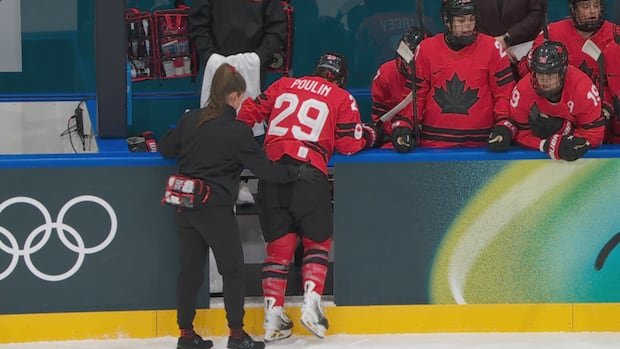
Marie-Philip Poulin left during the first period of Canada’s 5-1 victory over Czechia with a suspected lower-body injury.
Her linemate Emma Maltais immediately skated over to Kaltounková to defend Poulin.
“I won’t tell you exactly what I said,” Maltais said. “But it’s our responsibility to protect our captain, our players, especially when it’s Pou. I think there’s respect that she’s earned. So, yeah, I just shared my thoughts on that with her.”
The cameras showed Poulin in great pain on the bench, a rare sight for a captain who’s used to taking the brunt of physicality in the PWHL. She returned to the ice on the power play, but quickly went back to the bench, keeping weight off her right leg. She went down the tunnel shortly after.
“It’s just two teams fighting out there, that’s the reality,” Czechia head coach Carla MacLeod said. “You never want to see anyone go down, but we lost a couple of players in that game too. That’s just what a hard fought hockey game looks like.
“Certainly hope that Poulin is good to go — she’s the best player in the world, one of, if not the. You never want to see someone get an injury, but unfortunately that can be part of the game.”
Poulin returned to Canada’s bench for a spell in the first period, but head coach Troy Ryan said she was unavailable to play. The consummate teammate wanted to support those around her in any way she could.

“Pou just came back, I think, just to be with the group, probably to ease their minds a little bit,” he said.
There was no update on Poulin’s condition after the game. Both on and off the ice, Poulin is the “heartbeat” of this team, in Maltais’s words.
So the Canadians did what they knew their captain would have wanted. They kept going.
“She’s picked us up so many times, she’s led the way, and it was our turn to pick her up,” forward Laura Stacey said. “It was our turn to support her and try to do whatever we could to get that win tonight for her, but also for ourselves as a group.”
Poulin’s status for U.S. game unclear
It’s not yet clear whether Poulin will be healthy enough to compete in Tuesday’s preliminary round game against the United States, which begins at 2:10 p.m. ET on CBC and CBC Gem. Ryan was hopeful, given that Poulin briefly returned to the ice after the hit.
Things always feel more meaningful when it’s Canada and the United States, one of the best rivalries in all of sport.
In the grand scheme of things, Tuesday’s game only counts for positioning in Group A. Every team in that group, including Canada, will move on to the quarterfinals.
Much of the conversation around Canada and the United States has revolved around the cross-border rivals’ different approaches to integrating youth. The U.S. team has seven players who are still in college. The Canadian team didn’t select anyone from the NCAA ranks.
But Monday’s win showed Canada still has young talent.
Julia Gosling, 24, has scored three power play goals in the tournament, including two against Czechia.

A pair of power-play goals by Julia Gosling gave Canada a 5-1 victory over Czechia Monday at Milano-Cortina 2026.
Sarah Fillier, in her second Olympic tournament at just 25, registered her second goal in as many games.
Twenty-six-year-old Daryl Watts, who scored against Switzerland, added an assist on Monday. Her line with Fillier and Sarah Nurse has been Canada’s best of the tournament.
Canada also got goals on Monday from Stacey and Kristin O’Neill, who’s playing in her first Olympic tournament.
Canadian goaltender Ann-Renée Desbiens made her first start of the tournament, and allowed only one goal, a third period tally from her Montreal Victoire teammate, Natálie Mlýnková. The team outshot the Czechs, 34-19.
In a physical battle, Canada seemed to have a better handle on the line between a penalty and clean play.
“They’re going to cross it at times and to be honest, at times, I’m completely OK with our team crossing it at times as well,” Ryan said. “I think sometimes you’ve got to play the game hard, and you’ve got to play it mean at times. I think that’s one of their approaches and tonight it just cost them a little bit.”
Injury forces line shuffling
Poulin’s injury forced the team to shuffle its lines. Stacey was reunited with Emily Clark and Blayre Turnbull on the shutdown third line.
Natalie Spooner was elevated from extra forward to top-line duty with Maltais and Brianne Jenner, who had two assists.

“The core group being together for so long, we’ve had so many line combinations that we’ve worked on, I didn’t have to dig too deep to find some line combinations that we were comfortable with,” Ryan said.
Another scare came in the third period, when Mlýnková appeared to fall on top of Ambrose in front of the net. She returned to game later in the period.
In Poulin’s absence, Fillier led all Canadian forwards with 16:31 on ice.
“I feel good,” Fillier said. “My role on this team, I feel like I just want to come in and play a full 200-foot game. I’ve got to bring some offensive presence, so I’m happy with that. It’s been a long four years, especially this year in the PWHL, just trying to do everything I can in New York to come prepared and help us win a gold medal.”
Tuesday’s game against the United States will be the Canadians’ biggest test yet. They go into the game having lost six in a row to their cross-border rivals.
“Obviously, everyone knows we’re playing the U.S. — but we’re just trying to play our own game, and build our game, and stick to our game plan no matter who we’re playing,” Fillier said.
“We’re taking it period by period, and ultimately we’re trying to get our game to peak at the end of this tournament.”
Source link