U Sports can learn something from NCAA’s mastery of visibility when marketing its own football product

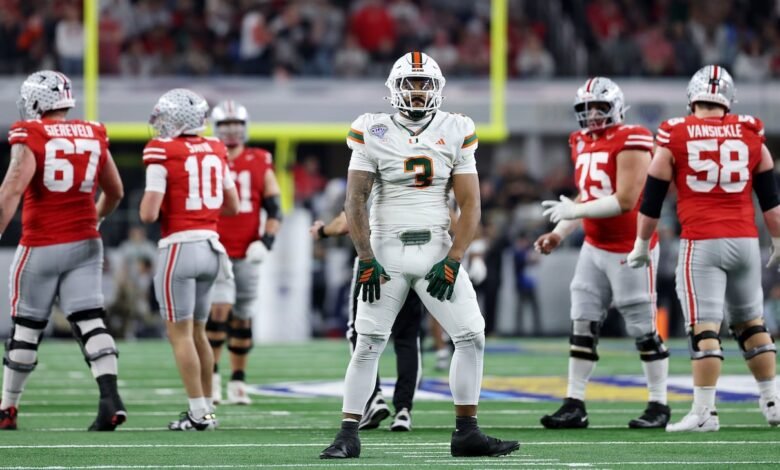
Shekai Mills-Knight, a freshman running back for Ole Miss, will earn some attention Thursday night when his Rebels take on the Miami Hurricanes in an NCAA semifinal football game in Glendale, Ariz., but he first made news a decade ago as a grade-schooler deemed too big for the local little league.
At 9, Mills-Knight, living Dollard-Des-Ormeaux in suburban Montreal, was listed at 111 pounds, which made him 11 pounds too heavy to carry the ball in a league with rigid weight classes. Officials refused to let him play running back, and forced his team to forfeit four wins. For the record, his family maintained that his official weight was a typo, and that young Shekai actually scaled 101 pounds.
It’s an important distinction. If he’d had a tall glass of OJ at breakfast and then weighed 101, a quick pee break might have put him back below the limit. But if he was a full-fledged 111 then he might as well make like Terence Crawford and find a new weight class.
His family protested the decision as far as they could, but Football Quebec upheld the position restriction, and losses remained on his team’s record.
Clearly, football worked out anyway for Mills-Knight, who wound up starring in five sports as he finished his prep career at Baylor School in Chatanooga, Tenn. He totaled 25 yards on eight carries as a freshman at Ole Miss, but his Derrick Henryesque dimensions – 6-foot-3, 220 pounds – and bulbous muscles hint at his future potential.
At 19, he’s young enough for us all to imagine how much better he’ll be in two years, but 10 years after his youth-league controversy, he’s also old enough to remember when rules mattered. The league said he needed to weigh 100 pounds, and stripped his team of victories to prove they meant it.
2015: Disqualified at 9 years old and told he was too heavy to be a ball-carrier in Montreal.
2026: Advancing to the College Football Playoff semis with Ole Miss.
Canadian freshman RB Shekai Mills-Knight’s story is still being written.
📸 @billyshields, @OleMissFB pic.twitter.com/pQ0nwQupB0
Contrast that hardline stance with the current anything-goes ethos governing big-time US college football.
Player contracts?
They might be legally binding, hence the University of Washington’s decision to have star quarterback Demond Williams Jr. sign a deal to return to the team next season. But maybe they’re just suggestions, which is why Williams put pen to paper, then entered the transfer portal anyway.
Loyalty?
It’s conditional. That’s why head coach Lane Kiffin, who left Ole Miss for a higher paying job at LSU in November, has been trying to poach Rebels assistant coaches ever since, even as his old team continues its playoff run.
And amateurism?
Always a charming idea, but never quite the reality. Now, with quarterbacks demanding seven-figure sums in the transfer portal, it’s officially extinct in high-level U.S. college football.
All that upheaval has created opportunities for programs not known for football. Until recently, if I had told you Indiana University was two wins away from a national title in a revenue sport, you’d have assumed I meant men’s basketball. And the idea of Ole Miss surviving the SEC and landing in a national semifinal was a non-starter unless we were talking baseball.
A constant amid all that change: Canadians playing at a high level.

This year, they’re all in the first semifinal. Ole Miss features Mills-Knight, while Miami’s roster includes Toronto-born offensive lineman Nino Francavilla, and Akheem Mesidor, a 24-year-old defensive lineman from Ottawa.
That success trickles up. This season, NFL rosters featured 24 Canadian-born players, and taken together those trends send a strong message to stakeholders both in the U.S., where college football is a major league sport, and in Canada, where the Vanier Cup plays to dwindling audiences each November.
At an elite level, Canadian football is healthier than ever, and even if U Sports can’t stop the brawn drain to the U.S., or replicate the big-money business model, it can learn a lot from the NCAA about how to market and position its on-field product.
Granted, the demand for U.S. college football among TV viewers is remarkably durable, given how many of the elements we thought made the sport unique and appealing have vanished in recent years. The transfer portal means your favourite players are harder than ever to locate, and their team might dump other guys before you’ve bonded with them. And the overdue movement to pay players undermines the amateurism NCAA officials once portrayed as the bedrock upon which fan support was built.
Yet we’re tuning in anyway.
Soap opera dressed as a sports tournament
According to ESPN, this season’s quarterfinal games averaged 19.3 million TV viewers in the U.S., a 14 per cent bump compared with last year’s quarters.
What’s the secret?
There is no secret.
College football succeeds on TV because it’s a soap opera dressed up as a sports tournament. Teams dump coaches mid-season. Coaches and ex-employers haggle over eight-figure buyouts. The transfer portal gives us free agency twice a year.
It’s all chaos, which we profess not to like. But it’s also drama, which we love. Where will the players you love and coaches you hate end up next season? Can Alabama keep winning in the post Nick Saban era? Will Curt Cignetti and Indiana parlay Mark Cuban’s massive recent investment into long-term success?
We can’t always answer those questions, but we’ll tune in every week until we find out.
Canadian subplots keep emerging, whether it’s Oakville, Ont.’s Kurtis Rourke quarterbacking last season’s Indiana Hoosiers to their first playoff appearance, Antwan Raymond of Lachine, Que., emerging as an elite Big Ten ball carrier, or a national semifinal that features three Canucks.
Given the stakes, it’s not even worth directly comparing the Vanier Cup to the U.S. playoffs. They’re from completely different species. The College Football Playoff national championship, slated for Jan. 19 in Miami Gardens, Fla., is a cultural event; the Vanier Cup is a football game.
Still, just as U.S. college football learned the value of having an undisputed champion every year, U Sports can adapt some lessons from the NCAA.
Not the business plan, obviously. Even schools that commit to spending big on coaches and facilities and player salaries can’t really afford it, which explains why the University of Utah recently accepted half a billion dollars of private equity cash.
But U.S. college football has mastered visibility, and that’s where U Sports and its broadcast partners – CBC included – can make progress. Mainstream Canadian sports fans parachute into the Vanier Cup every November. Sports fans on both sides of the border can track U.S. college football drama year-round. That attention is the rising tide lifting everyone’s boat, but depends on sports fans having plotlines to follow across and between seasons.
U Sports and its partners can work toward a version of that regular broadcast presence, even if they can’t replicate the ESPN Gameday experience.
The alternative is the counter-intuitive pattern we’re stuck in right now, where we can’t see Canadians play college football weekly – unless they’re in the U.S.