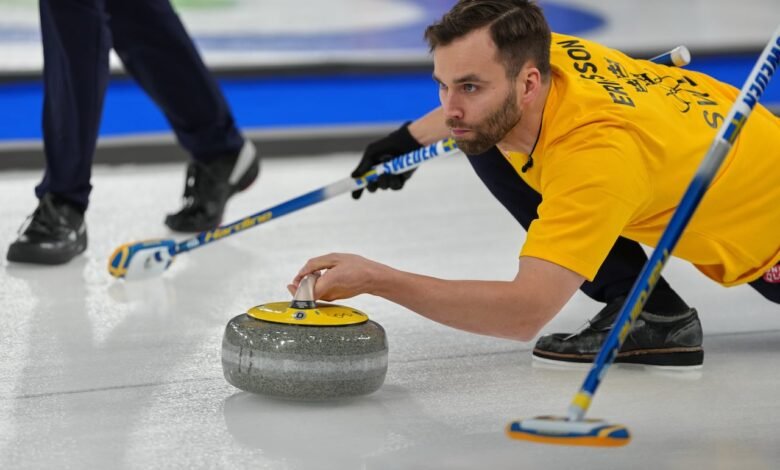
Thought curling season was over? Well, think again.
Because even after an electric ride through the Grand Slams, Olympic trials, Olympics, Scotties, Brier and world championships, there is one event still to come.
Rock League — a new professional curling outfit — will make its debut Monday at Toronto’s Mattamy Athletic Centre.
Live coverage throughout the week will be available on CBC Gem and CBCSports.ca, with draws every day at noon, 3:30 p.m. and 7 p.m. ET. A champion will be crowned on Sunday at 4 p.m. ET.
Even if you’ve been locked in on every end of a wild 2026 season, Rock League will offer something different, with new rules and new teams that should spice things up.
And if you’re the type to scoff and call it gimmicky — well, can we interest you in a Brad Jacobs vs. Oskar Eriksson match to open the proceedings on Monday? Thought so.

The format
Here’s everything else you need to know:
Each of the six teams will play each other once during the round robin from Monday through Friday, culminating in a matchup between the Canadian-centred Maple United and Shield Curling Club on Friday night.
During this period, each match will consist of three separate games: men’s, women’s and mixed doubles. General managers must disperse their players across all three sheets, with lineups submitted the night before each match.
One twist: while players cannot move between matches, GMs are able to adjust their lineups within each sheet at any point during the game.
From there, each of the six clubs will be seeded for Saturday’s mixed fours matches, with the top seed taking on the sixth, 2 vs. 5 and 3 vs. 4. Each of these matches will consist of two mixed-fours games — and GMs can switch or substitute players between sheets after any end.
On Sunday, the semifinals will pit the top four teams against each other, with the winners moving onto the championship match. The champions will receive $100,000 US for their team, and a league MVP who takes home $5,000 will be named.
The teams
Six teams of 10 players — five men and five women — each will go head-to-head over the course of the week.
The curlers themselves are among the highest quality — of the 60 set to compete, 39 participated at the Milano-Cortina Olympics. That includes Canadian men’s gold medallists Brad Jacobs and Brett Gallant, as well as Swedish women’s champion Anna Hasselborg and the entire bronze-medal-winning Rachel Homan rink.
Unlike the Olympics, however, the teams have mixed nationalities, though each has a theme. For example, Team Homan second Emma Miskew is part of Alpine Curling Club, which otherwise features nine Europeans.
In fact, each of the four Homan rink members are dispersed across four different teams, which should make for some interesting and odd sights.
The other five teams are Frontier Curling Club (captained by American Korey Dropkin), Maple United (captained by Homan), Northern United (captained by Scotland’s Bruce Mouat), Shield Curling Club (captained by Jacobs) and Typhoon Curling Club (captained by Japan’s Chinami Yoshida).
The teams were assembled by Rock League strategic advisors and Canadian curling greats Jennifer Jones and John Morris.

Team Homan stopped by the CBC Sports digital studio to share their excitement for the new curling league, Rock League, and why fans should tune in.
The rules
Here’s where things get even weirder.
For starters, every fours game will consist of seven ends, while mixed doubles remain at eight. There are no concessions, since total points scored is a standings tiebreaker. Any ties will be broken by a draw to the button.
There should be plenty of action within each game — in fours, teams can only blank an end once every four, or else they lose the hammer.
Simple enough. Not too radical. Now, bear with me: in fours, during the seventh end, any stone on the button is counted as two points. You can already sense that last-end drama ratcheting up.
Oh, and one more thing: Rock League will be testing a hog-line camera Monday through Friday. If things go well, it will be fully implemented Saturday and Sunday. Teams will have one hog-line challenge per game.
Why is that a big deal? Well, if you think back to the Olympics, the hog line became a massive talking point in the Canada-Sweden controversy, in which the Swedes accused the Canadians of double-touching past the hog line, and the Canadians accused the Swedes of … setting up an illegal hog-line camera.
Now, the line may be under even more scrutiny.

CBC Sports sits down with Canadian skip Rachel Homan following her emotional bronze medal win at the Milano Cortina 2026 Winter Olympics. After years of chasing an Olympic podium, Homan reflects on finally capturing her first Olympic medal and what the moment meant to her and her teammates.
The stakes
In addition to the champion and MVP, each team will get descending payouts, with second place taking $60,000 and third earning $35,000. There is also an award called The Ultimate Competitor, voted on by all athletes, of which the winner will receive $5,000.
More than the financial rewards, however, this week of Rock League action is being billed as a preview season.
The true vision will be borne out over five weeks from January through April next year across Canada and the U.S. But by starting with one week in Toronto, league owner Nic Sulsky is putting his cards on the table — while an entertaining week of curling could be catalyst for the entire concept, a flop could hinder the whole thing before it well and truly even began.
Plenty of sports offshoots — from LIV Golf to arena football – have taken their shots at the establishment in the past. Rock League isn’t quite that, instead working in concert with the Grand Slams and key international events. But it is of the same vein as a bold reinvention of a long-loved sport full of tradition.
There is every reason to believe Rock League will ultimately be hailed as a success. But as we all know, it’s the first impression that matters most.
Source link