The International Olympic Committee says it will have gender parity at a Winter Olympic Games for the first time in 2030.
The 2030 Olympics, set to be hosted in the French Alps, will also feature the Olympic debut of synchro9, a form of synchronized figure skating, and freeride ski and snowboard.
The changes to the 2030 Olympic programme were announced on Tuesday following an IOC executive board meeting in Switzerland, after months of consultation with international sporting federations.
The 2030 Games will see an estimated 3,046 athletes competing across 126 events. That will include 1,525 women and 1,521 men.
Several new events will result in more women competing, including a women’s team event in ski jumping, a mixed team event in freestyle skiing (ski cross), a mixed team event in snowboarding (snowboard parallel) and new team sprint events for both men and women in speed skating, among other additions.
“What I expect in the future is to be a little bit fluid,” IOC president Kirsty Coventry said on Tuesday when asked about the expectation of gender parity at future Olympic Games.
“We don’t want to leave anyone out just because we’re stuck on a specific number. We would love to be able to ensure that every Games is 50/50. But if we are going to get down to a process in the programme where maybe it’s 49/51 per cent or vice versa, male female, I think that would be OK too. I think it’s just the priority that this is important for us to continue to keep working towards.”
The quota of female athletes was also increased in luge, skiing, bobsleigh and hockey.
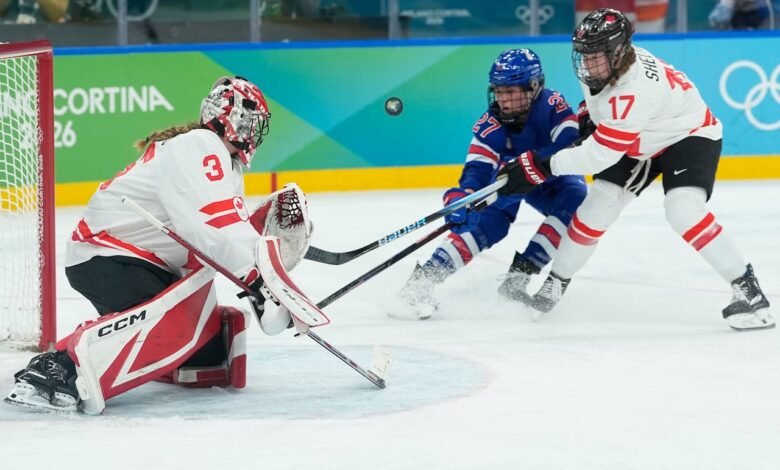
Men’s hockey teams fielded 25-player rosters, compared to the 23-player rosters allowed for the women’s tournament at the 2026 Olympics. Women will make up 45.6 per cent of hockey athletes in 2030, up from 43.4 per cent.
The International Ice Hockey Federation hasn’t yet said what that could mean for roster sizes for women’s teams. The organization expanded roster sizes to 25 for the women’s world championship in 2025.

For the first time since the 1920s, nordic combined won’t be on the Olympic programme.
The sport, which blends cross-country skiing and ski jumping, was the only one without any women competing at Milano-Cortina 2026, but that wasn’t the main reason for its elimination.
“What was really at stake is the universality of nordic combined overall as a discipline,” IOC sports director Pierre Ducrey told reporters on Tuesday. “It’s also capacity to raise audiences. For us, it was really a debate not so much about the parity within the discipline but … low popularity and having a high concentration of a few countries at the top of the sport.”
Only five countries have won medals in nordic combined at the last four Winter Olympic Games. Canada hasn’t had an athlete compete in nordic combined at the Olympics since 2010.
Modern twist on synchronized skating
Synchro9 is a modern twist on traditional synchronized skating, which would typically have up to 16 skaters performing long, structured routines.
Instead, teams of nine skaters will perform “shorter, high-impact performances” in a format designed to be faster, more entertaining and easier to follow, according to the International Skating Union (ISU).
“The event features knockout rounds, an accessible scoring system and an energetic in-arena presentation designed to deliver a thrilling experience for spectators, broadcasters and digital audiences alike, while staying true to the technical excellence, creativity and team spirit that define the discipline,” the ISU said on Tuesday.

Synchronized skating was officially recognized as a discipline by the ISU in the 1990s, while synchro9 made its debut during the exhibition gala at the 2026 ISU Figure Skating World Championships.
It was welcome news for Skate Canada, which named three synchronized skating teams to its national team earlier this week.
That list includes Les Suprêmes, a team based out of Saint-Léonard, Que., that won its fourth synchronized skating world championship this past April.
“Skate Canada is thrilled by the International Olympic Committee’s decision to include Synchro9 as part of the Alpes 2030 Olympic Winter Games programme,” a statement from Skate Canada says.
“This historic milestone marks a new era for synchronized skating and for the growth of figure skating worldwide. The IOC’s decision also represents an important step toward achieving gender parity at the Olympic Winter Games and we look forward to seeing synchronized skating make its long-awaited Olympic debut.”
‘Visually spectacular’ freeride competition
Freeride will debut with events in men’s and women’s skiing and men’s and women’s snowboarding. Athletes will compete on natural terrain instead of a man-made course.
The sport has deep roots in Canada and is continuing to grow, Freestyle Canada CEO Peter Judge told CBC Sports.
He compared the viewing experience to watching surfing at the Olympics, as athletes test themselves against the mountains and the weather.
“It’s great to watch — very exciting,” Judge said. “Just being able to see the scope of the mountains and everything else, it will be very visually spectacular.”

One athlete to watch will be Justine Dufour-Lapointe, a 2014 Olympic champion in moguls who has become one of the top freeride skiers, Judge said.
“Canada has a really strong pathway,” he said. “That’s one of the things we’ll be really looking to fortify now. This is one of the most important thresholds that you cross that gives the sport notoriety, but also ensures that you have access to certain funding mechanisms that allow you to be able to build out the programming that will make it sustainable as a sport.”
Canada will also have a good chance to earn medals in women’s and men’s team sprint, which will be added to the long-track speed skating programme in 2030.
At the world championship, which added team sprint events in 2030, Canada has made the podium six times.
Team sprint sees two teams of three skaters begin skating on opposite sides of the 400-metre oval, with each skater leading for one lap before dropping off the track. That continues until the third skater completes the final lap alone, stopping the clock.
Long-track speed skating will be held in Heerenveen, Netherlands at the 2030 Olympics.
Source link