From the book LEGS HEARTS MINDS: Loss and Its Remedies by Chris Jones. Copyright © 2026 by Chris Jones. Published by Random House, an imprint and division of Penguin Random House LLC. All rights reserved.
Chris Jones covered the 2022 World Cup in Qatar for CBC and was there when famed American soccer writer Grant Wahl died. In his new memoir, Legs Hearts Minds: Loss and Its Remedies, Jones reflects on the loss of his friend.
The day after Grant died, I headed to the last of the World Cup quarterfinals: England versus France at Al Bayt, the make-believe Bedouin tent in the desert. I sat on the bus and watched the dunes streak by in a thin purple light. Pat, my editor at CBC, had told me to take the day off, but I didn’t want to sit alone in my apartment. I wanted to watch some soccer.
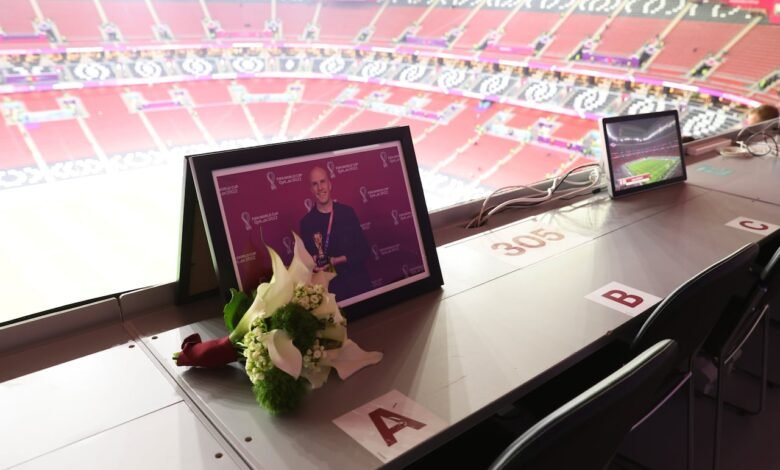
I took my seat. Just to my left, there was a framed photograph of Grant and a bouquet of white flowers where he was supposed to sit: Desk 305, Seat A. I looked at it for a long time. The game began, and I tried to get drawn into it. I didn’t get all the way there. It was a good game, but it was filled with football’s version of heartbreak — Harry Kane missed a penalty that will haunt him forever, and England lost again, 2-1 — and I couldn’t keep my eyes from wandering to my left, or my mind from wandering with them.
I know Grant’s death was not about me. It was about him and the loss of him, and the people who loved him whom he left behind, his wife, Céline, especially. But I was rocked by his departure, unlike any other I had experienced. I won’t pretend we were best friends, but he was my friend; more than that, I thought of him as an ally. When I’d covered my first World Cup in South Africa in 2010, I was nervous and overwhelmed. Even though we were the same age — he turned 49 in Qatar, three days after me — my first tournament was Grant’s fifth, and he’d helped settle me into the rhythms of our work, ignoring that we were competitors. He didn’t care about conventions. I was insecure enough to worry about saying “football” in front of the Brits, as if my accent didn’t already make them dismiss me; Grant chided me, providing a passionate defense of the word “soccer.” It was English shorthand for “association” and represented everything we both loved about the game. When Grant believed in something, he believed in it with his whole heart. “You should call it soccer,” he said.

Because we were so close in age and aligned in our loves, and because my heart had sometimes felt unreliable, I hope I can be forgiven for my maelstrom of thoughts that night at Al Bayt. They included my disbelief that he was gone. I also imagined what might have happened had our roles been reversed and my desk was the one with a picture on it.
I imagined the logistics of my death, the mechanics of my departure, the raiding of my closets and dispensing of my personal effects. I wondered who would have gone into my apartment in Doha and packed up my things, and whether they would have had any idea where to send them. I was divorced and single. I didn’t have my person, my Céline. I didn’t know who would have brought my body home, or who would have received it. I didn’t know who would have told my sons that I had died, or how they would have processed the news.
I remembered a conversation I’d had with a man named Darryl years ago. I’d written a story for Esquire that required me to spend a month embedded with paramedics in Ottawa. Darryl was my mentor. During a brief, quiet moment between calls, we had talked about souls. I’d thought he’d be an atheist, that he’d believe that human beings were temporary machines, our lives governed by some intricate combination of luck and circumstance and maybe a sliver of free will until we died. Darryl had surprised me. He believed in an afterlife. He used me as an example. “You can’t tell me all of that personality, all of that memory and experience, disappears when you die,” he said.
“I don’t know, man,” I said. “I think it kind of does.”
“No,” Darryl said. “It goes somewhere.”
The radio crackled. We had to answer another call.
Darryl lit up our lights and fired up our sirens, and he shouted something that I’ve never been able to shake, in part because it felt less like an opinion than an instruction.
“We aren’t just meat,” he hollered at me, like a battle cry.
I watched the stadium empty, and Grant’s picture and his flowers were taken away. That’s it, then, I thought. Life goes on. I sat in my seat, crying my guts out. I was 49 years old, and my friends had started to die in front of me, and I had nobody with me. I felt so sad my chest hurt. I’m not sure I’ve ever felt more alone. I was just meat.
Suddenly I felt a gentle hand on my back. A writer named Joe, an Irish freelancer who lived in Toronto, had come up behind me. I didn’t think anyone else was still there, and I was embarrassed at the state of me. Joe and I had been at the same tables in bars, but I didn’t know him well enough to cry on him. Yet there he was, as real as could be. He stood there and kept his hand on me until I managed to stop the worst of my tears. “You all right then?” he said gently, finally, and I nodded and wiped my red eyes, and then I got up and packed my bag, and we walked together down the stadium steps, and outside to the bus, where we sat beside each other and stared out the window in silence, until Joe marveled that the desert might as well be the ocean when you’re looking at it at night.

Ten mostly sleepless days later, I went to a final that was maybe the best game any of us will see. It featured two of the game’s biggest stars, with enormous personal stakes: Either the 35-year-old Lionel Messi would cap his imperious career with the only trophy he hadn’t won, or 23-yearold Kylian Mbappé would become the next Pelé, a two-time winner at such a tender and precocious age. It was a contest between philosophies more than countries: a battle between experience and youth, precision and power, timing and speed, acceptance and denial. A lot of big games don’t live up to our expectations of them. The ambition that makes football gorgeous disappears, replaced by a crippling doubt. That final was an exception, something beyond a soccer game. It was a spiritual litmus test.
“I had a feeling that this was mine,” Messi said after he’d won and the last of his dreams had come true.
I knew while it was happening that I would tell my grandchildren that I was there. That thought filled me up, and then it crushed me. The final was in Lusail, where Grant had died, and I looked up at the lights to steady myself.
By the time Messi kissed the World Cup, I decided that it wasn’t an accident that the diminished version of him finally did. We all lose people and things we love. We all have regrets. What matters is that we honor them by learning from them. Messi can no longer play the way he once played. His former self still made regular appearances, usually when he was taking a free kick, but it must have sometimes also felt to him as though he were losing a superpower, reduced to someone closer to ordinary. He had made his peace with his deficiencies and found a new, more careful, more considered way to play. I looked at him and decided there is a time for fighting, for an active resistance against sinister forces and feelings. There are also opponents that we will never beat. There is no stand we can make against biology or history. There is no weapon we can use to defeat grief. I was still sad about Grant. I was still sad about a lot of things.
That’s okay, I told myself under the glittering lights of Lusail. Some wounds heal fully, and we forget about them. Some leave scars, and they remind us that we lived. The open ones are how we know that we’re still alive and that we still have a chance to get better.
Source link