Wheelchair basketball took Reid Richard around the world. Now, he’s coaching the next generation

CBC Saskatchewan’s Creator Network is a place where young digital storytellers from diverse backgrounds can produce original video content to air on CBC and tell stories through their own lens. Get in touch or pitch your own story here.
As a child, Reid Richard played all kinds of sports, including soccer and baseball. But he says nothing really captured his attention.
That all changed the day an adaptive sports demonstration came to his elementary school in Fillmore, Sask., about 100 kilometres south-east of Regina.
“They brought in all the chairs. I was able to actually see the sport and get in,” Richard said. “It felt like the first time I was in the chair, it was a sport I could actually not just participate in, but actually succeed in.”
For a kid who often felt like he couldn’t contribute as much as he wanted in able-bodied sports, the discovery was exhilarating. He couldn’t get enough of it.
“My parents would get sick of me because I’d be sitting in my [wheelchair basketball] chair at home without, like, the wheels on, just because I like sitting in my chair so much,” Richard said. “But it still gives me that joy today.”

‘This is who I’ve always been’
The 31-year-old was born missing the tibia bones in his lower legs. His parents were faced with a difficult choice: attempt to insert metal rods into his legs and face years of painful surgeries, or proceed with amputation.
They chose amputation. Richard agrees it was the right thing to do.
“I’d say it was definitely never something I had to come to terms with because it was kind of, ‘this is me, this is who I’ve always been,'” he said. “I just have to look at things a different way and find my own way of doing things a lot of the time.”

Reid Richard was born without tibia bones in his lower legs. His parents faced a tough decision for their son: either have metal rods implanted repeatedly as he grew up, or proceed with amputation. They ultimately chose amputation, and Richard says that was the right choice. Eventually, Richard discovered wheelchair basketball, and went on to play at an elite level. Now, he’s transitioned to coaching the next generation. He’s featured in a new video for the CBC Creator Network by Regina based filmmaker, RC Equina.
Richard said he’s grateful he didn’t have to make the transition from fully able-bodied to having a disability.
“I think the biggest thing is just own it — you are who you are,” he said. “It’s not going to change. A lot of people are just going to have questions, but celebrate the fact that you’re so different.”
Richard said he wears “stubbies” that cover his thigh bones most of the time.
The custom made prosthetic sockets are fitted with a bottom piece that operates like a shoe. They lower a person’s centre of gravity, and provide stability and balance.
Richard, who works as a sales assistant for a Regina’s District Brewing Company, said he can walk around in his stubbies all day, and go up and down stairs.
He doesn’t use a wheelchair unless he’s playing basketball, and while he does have a set of prosthetic legs, he doesn’t use them very often.
“They’re actually quite exhausting to wear for most of the time, because they’re quite heavy,” he said. “So I use them typically in certain coaching situations or if I’m going out to work, or going out to a function or event.”

Basketball journey
Richard was 12 when he started playing basketball more seriously. By 14, he was selected to play for Team Saskatchewan.
His first big tournament was in Toronto. His nerves almost got the best of him.
“I remember just being there and feeling so sick because I was so nervous to play,” Richard said. “But they got me out there. And that’s how I started off in the more competitive aspect of the sport.”
Playing for Team Saskatchewan led to more opportunities. In 2013, he was named to Team Canada’s U23 roster.
His career highlights include finishing first with Team Canada at the Americas Zone Qualification Tournament in Mexico, playing multiple games in London, England, and heading to the U23 World Championships in Adana, Turkey.
“We only finished eighth, but I still wouldn’t trade that experience for anything,” he said.
Breaking out of his Shell
Richard hopes his journey will encourage more people to join adaptive sports — even if they’re physically intense or high impact, like wheelchair basketball can be.
“For me personally, it was just a different way of being treated. Not being put in, like, a Saran Wrap or glass jar,” Richard said. “I’d say getting enrolled in sports is the best thing that ever happened to me personally, because I was a very quiet kid and didn’t want to do any of this. It got me out of my shell, it got me active.”
Leading the Regina Paratroopers
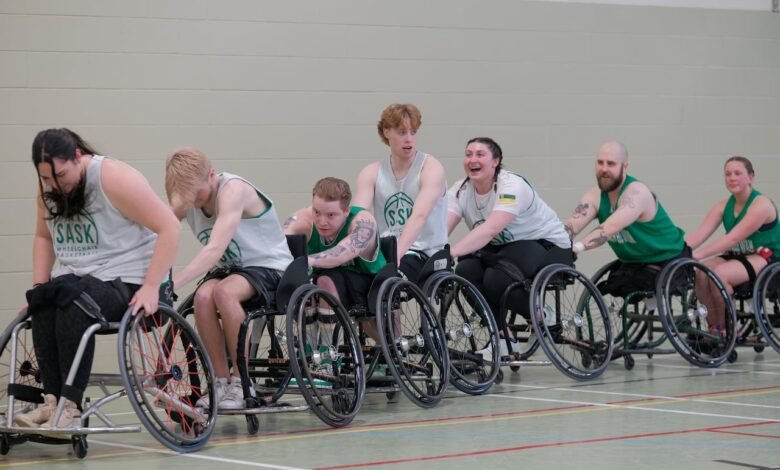
Richard has transitioned from elite athlete to mentor, as the coach of the Regina Paratroopers. The club has provided a competitive and social community for co-ed wheelchair basketball players for more than 20 years.
About half of the players on the team are able-bodied, due to the small population of wheelchair basketball players in Regina.
“I love having the able-bodied athletes in the sports as well,” Richard said. “It’s great interaction between people with disabilities … and just getting used to each other and how we can help each other.”

The Paratroopers just wrapped up the season and will start playing again in the fall. Anyone who wants to get involved, or find out more about any adaptive sports teams across the province, can connect with the Saskatchewan Wheelchair Sports Association.
As a coach, Richard’s philosophy is simple: attitude over everything.
“As long as you have that drive to do what you want, I’ll get you the rest of the way there,” he said. “So I just want to keep developing my own style … and just get better, so I can pass that along to my athletes.”
Source link