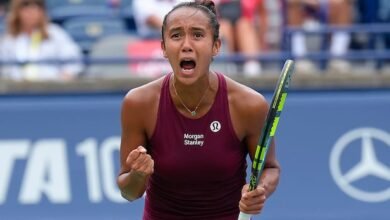
Everything about WNBA star Caitlin Clark is outsized, from financial influence to impact on U.S. culture wars

If you wanted a moment that distilled Caitlin Clark’s current fame in the United States, you could not do better than a basketball practice last month during the WNBA’s All-Star weekend in Chicago.
Clark is the most famous women’s basketball player in America — and often at the epicentre of debates about the positives and negatives of the league — and during a practice session for All-Star players on July 24 at the Obama Presidential Center, a familiar man approached the Indiana Fever point guard to offer some sage advice.
The man’s name was Barack Obama — and a flurry of cameras allowed us to hear a conversation between the former U.S. president and the Fever point guard.
“You’re great. You’re fantastic,” said Obama. “Don’t let all this nonsense get you down. I always say one of the things that was luckiest for me was I didn’t get famous ’til I was like 45. So I was an old-ass man. I mean, you’re my daughter’s age. They’ve not had that much immersion, nonsense. So don’t lose that joy. The game’s like the game. And you’re a hooper.”
“I try,” said Clark.
“No, you’re always a hooper,” responded Obama. “And you’re on a nice little run right now.”
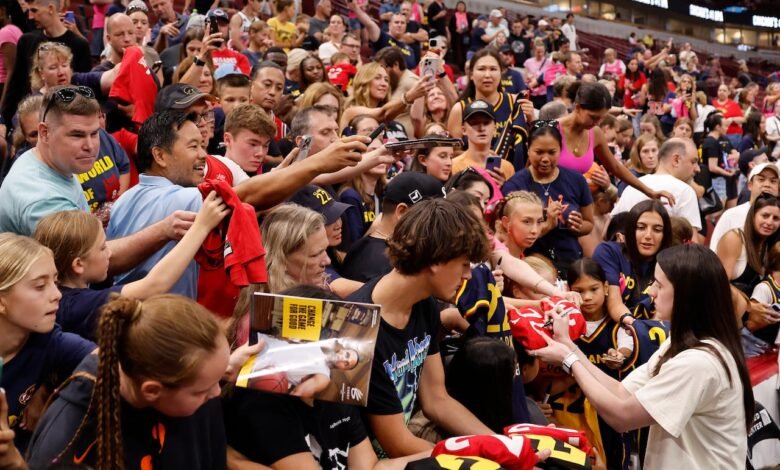
It was an outsized moment, but everything about Clark has been outsized since she entered the WNBA in 2024 — her fame, her otherworldly shooting from distance, her preternatural passing wizardly, her ability to draw television viewers, her being targeted by opposing players, her over-the-top reactions to foul calls, and her consistently being used as an avatar for others to express their politics including elected U.S. politicians. The noise, or nonsense as Obama described it, is never-ending.
If you are not familiar with Caitlin Clark, this would be a good week to get acclimated. The 24-year-old makes her debut on Canadian soil Tuesday night against the struggling 10-23 Toronto Tempo at a nearly sold-out Scotiabank Arena. Why has Clark found such cultural relevancy in the U.S.?
“First and most importantly, she plays a different style of basketball than any women’s player before her,” said Rebecca Lobo, the Naismith Memorial Basketball Hall of Famer who will call the game for U.S.-based ESPN. “We’d never seen anyone consistently take and make 30+ footers in the women’s game. Like Steph Curry, she has unmatched range and starting in her college career had the freedom to take them consistently. Her passing is also unique and exciting. She makes people feel excited when watching her in a way that is different.”

Basketball beginnings
Clark was a top high school prospect out of West Des Moines, Iowa who drew attention from most major U.S. college programs before choosing the University of Iowa. As a junior at Iowa in 2023, she led her school to its first NCAA women’s basketball championship game. Though Iowa lost in a now-famous title game against Angel Reese’s LSU team, Clark’s play attracted significant interest from those who had never watched women’s basketball before. The title game averaged 9.9 million television viewers, shattering the old record by nearly two million viewers.
Clark’s fame truly exploded the following year. With cameras and reporters following her every move, she once again led Iowa to the national championship game. While she did not get her storybook ending, women’s college basketball did when the viewership figures came in.
South Carolina’s win over Iowa in the 2024 NCAA women’s basketball final was seen by an astonishing 18.9 million viewers in the U.S. and peaked at 24.1 million viewers. Clark finished her college career as the NCAA’s all-time leading scorer and was drafted by the Fever with the No. 1 overall pick in the 2024 WNBA draft, winning Rookie of the Year in her debut pro season.
She has battled injuries over the last two seasons — including missing 28 games last year– but looks healthy at the moment, averaging 22 points and 8.3 assists per game for the 23-12 Fever. This season she became the fastest player in WNBA history to reach 1,500 points and 500 assists. Probably the biggest criticism of her game focuses on her on-court comportment and interaction with officials. But to be fair to Clark, WNBA officiating has needed an upgrade for years.
“She’s a top-five player in the game, and still has plenty of room to grow,” Lobo said. “She is more comfortable driving into the lane and initiating contact and also more comfortable getting to her midrange game. She is also an improved defender, although she can still have lapses occasionally on that end.”

Business impact
No singular player has impacted the economics of the WNBA more than Clark. Sportico reported that the 13 WNBA franchises that competed in 2025 are worth an estimated $427 million (all figures US) on average. That’s up 59 per cent over 2024 and 180 per cent over 2023. The expansion fees for the next three franchises to enter the league — Cleveland, Detroit and Philadelphia — went for $250 million in 2025. Just a year previous, the Tempo paid a $50-million franchise fee — now a relative bargain.
The WNBA’s record-setting media deals — totalling $3.1 billion over 11 years — have all occurred over the last three years, matching the Clark era. The league has U.S. media partnerships with Amazon’s Prime Video, Disney’s ABC/ESPN, NBCUniversal’s NBC and Peacock, Paramount’s CBS, Scripps’s ION, USA Sports’ USA Network, and NBA TV while TSN owns the rights in Canada.
All 44 games of the Fever’s games this season are nationally televised in the U.S. which makes everything Clark and her teammates akin to the NFL’s Dallas Cowboys. Per Sports Media Watch: WNBA regular season games were averaging 756,000 viewers through Aug 5, up 15 per cent over last year. The league had 29 games averaging over one million viewers prior to the All-Star break, setting a new record. The eight most-watched WNBA games this season all involve the Fever, including the most-watched game, a July 12th contest between the Las Vegas Aces and Fever that drew 2.64 million viewers on NBC and Peacock in primetime. While Clark is not the best player in the WNBA — that title belongs to Aces centre and four-time MVP A’Ja Wilson — she is a legitimate All-WNBA player and the league’s most recognizable face. To not recognize her staggering economic impact is to not deal in reality.
Caitlin Clark on Alyssa Thomas punching her in the throat:
“It seems like there’s always a moment like that in every season that I’ve played so far. It gets exhausting. It gets frustrating… It was a hard foul and it should have been dealt with in the moment and they should…
Clark as a political avatar
You cannot escape politics in the United States during the Trump Era and Clark has found herself thrust into the endless culture wars. She is an avatar for political motivations far beyond her control and typing her name into a social media outlet often leads to a soufflé of misogyny, racism, toxicity, and homophobia. In July, a group of 11 Republican lawmakers wrote a letter to WNBA commissioner Cathy Englebert saying they were concerned by reports that “attacks against Clark may be racially motivated” following Phoenix Mercury forward Alyssa Thomas receiving a one-game suspension after she made contact with her fist to Clark’s throat in a matchup against Indiana. (Thomas and her family received racist abuse and death threats after the incident.)
It’s important to note Clark herself is far from a polarizing personality. Quite the opposite, in fact. She generally puts on a clinic when it comes to how to perform in the public sphere and has repeatedly called out harassment and hate of WNBA players. She owes no one a public dissertation of her politics, yet she continually faces criticism from disparate ideologies who want her to be more vociferous on issues they care about.
One of women’s basketball most prominent figures — the 12-time NCAA champion UConn coach Geno Auriemma — recently highlighted Clark being used as a vessel in America’s culture wars.
“Because the bandwagon and the fandom became so obsessed with the whole thing, it turned into a cause,” Auriemma said. “She became the reason why white players get beat up in the WNBA and she became the reason why Black players don’t get the endorsements and don’t get the adulation that white players get. … So instead of it becoming Caitlin Clark gets fouled hard … no sh**, every first-round draft pick gets fouled hard. Not every foul is a good foul. Not every foul is a bad foul but there are fouls that are flagrant. But that’s all they are. They are not a referendum on America, which is what the whole goddamn thing has become.”
“She’s never said or done anything controversial, yet some people like to project their agendas onto her,” Lobo added. “ It’s been an unfair burden dumped onto her — she just wants to hoop.”

Welcome to Toronto
In a season that has gone south record-wise since Tempo star guard Brittney Sykes suffered a left plantar fascia non-contact injury in a June 16 loss to the Fever in Indianapolis, Clark playing in Toronto is one of the remaining highlights of the season for Tempo fans. Even with a losing record, the in-game atmosphere has been fantastic and the franchise is in a strong position having smartly positioned themselves as Canada’s team rather than a Toronto team.
Lisa Ferkul, the Tempo’s chief revenue officer, said the goal of the franchise was to be at the top of the WNBA among revenue generation, and the franchise is tracking as one of the highest partnership-revenue-generating teams in the league in its first season. The Tempo opened the season with 17 inaugural sponsors, including Sephora and CIBC, and new partnerships including SiriusXM, Destination Toronto, Lucille’s and MoveU were added as part of the Cross Canada Series (games played in Montreal and Vancouver).
“A few of my former UCLA teammates said Toronto is one of their favourite cities they’ve come to so far,” said Tempo rookie Kiki Rice, the team’s first-round pick in its inaugural draft. “People like coming here. It’s obviously a beautiful place, a lot going on. We have great fans, a great atmosphere, a great arena, and that’s really a special thing regardless of the outcome of the game.”
When Wilson played in Toronto on July 20, she was struck by how many people were wearing her sneakers and jersey.
“It kind of stunned me a little bit, just the love that I received,” Wilson said. “People have my shoes, people have my jerseys. They were screaming my name. This is just the beginning for Toronto when it comes to the women’s game.”
That’s not a surprise to Tempo coach Sandy Brondello, who chose to take the Toronto job in part because of the potential of a franchise representing an entire country.
“Obviously we’ve got a lot of Tempo fans, but I think we have a lot of WNBA fans too,” Brondello said. “You see how they knew [Dallas Wings guard] Paige [Bueckers], Angel [Reese] and A’Ja. I mean, Caitlin hasn’t even come here yet, but that’s going to be crazy.”
Well, she’s here now. Enjoy the show.
Source link