Canada is the underdog vs. Morocco. Balancing the duality of that psychology will determine their fate

The psychology of the underdog is a fascinating one.
Morocco, the sixth-ranked team in the world and a giant of the modern game, should beat Canada on Saturday in the World Cup’s Round of 16. The Moroccans outstrip the Canadians by nearly every measure beyond pure athleticism: They are tactically more fluid and astute, they are brilliant passers, they are technically superior, they are more experienced.
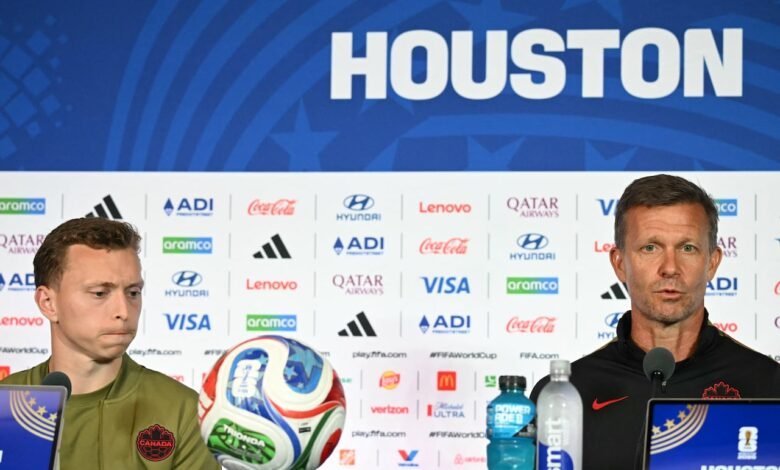
“This is a team that has literally zero weaknesses,” Canada’s head coach Jesse Marsch said at Friday’s packed news conference at Houston Stadium.
The Moroccan media in attendance accused Marsch of overstating the disparity between the two sides, shifting the weight of expectation, the burden of responsibility, even more fully onto the better team.
“No,” Marsch said. “It’s the reality of the situation.”

Morocco were semifinalists at the World Cup in 2022 and finalists at the Africa Cup of Nations in 2025. When they met in Qatar, the Moroccans beat the Canadians 2-1; the goal they conceded, they scored on themselves.
For the 13 men on Canada’s roster who played in that game, the memory of it haunts them like tinnitus.
“It’s going to be loud,” Alistair Johnston, who has been an inspiration this tournament, said when he was asked what that game taught him. “Noises you didn’t even know were possible to be made.”
Marsch, who believes in evaluating teams in the flesh, flew to Monterrey to watch the Moroccans dispatch the mighty Netherlands in the Round of 32. What he felt that incredible night in Mexico made more of an impression than what he saw.
“The confidence that the team had, the swagger they played with, we know we’re in for a massive challenge against a really talented team,” he said.
So, what does Canada do? Given the harshness of Friday’s comparisons — as undeniable as mathematical proofs — what do Marsch’s men tell themselves in the minutes before they play the biggest game of their lives?
“We’ve been pushing so much, we’ve created so much new history, so many firsts,” Johnston said. “We wanted to make sure we got to the point in the tournament where we were going to get to play an actual Goliath, and that’s what this Moroccan team is. It’s about going out there and enjoying it.”
“Stay organized, but go for it,” Marsch said.
I just want to be able to look myself in the mirror after this World Cup and say, You left it all out there.– Alistair Johnston
Canada’s men have already accomplished what, for many, was the best they could hope to do. Italy didn’t even qualify for the tournament. They’ve outlasted Uruguay, Germany, Croatia, and the Netherlands. The 30th-ranked country in the world has made it to the Round of 16. Algeria and Ivory Coast, the teams on either side of it, did not.
Every minute in the sun from here on out is a gift. Of course, it is. Of course.
But there is a danger in that approach, a kind of self-permission to let yourself down easy. Playing without fear of consequence can set underdogs free; it might also see their chance to do something even more special escape their looser grip. There is an elusive, almost mystical balance for them to find, between the tranquility of acceptance and the possibility of resolve.
These remarkable men don’t want to give their proud and happy memories a stain, the sliver of lifelong doubt that comes with what might have been.
They know that, too.

“I just want to be able to look myself in the mirror after this World Cup and say, You left it all out there,” Johnston said. “We’ve proven to ourselves, and we know now, that if we play our football and everyone’s committed to that, we can beat anyone in the world. We also know that if we’re off it, and all it takes is one guy, we can lose to anyone.”
Marsch looked at Johnston and nodded. The Round of 16 is its own universe, governed by its own set of rules. He wants his players to remember what granted them entry to it for the first time.
“This is Morocco,” he said. “This is what they’re good at it. This is what we have to prevent. This is what we have to try to do to be at our best… We make sure we understand exactly who we are, how we want to play, who we want to be, and we execute that at the highest level.”
If Canada’s men do that on Saturday and lose, they will have submitted to the natural order of things. Years from now, they can tell themselves that they ran headlong into their ceiling and a better team.
But that’s not what they should be telling themselves right now.
Right now, they should be imagining what the world will think of them if they win.
Source link