Questions surround how Canada has handled the Alphonso Davies will-he-or-won’t-he-play saga at World Cup

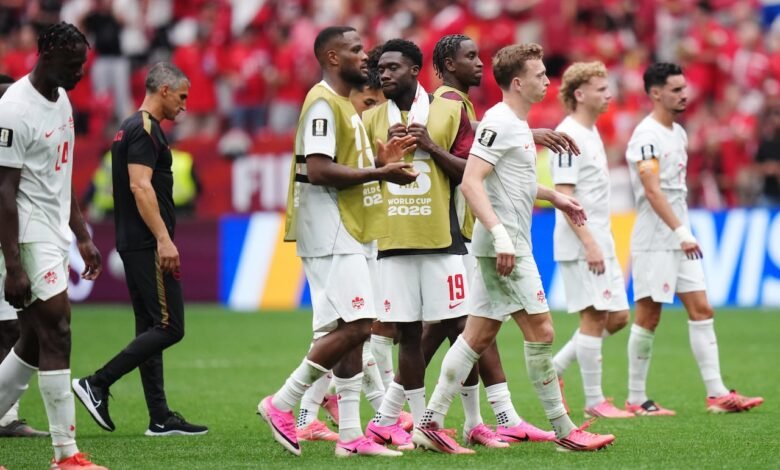
For the second consecutive World Cup, there are questions about Alphonso Davies, arguably the best player Canada has produced, and his contributions to the men’s team. The difference this time around is that he hasn’t played a minute.
Before last Wednesday’s loss to Switzerland, a reporter asked head coach Jesse Marsch what she called “the requisite Alphonso Davies question,” because the star left back’s prolonged return from a series of hamstring and muscle strains has become a major subplot in Canada’s historic campaign.
“He’s trained with the team all week,” Marsch said. “He will not start, but he will be available to play.”
After a narrow 2-1 defeat, Marsch said that he’d lied, using Davies as a “decoy” to waste Swiss time and attention.
Had Canada’s men won or drawn the match, they would have topped their group and made their first World Cup knockout-round appearance in Vancouver next week. Instead, they finished second and have traveled to Los Angeles to meet South Africa in Round of 32 action on Sunday.
Marsch defended his deception the morning after. “This is not a friendly,” he said. “This is competitive. We’re going to do whatever we can as a group to make sure that we can get an edge.”
He also said that Davies had asked to play, and Marsch told him no.
Marsch was asked if that was a difficult decision.

“It’s been easy because we’ve had a plan,” he said. “The only deviation to the plan is how I’ve communicated it with you guys.”
Essentially, Marsch suggested he’d been lying to reporters, and so to fans, about Davies and his status for some time, and had no intention of playing him before the elimination games.
“He’s excited to see the guys again, and he’ll be ready,” Marsch said after he’d included Davies on his 26-man roster at the end of May. “That part is the best part.”
Davies, Canada’s captain, tore his ACL with the national team in March 2025 and hasn’t played for it since. He returned to play with Bayern Munich, his club side, in December, but he suffered three muscle and hamstring strains in short order, the latest on May 6.
The timeline for his return was set at four to six weeks, in time for some of the group stage and perhaps all of it.
In 2022, Davies scored Canada’s first men’s World Cup goal in a 4-1 loss to Croatia. He also missed a penalty he shouldn’t have taken in a loss to Belgium and played a maddening brand of hero ball in another loss to Morocco.

Canadians finish second in Group B at the FIFA World Cup 2026 after falling 2-1 to Switzerland in their final group game at BC Place. Soccer North hosts Anastasia Bucsis and Amy Walsh break down all the actions with Inter Toronto coach Mauro Eustáquio.
He remains a remarkable talent, and Marsch had waited to the last moment to submit his roster, finally deciding that Davies’s potential impact outweighed the lower-ceilinged certainty provided by Ralph Priso and Zorhan Bassong. They were cut after attending Canada’s pre-tournament training camp in Charlotte.
Davies had skipped it to continue his treatment in Munich. (“We need to get Alphonso here,” Marsch said at the time, a little impatiently.)
Davies joined the team for Canada’s final two friendlies but did not play in either. Marsch eventually conceded that he wouldn’t be ready for the opener against Bosnia-Herzegovina on June 12.
Marsch did offer significant hope in the form of an MRI taken two days earlier. It showed that Davies was “healing incredibly well, almost completely,” he said.
Rather than rely on Canada Soccer’s medical staff, Davies has continued his recovery under the watchful eye of Matthias Blankenburg, a personal trainer he’s imported from Germany. Blankenburg has worn Canada’s colours at training and is allegedly independent, but it seems unlikely that Davies hired him without Bayern’s approval, if not influence.

When Davies tore his ACL, he was only weeks into a massive new contract with the German giants, worth about $190 million Cdn. Club executives threatened to sue Canada Soccer, and Nedal Huoseh, Davies’s agent, accused Marsch of pressuring his client to play when he “was not 100 per cent.”
Cooler heads prevailed, but Bayern reportedly put considerable pressure on Davies to take this summer off to cement his recovery, with club sources whispering to German tabloids that they might sell Davies rather than risk keeping a depreciating asset.
On Friday, the club reached an agreement to sign Nathaniel Brown, Germany’s emergent 23-year-old left back, from Eintracht Frankfurt for about $90 million. Bayern was apparently serious about its not-so-veiled threats to Davies, who must be suffering under the burden of an unwinnable choice between club and country, even while Marsch claims the choice is his.
Before Canada’s second match against Qatar on June 18 — a day after Davies’s six-week recovery window had closed — Marsch said for the first time that he was available. “We’ll see how the match goes and make a decision as to how we will choose to use him,” he said.
The game turned into a 6-0 rout, and Davies did not feature. That made sense: Why risk playing Davies in a game that had already been decided?
The Switzerland game was different.
Marsch has built a reputation for radical honesty, at least by soccer’s measures, and when he said Davies was again available, many took him at his word. It helped that Davies looked healthy in training, running freely and leathering balls into the net.
The game’s dying minutes also seemed like the perfect opportunity for Davies to reassert his influence. Canada had trailed 2-0, but Promise David scored a gorgeous goal in the 76th minute to put a fate-turning draw within reach.
Davies did not play because he had not reached the required fitness benchmarks, Marsch said, without specifying who required them.
“However, he will be ready” for the game against South Africa, Marsch also said.
That could be more gamesmanship, of course, to use a kinder word for it.
If it’s not, and Davies is fit enough to play Sunday, it will raise a “requisite” question: Then why wasn’t he fit enough to play two days ago in another game that mattered, especially to the tens of thousands of fans with tickets in Vancouver?
If he stays on the bench — if he’s not ready to play in the first knockout game in the history of the country that he captains — it will raise another: Why is he on the team at all?
Source link