How identical relay silver medals mean different things for Canada’s men and women and the L.A. Olympics

What’s the difference between a silver medal and a silver medal?
For Canada’s 4×100-metre relay teams at the Commonwealth Games, it’s expectations.
The women’s squad arrived in Glasgow the second-fastest seed time, trailing only Jamaica. In Saturday night’s final, anchor runner Audrey Leduc crossed the line second, trailing only — you guessed it — Jamaica. A surprise win over the pre-race favourites would qualify as an upset and a bonus, but a silver medal still equals success.
But the men’s team entered Commonwealth with the fastest seed time in the field, and the 37.56-second clocking they ran to win silver at World Relays in May remains the second best relay result on the planet this year. Only the U.S. outran them at World Relays, and the Americans weren’t in Glasgow. If Canada performed as expected, every other team should have been jockeying for second behind them.
So why does the men’s silver medal feel like a triumph, too?
Perspective.

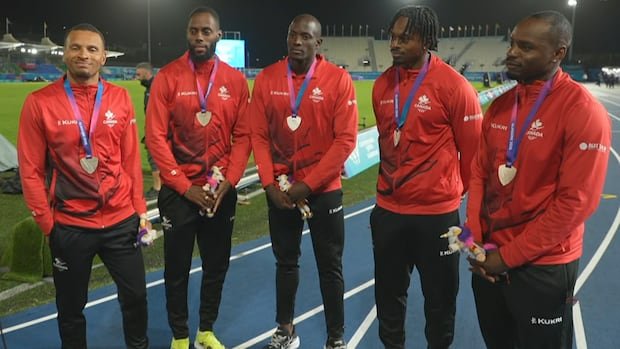
Aaron Brown, Jerome Blake, Brendon Rodney, Duan Asemota and Andre De Grasse describe the stressful appeal process of confirming their silver medal.
Anchor runner Andre De Grasse crossed the finish line second, but Canada was quickly DQ’d when a video review seemed to reveal that leadoff runner Aaron Brown had stepped on the line marking the inside of his lane. Suddenly Canada faced the prospect of entering the Commonwealth Games as favourites and leaving empty-handed, and of pondering how the most experienced sprint relay quartet on earth had failed such a basic test.
But then came the auxiliary footage, a camera angle showing that Brown had, indeed, stayed in his lane, and illustrating the thinness of the margin between hugging a curve and cutting a corner. The first one is a veteran move, the second a rookie mistake in a race where every centimetre matters. Officials reinstated Canada’s result, placing them .01 seconds ahead of third-place Nigeria, and .02 away from missing the medals altogether.
And suddenly Canada hadn’t lost a gold medal. It won silver, because video vindicated them. Without that drama, we could rightfully view them as settling for second in a competition where their previous performances made them favourites to finish first. Their 38.11 clocking trailed their silver-medal run at World Relays by more than half a second.
So turning a DQ into a silver medal is a triumph, but the result, coming at the halfway point between Paris 2024 and LA28, raises questions about the future of Canada’s 4×100-metre team.

Frederique Chiasson, Audrey Leduc, Marie-Eloise Leclair and Sade McCreath talk about their silver medal run and what’s in store for the future.
Brown, De Grasse, Jerome Blake and Brendon Rodney brought home yet another medal, but as time advances how many more times can this familiar foursome reach the podium?
How does Team Canada braintrust integrate younger talent to smooth out the program’s transition to its post-LA28 future?
And after losing to an Australian team that featured breakout star Lachlan Kennedy running leadoff, where might team Canada find a similar infusion of raw speed?
We’ll tackle that last question first, since Kennedy lopped more than a tenth of a second off his personal best at Commonwealth, winning 100-metre silver in 9.85 seconds. Suddenly, team Australia is 1.5 metres faster than last year, before they’ve even passed the baton. By the first exchange, everyone else in the commonwealth faced a deficit.

A video essay narrated by CBC Sports’ Devin Heroux on the best moments of the 2026 Commonwealth Games.
For perspective, Kennedy’s 9.85 ties him for fifth on the world list this season. He’s faster than every Canadian in history besides Donovan Bailey and Bruny Surin, who share the 9.84-second national record, and more than half a metre ahead of any Canuck currently running.
Meanwhile, all four members of Canada’s top-line relay team are on the far side of 30. Doesn’t mean a Kennedy-style breakthrough is impossible — Commonwealth champ Emmanuel Eseme ran 9.83 at age 32 — but it looks less likely with each passing year.
Earlier this summer, Canada’s Eliezer Adjibi showed tantalizing promise, running 9.92 at a meet in Colombia. But a freak arm injury slowed him in Glasgow, so we won’t know how much faster he could have run this year, or how he might have strengthened the relay team at Commonwealth.
If he were a tenth faster maybe there’s nothing to discuss. If you have a legit 9.8 sprinter who wants to run the relay, he runs and you make the rest of the pieces fit. We just don’t know if Canada, which has produced three legal sub-9.9 sprinters in its history, has another one set to emerge.
Of course, elite performers don’t always warn us they’re coming. In 2014, De Grasse was a debutant with Canada’s senior 4×100 team, anchoring a unit that DQ’d in the Commonwealth final. By the following summer he had become a cornerstone on a relay team that won Pan Am Games gold and World Championship bronze. Maybe some other Canadian is on the brink of a similar quantum leap.

Relive all of the most magical moments for Team Canada and the rest of the competitors at the 2026 Commonwealth Games.
But until that happens, we’re looking at a men’s 4×100 team that will enter L.A. with an average age of 34.2, its youngest member, Jerome Blake, just weeks from turning 33.
That’s not ideal in a sport where most athletes peak in their 20s.
Here’s where a member of Team Glass Half-Full would point out, correctly, that in world-class relay running, continuity is king and queen. Team Canada has it, and many other teams don’t. That’s why the U.S. produces more 9.8 guys each year than Canada, yet still has a sketchy record in relay finals. The best relay teams are ensemble casts, but U.S. men’s relay pools are full of main characters who often struggle to share the spotlight, the baton, and accountability.
On the women’s side, Canada can tinker with lineups and experiment with orders without drawing scrutiny from a sports fanosphere that has grown to expect podium finishes at world finals. Over the past three seasons, Leduc, Sade McCreath and Marie Eloise Leclair have emerged as constants, with a rotating cast of supporting players in the fourth spot. They make world level finals, and win medals at events like Commonwealth, but never labour under the weight of public expectation.
But the men’s team has two years to figure out how to add depth without damaging chemistry that propelled them to gold in Paris two summers ago, and world-championship silver last year. Otherwise they’ll enter LA28 fielding a team of sprinters in their mid 30s, facing a series of formidable opponents.
The fastest relay teams in the world.
The stopwatch.
Their biological clocks.
Source link