As much as FIFA stood to make on Infantino’s ill-fated World Cup selloff, the backlash would cost even more

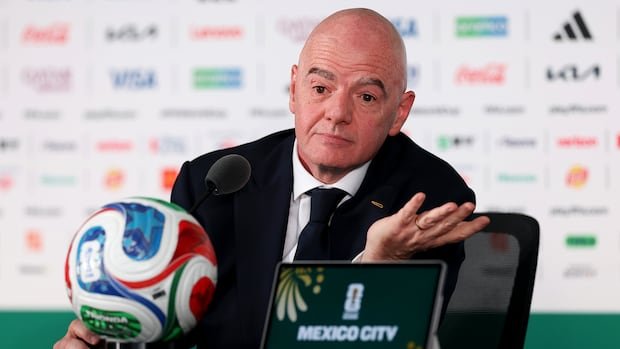
If Gianni Infantino’s plan to sell a 20 per cent stake in the World Cup was a surprise, the scheme’s rapid collapse is the opposite of a shock.
To recap, the FIFA boss didn’t even tell his deputies that he had secured a tentative deal with a private equity firm named Thrive, under which the investors would send the soccer governing body $4.2 billion (all figures US) in exchange for part ownership of the world’s biggest sports event. They found out a week ago, the way the rest of us did, either via a smart phone alert or coming across the development on their sports news website of their choice. In response to the arrangement, FIFA adviser Carlos Cordeiro quit his job.
Infantino, who took charge of FIFA in 2016, could always recruit new executives, but he couldn’t get UEFA on board with the private equity deal. The confederation, which comprises 55 nations, vowed to boycott future FIFA events. Other objectors included CONCACAF, home to Canada, Mexico and the U.S., and the Asian football confederation, together which total 98 nations. Those major blocs joined soccer commentators and everyday fans in making plain their disgust at the proposed sell-off.
Late last Friday, there went Infantino, backing down from his plan, and now scrambling to keep his job while disgruntled FIFA member federations look to unseat him.

FIFA president Gianni Infantino’s plan to sell stakes in future World Cups to private investors is dead after furious backlash, most notably from Europe’s powerful soccer body, UEFA.
The eventual flip-flop wasn’t predictable because the arc of the sport’s industry’s moral universe curves toward justice, but because it always bends in the direction of money. If the idea of serving fans and federations can’t prompt FIFA to do the right thing, the prospect of losing a fortune is a powerful reality check.
We don’t know exactly how the proposed private equity investment would have affected future World Cup tournaments, but it’s easy, and not unreasonable, to envision the worst.
If Thrive had the inside track on the FIFA deal because it’s headed by Joshua Kushner, whose brother, Jared is married to the daughter of U.S. President and Infantino ally Donald Trump, we can assume it was more than a coincidence. But we know for sure that if a private equity firm dumps more than $4 billion into FIFA’s piggy bank, they expect to some multiple of that number when they put the hammer to it. Otherwise they’re not investors. They’re charitable donors.
Private equity firms have a well-worn playbook for wringing revenue from companies they acquire, and one strategy involves selling off assets, like buildings and the land on which they stand. Except FIFA doesn’t own the stadiums that host World Cup matches, so let’s skip that page.
What FIFA does have is a long list of commercial partners that pay for the privilege of doing official World Cup business. Sponsors, broadcasters, equipment providers — they all might have to brace for a price hike anyway, but they’d have to pay even more to satisfy a part-owner looking to profit on a 10-figure investment.
As for fans?

They’re already paying more than ever for World Cup tickets. A seat at the final cost anywhere from $8,000 to $2 million. And if you’re one of those unlucky customers who paid for premium seats early on, only to learn FIFA had displaced you in favour of wealthier spectators later, then you’ve had a taste of what the World Cup’s new co-proprietors might have been planning for 2030 and beyond.
So, of course, backlash to FIFA’s plan came quickly.
Whether Infantino changed course out of sensitivity to everyday fans and their overburdened budgets is questionable. But threatened boycotts by UEFA, and more opposition from other bodies changed that calculus.
Infantino has stated publicly that he hopes to expand the World Cup to 64 teams from its current 48. Under normal circumstances, choosing that many quality squads from among FIFA’s 211 member nations is challenging, but possible. Finding that many teams worth watching from a pool of fewer than 100 candidates is a vastly different challenge. Europe, North America and Asia all opting out would have left FIFA with 58 teams, making a full World Cup field impossible without employing MLB spring training-style split squads.
Plus, the missing teams aren’t randomly distributed. FIFA’s private equity partnership would have eliminated nations like England, France and Germany – name-brand programs whose supporters travel in big numbers, buying the overpriced tickets organizers were set to sell. And the superstars who prompt drive-by fans to watch on TV or consume highlights on social media? The Mbappés and Belllinghams and Haalunds? All absent from the World Cup, featuring 64 teams from 58 countries, after boycotts prompted by FIFA’s romance with private equity.
Are you building your schedule around a group-stage match between The Cook Islands and Argentina II?
Neither am I.

It’s tough to put words to the effect a UEFA boycott, the resulting dearth of star power, would have on the World Cup’s commercial value, and its ability to generate returns for deep-pocketed investors.
Tarnish?
Not even close. We need something stronger.
If “tank” doesn’t capture it, maybe “torpedo” does.
So, inevitably, Infantino backed down.
“Having listened carefully to all the views, it has become clear that the project has created divisions of a nature that, regardless of the level of support, are no longer in the interest of the objective set out in the first place,” Infantino is quoted as saying in a statement issued last Friday. “Our purpose has always been — and will always be — to unite and improve. As a result, this proposal will not proceed.”
Note that he didn’t apologize for the initial plan, or the turmoil it caused. Peer between the lines and can almost see him blaming the rest of the soccer world for not recognizing his proposal’s brilliance.
Either way, it’s done.
FIFA might have changed course because it’s the right thing to do, or because member federations threatened to revolt. And maybe the people writing cheques figured out that they were better off spending their $4.2 billion on bored ape NFTs from 2021 than on a World Cup that’s simultaneously expanded and downsized, with precious few superstars to keep the world’s attention focused on the field.
We just know that the possibility of private equity cash has vanished, and if FIFA wants to improve on the record $15 billion in revenue the 2026 World Cup generated, the governing body will have to get creative. Maybe it could focus on delivering value to partners and spectators, instead of squeezing it from them, but that thought, for FIFA, might seem even more radical than selling a stake in the tournament.
Source link