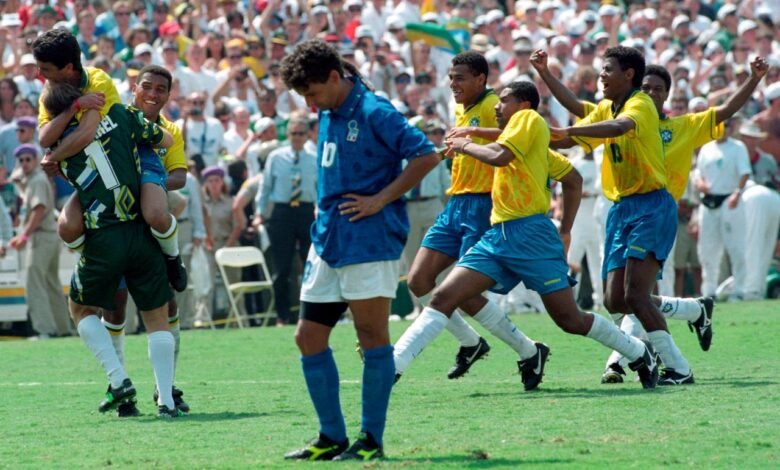
One ball. One player to kick it, another to try to stop it crossing a line 12 yards away.
The penalty kick in soccer is so simple. Yet, as one way of deciding the outcome of some of the world’s biggest sporting events, it can be the difference between glory and failure.
As we enter the knockout rounds of another FIFA World Cup, the spectre of the penalty shootout tiebreaker hovers over every match — including Sunday’s Round of 32 game between Canada and South Africa.
For the uninitiated, if a knockout game finishes in a draw after the regulation 90 minutes and a subsequent 30 minutes of extra time, five penalty kicks are given to each team. The team that scores the most wins.
This test of nerve in front of potentially hundreds of millions of spectators around the world can provide some of the most excruciating moments of tension sports has to offer.
In doing so, penalty shootouts have created heroes — usually the goalkeepers who make crucial saves like Argentina’s Emiliano Martínez in the 2022 World Cup final — and also tragic losers: the image of Italy’s Roberto Baggio staring hopelessly at the ground after missing the decisive penalty in the 1994 World Cup final could have been sculpted by Michelangelo as the archetype of a fallen idol.

With so much at stake from such a simple game within a game, it’s understandable that the science of penalty kicks has attracted an enormous amount of research. But when it comes to the intense pressure of the shootout, is the search for the perfect penalty in vain?
“It is loading a bullet into the chamber of a gun and asking everyone to pull the trigger,” 1998 World Cup-winning French midfielder Christian Karembeu once said of the penalty shootout. “Someone will get the bullet, you know that. And it will reduce them to nothing.”
Others in the sport agree it’s a game of chance, “always a lottery,” according to former Brazil and Portugal coach Luiz Felipe Scolari. Even Joachim Löw, the 2014 World Cup-winning coach of Germany — a country whose players are renowned for their penalty-taking prowess — once said, “I don’t think there’s any way you can prepare for penalties.”

Canada finished second in its 2026 FIFA World Cup group following a 2-1 loss to Switzerland. Players were back on the pitch Thursday as they prepare to face South Africa in the Canadian men’s first-ever World Cup knockout match.
Statistical insights
The shootout tiebreaker first appeared in soccer in the late 1970s — before then, games were settled by the drawing of lots or a coin toss — and made its World Cup debut in 1982. Since then, it has evolved into an integral part of soccer subject to intense study by players, coaches and academics in a bid to find the perfect shot from the spot.
One recent analysis by sports statistics firm Opta looked at the 292 penalties taken in shootouts at the World Cup since 1982. It shows a majority of players (14 per cent) aimed their kicks low and to their left side of the goal, and just over 85 per cent of those penalties were converted.
For an apparently 100-per-cent guaranteed successful penalty, the Opta stats suggest aiming anywhere in the top third of the goal. This, however, requires more skill and precision and increases the risk of hitting the post or crossbar, or missing the goal completely.
The least successful penalties are aimed at medium height at the centre of the goal, the Opta stats suggest.

The stats can go even more granular: accuracy should be prioritized over power, and the penalty taker’s run-up should ideally be more than five steps at a medium pace, according to 2018 InStat findings compiled from more than 100,000 penalty kicks around the world. Looking at the goalkeeper, not the ball, when taking the penalty also helps, it says.
Other studies claim to have found the perfect order for a team’s roster of penalty takers in a shootout: the most five successful penalty takers in reverse order.
Mental preparation is key, prof says
While statistics can give players and coaches guidelines on the optimal penalty kick, the big wild card here is psychology — how individual players deal with the pressure of knowing they have the fate of their team, their supporters and potentially the mood of a nation literally at their feet.
But that, too, can be prepared for, says sports psychologist Prof. Mark Wilson, head of the public health and sports sciences department at the University of Exeter in England.
He says he’s amazed by how many soccer teams still appear to leave the penalty shootout to chance when there’s a clear opportunity for players, and the wider team, to control the moment.
“You don’t have any given right to be successful. But my view is, work on the things that make it more likely that you’re going to do well. I always talk about giving yourself the best chance for performance,” said Wilson, who has worked on mental preparation with soccer players and other athletes including mixed martial arts fighters.
When it comes to the high-pressure act of taking a penalty, players can prep a routine, Wilson says. They can visualize the moment ahead of time; choose what words they will say or think to themselves as they walk from the centre circle to the penalty spot; control their breathing so they keep their heart rate in check; take their time after the referee blows their whistle to start their run-up to the kick.
As she stepped up to take what would be a gold-medal-winning penalty kick for the Canadian women’s national team in the 2021 Olympics, Julia Grosso recalled thinking, “I’ve just got to be calm and think of it as a game, not get myself nervous … just go on there and do what I do best,” in an interview soon after the match.
Wilson says more players, like Grosso, should learn to embrace what he calls the “privilege of pressure” — intense, knife-edge moments in sports are what many athletes dream of living from an early age.
He says players should be focusing on the opportunity and thinking about things like: “Yeah, I’m anxious, but I’m anxious because I want to do well.… I would rather nobody else but me. I feel prepared. I’m skillful enough. I can do this.'”

On a team level, every player should be prepared to take a penalty, Wilson says, but also be prepared to to support their teammates whether it’s a successful penalty or a player who’s walking back to the team after missing.
“Send somebody out, bring them back. That’s a long walk [to the penalty spot],” he said. “It’s a longer walk back if you’ve missed.”
Despite the known psychological approaches to coping, Wilson says he still sees disorganization among some teams when penalty-takers for the shootout must be chosen at the end of extra time — for example, coaches scrambling and pointing at players, players appearing disconnected from the team, and no one controlling the “emotional energy” of the moment.
“We know that as human beings we like to have control, and if we’ve got control, we take away a bit of anxiety. So the thought of giving that up, to me, was always crazy,” Wilson says.
Control or none, with so many variables at play, many see the penalty shootout as a cruel way to decide the outcome of such high-stakes matches.
But perhaps legendary French defender Laurent Blanc, a World Cup winner in 1998, said it best: “Penalties are awful, unfair … but what else is there?”
Source link