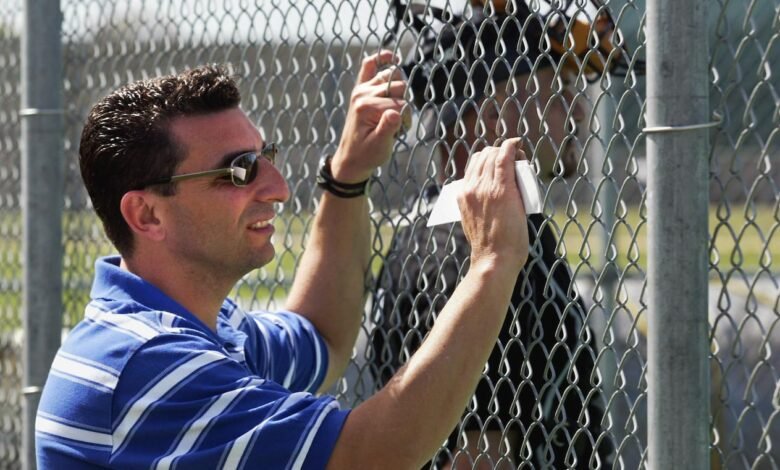
Major League Baseball’s collective agreement is set to expire at the end of the season, and J.P. Ricciardi sees storm clouds on the horizon.
“I think we’re really in uncharted waters,” said the former Blue Jays general manager and current analyst for the New England Sports Network, weighing in on the tensions emerging as team owners push to establish a salary cap in the sport.
“This has the potential to be one of the worst strikes in baseball history.”

The contentious proposal has the league’s owners and its players’ union at odds, so much so that Ricciardi and other observers are expecting a lockout when the season is over.
Here’s a look at what’s happened so far and what it all means for the Blue Jays.
Why is this happening now?
MLB’s current bargaining agreement expires on Dec. 1. It began in 2022, with the two sides reaching a deal after a 99-day lockout that delayed the start of that season.
That five-year agreement notably brought designated hitters to the National League on a full-time basis and expanded the number of teams that play in the post-season.
But that was then, with the two sides now jostling over what the next labour deal should look like.

Vancouver City Council has approved a motion to explore a bid for a Major League Baseball expansion team. But some sports experts say getting — and keeping — an MLB team would not be easy for a city with limited funds and space.
Salary cap showdown
The union, the Major League Baseball Players Association (MLBPA), wants higher minimum salaries for major leaguers and more revenue sharing to help small-market teams, among other proposals it has publicly disclosed.
MLB and its franchise owners want a salary cap of $245.3 million US — meaning teams couldn’t spend more than that on players in a given season — and a corresponding payroll floor that would require clubs to spend at least $171.2 million. The owners say this will level the competition, so deep-pocketed teams can’t trounce their lower-spending counterparts.
The players reject that approach, and they’re not very receptive to management’s starting point in the negotiations either.
“I thought [the MLB owners] offer was going to be a lot better than what it was,” said Chris Bassitt when discussing the proposal on Sportsnet’s JD Bunkis Podcast. The former Jays pitcher, now with the Baltimore Orioles, is a member of the MLBPA’s executive subcommittee.
“I think the very first proposal, I truly think you can take them and throw them in the trash,” he said. “I just don’t like that, because why are we starting so far apart already?
“Yes, there are deficiencies in the system, yes, we need to fix some things, but let’s work together to fix these things, rather than asking for Pluto and we’re on the opposite side of the spectrum.”
The MLBPA has vowed to fight any effort to bring a cap forward.
Why do players oppose a cap?
David Aardsma, a retired big-league pitcher who served as a player rep during his career, says a salary cap limits what players can earn and prevents them from being paid “what they’re worth” on the open market.

That’s a long-held stance for the players and their union.
“A salary cap is, and has always been, a hard stop with players,” said Jacob Turner, a retired pitcher who now works as a financial planner for pro athletes.
Turner says MLB players see the sport riding high right now amid solid attendance and an exciting on-field product for fans. But that doesn’t mean they lack the will to fight a salary cap.

Players are keenly aware of what their predecessors won for them in prior contracts, he says, and that underscores their resolve to stand together on labour issues.
“It is a very united front and it’s always been that way,” said Turner, who also points out the MLBPA has amassed “an incredible war chest” to support members if a lockout occurs.

The 1994 Montreal Expos are the best team in baseball. But a strike ruins everything.
Wasn’t this an issue in the ’90s?
Yes. The owners tried to make a salary cap happen in 1994.
But an ensuing strike eventually scrapped the season (and the World Series) and claimed a small part of the 1995 season, too.
MLB Commissioner Rob Manfred — a junior lawyer on the owners’ negotiating team back then — was recently asked if he has concerns that a similar situation could unfold this time around.

“Of course I do,” said Manfred, who would not say if management believed a work stoppage would be worth it to get a cap in place.
“I’m not going to speculate about work stoppages,” he said.
“I think that the proposal we’ve made is grounds for constructive dialogue and back and forth with the MLBPA about how we can address the number one concern of our fans and that is a lack of competitive balance in the game.”

Aardsma was a teenager when the mid-’90s strike wrapped.
“As a fan, it was miserable,” said Aardsma, who previously worked for the Jays after his playing career ended, adding: “We don’t want that” to happen again.
Is a cap a problem for Toronto?
Toronto spent big in the off-season to bring in some new talent in hopes of giving the Blue Jays another shot at winning it all.
That spending spree added to the team’s already robust payroll, making it one of the highest in baseball on opening day this year and well above the cap being proposed.

So, if the team’s current spending levels hold and the Jays maintain a payroll above a cap, the organization would have to bring that down somehow, whether that means unloading burdensome contracts, making payroll-slashing trades or relying more on players under club control.
However, the owners have said all current contracts would be guaranteed if a cap was introduced. They’ve also suggested a “phase-in schedule” to adjust to cap requirements.
Ricciardi says teams would likely need several seasons to have time to adapt.
“I still don’t see a cap happening,” he said, pointing to the fact that the league has never had a cap and that it would be hard to convince players to accept limitations on what they can earn.
What about Toronto’s contracts?
This year, starting pitcher Kevin Gausman and designated hitter George Springer have deals that expire at the end of the season. Pitcher Shane Bieber and outfielder Daulton Varsho will become free agents as well.

On the flip-side, two Jays players currently under contract have hefty, long-term, nine-digit total payouts coming: franchise star Vladimir Guerrero Jr., whose 14-season contract extension totals $500 million, and pitcher Dylan Cease, who’s just begun a seven-year, $210-million deal.
Two other players are owed more than $20 million annually in the immediate future: Pitcher José Berríos, who’s under contract through 2028, and Andrés Giménez whose deal stretches through 2029.
What about other big spenders?
The Associated Press has reported that eight of MLB’s 30 teams had opening day payrolls exceeding the proposed cap.
They include the free-spending, but struggling New York Mets; the defending champion Los Angeles Dodgers; and the Jays’ division rivals, the New York Yankees.

These marquee teams, including the Jays, have many superstars on their rosters, including some of the highest-paid players in the game.
“Those guys are still going to get paid,” said Ricciardi — both in terms of the contracts they’ve already inked, and in the sense that they would likely remain top-tier talent, even under a cap.
What about lower-spending teams?
Twelve MLB teams started the season below the payroll floor the owners are proposing that would force them to spend more.
Ricciardi thinks the concept could incentivize teams to offer inflated contracts to less-skilled players just to meet minimum spending requirements.
That, he says, would be like “Coca-Cola paying the drivers as much as the executives.”
Source link