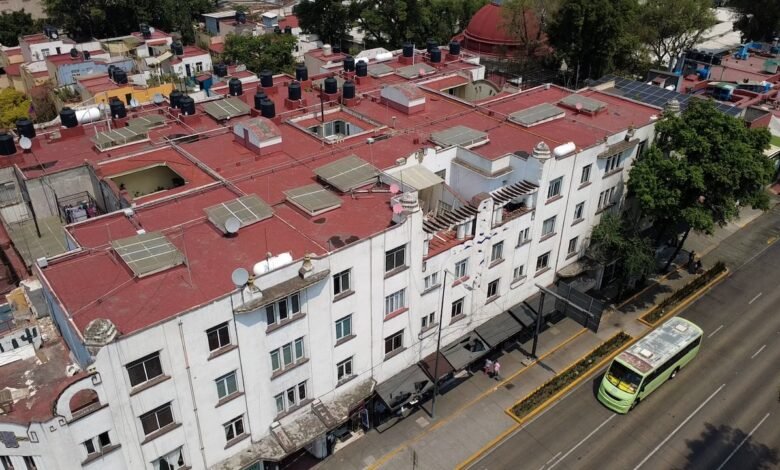
L.M. says she could get kicked out at any time from her apartment inside an art deco building complex in Mexico City’s Tacubaya neighbourhood, one of the new frontlines in the ongoing battles over gentrification.
She moved to Mexico City from the city of Puebla, about 135 kilometres to the east, and found a townhouse where one of the roommates has held the rental contract for the past 16 years.
Then, this past December, the building’s ownership — which is turning spacious townhouses and apartments in the complex into multiple units for the short-term rental market — sent an email saying the year-to-year contract would not be renewed.
Now L.M. and her roommates, who continue to pay the monthly rent, live under constant fear they could be forced out at any time.
“It’s difficult and obviously it is a risk to keep going in this situation,” said L.M.
“There is no protection.”
CBC News agreed to identify L.M by her initials because she fears being blacklisted by prospective landlords, who often Google the names of prospective tenants. Mexico City landlords have denied rental applications from people linked to activism around evictions and gentrification issues, she said.

Tenants say short-term rentals are pushing them out
L.M.’s case reflects increasing pressure from gentrification in Mexico City, where advocates say landlords are pushing tenants out to convert long-term homes into short-term rentals. The pressure has grown since the pandemic, when digital nomads flocked to the city, and advocates say the looming FIFA World Cup is adding new incentive for owners hoping to profit from tourist demand.
Mexico is co-hosting the tournament with Canada and the U.S.
Maria Silvia Emanuelli, with International Habitat Coalition, an international housing rights non-profit, said there is no data yet available to gauge the specific impact of the World Cup on rent prices, the rate of evictions and broader gentrification trends.
However, Emanuelli said her organization has received frequent complaints from people who say they’ve been evicted because landlords want to use their units to cash in on lucrative short-term rental demand expected during the World Cup.
“Owners are even ending year-long contracts before they expire because they prefer to offer this home during the World Cup to tourists who will pay much more,” said Emanuelli.
“What we are seeing are what we call indirect evictions, or evictions that are not court-ordered, but invisible.”

The organization’s data shows that every 48 hours in Mexico City, three rental units are taken off the general market and turned into short-term rentals.
The group has also released findings showing that the district accounting for nearly half of the 27,000 available Mexico City units on AirBnB has also seen 82 forced evictions between 2015 and 2025.
That district, Cuauhtémoc, is home to the highly gentrified neighbourhoods of Condesa, Roma and Juarez, which make up about 46 per cent of units available on the short-term rental platform, according to the coalition’s data.
Gentrification spreads beyond tourist zones
Rental units in L.M.’s neighbourhood of Tacubaya are starting to be advertised as being in “Condesa South,” according to local residents. While the area is close, it sits in a completely different district.
“There’s a housing crisis. This is a city with a lot of inequality” said Adriana Enriquez, a Mexico City public policy and urban development consultant.
Enriquez says tourists and the influx of digital nomads only account for some of the factors driving gentrification. Other factors include the flow of people from other parts of the country seeking employment and city developers who operate with little restraint.
As rents rise in the city’s central neighbourhoods, more people are forced to the periphery, where prices are cheaper but public transportation is often strained or unreliable.
“We are expelling the poor,” Enriquez said.
“We are not improving conditions, we are transforming Mexico City and only allowing those who can pay to stay.”

Tenants push back against renovations
L.M. and her neighbours in the 67-unit apartment complex started fighting back after seven families were forced out and 15 units went under renovation over the past four months. They filed a complaint with the city to stop ongoing renovations, and an inspection revealed the work was being done without proper permits.
One of L.M.’s neighbours told CBC News that the building’s ownership, a designated non-profit foundation, was using the construction work, which continued throughout the night, along with unexpected rent increases, to force people out.
“This is what we are calling … silent evictions,” the neighbour said.
“What’s happening here is that they’ve been, over months, slowly making life more difficult for residents so that we eventually have no option but to leave.”
CBC News agreed not to identify the neighbour, who currently has an existing rental contract and feared the building’s ownership would claim the criticism was a violation of the agreement.
“We are all in the same boat of being vulnerable to whatever they decide,” he said.
“That’s why I’m also joining the cause regardless of what my specific outcome could be.”
The Mier and Pesado Foundation, which owns the building, declined a request for comment.

Mexico City Mayor Clara Brugada recently said that more than two million people rent in Mexico City and that rental rates increased by 30 per cent between 2019 and 2023. She said about 500,000 people in the city faced eviction in 2020.
Brugada tabled a new law in late April to expand social housing, tighten rent cap rules, and create the Office for the Defence of Tenants’ Rights to provide recommendations, mediation and ensure compliance with laws.
The city has already passed laws tying rent increases to the rate of inflation and limiting the amount a rental unit can be offered on a short-term rental platform to 180 days a year.
But none of those rules are being followed, said Enriquez.
“You have to move forward at the very least with the law, with what is already in the law,” she said.
“If nothing happens, then turn up the pressure.”
Source link