After more than 100 matches across Canada, Mexico and the United States, the FIFA World Cup 2026 is about to come to an end, cementing its legacy with highs, lows — and seemingly endless controversies.
“It’s been one of the most controversial World Cups. I think that’s fair to say,” said Alan McDougall, professor of history at the University of Guelph who’s written multiple books about soccer’s history. “I don’t feel that it’s breaking the mould, but the debates around it are more widespread and more intense.”
Several controversies have indeed overshadowed the tournament’s high points, with experts saying FIFA, known for blatant corruption in the past, is making it difficult for fans to trust the sport.
Several decisions have inspired frustration on and off the pitch, including travel bans in the U.S. that made it difficult for many fans and some players to attend games, exorbitant ticket prices, hydration breaks and seemingly inconsistent use of the video assisted referee, known as VAR.
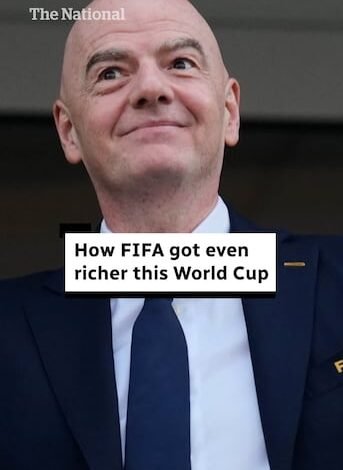
Then, there’s FIFA president Gianni Infantino’s relationship with U.S. President Donald Trump.

CBC’s Jonathon Gatehouse breaks down how Gianni Infantino doubled profits for the 2026 World Cup, and how much of that money ends up in the hands of organizations like Soccer Canada.
In December at the World Cup Final Draw ceremony, Infantino awarded the president a first-of-its-kind peace price — a highly polarizing move. Their relationship came under renewed scrutiny after Trump successfully lobbied to have an American player’s red card rescinded ahead of a big game against Belgium. (The U.S. ultimately lost the match.) Trump is also expected to award the World Cup trophy to the winner on Sunday.
“Honestly FIFA is just shooting itself in the foot,” said Alan Koch, a South African-Canadian professional soccer coach who has worked in Canada’s premier league, MLS and currently manages the University of Guelph men’s soccer team.
“Am I surprised with the frustrations coming to light? Not at all to be brutally honest.”
“Once you set the precedent, you’re a hostage to fortune,” McDougall said of FIFA’s apparent capitulation to Trump’s lobbying. “A lot of the controversies are just the rough and smooth of the game, but because of this wider sport-political context — and FIFA’s obvious greed and corruption — fans are understandably losing trust.”

‘Changed the entire game’
One problem, experts say, is that FIFA’s decisions this year have ultimately changed the game, and likely for the wrong reasons.
Take hydration breaks, which introduce a three-minute break in the middle of each half. FIFA has maintained that the breaks are meant to help players cope with high temperatures, but onlookers are skeptical.
“If they’re done for player welfare, we’d all support that. But they’re not; they’re done for commercial reasons,” Koch said.
“It’s changed the entire game. You’ve taken a sport that is a two-period sport and made it into four periods,” Koch said. “It’s changed the outcomes. Teams and coaches who have adjusted to these added breaks best are the ones doing the best.”
The scheduled halftime show during the final between Spain and Argentina will also change the pace of the game by likely extending the 15-minute break between the two halves.
“They’ve done a lot that’s challenged the structure and integrity of the game,” McDougall said.
FIFA didn’t respond to a CBC News request for comment by the time of publication. But the organization has defended itself throughout the tournament, repeatedly justifying ticket prices by saying they compare to other major U.S. sporting spectacles and that the profits will help grow soccer (or football) internationally.
FIFA also defended the suspension of the American player’s red card by saying the decision was made by an independent disciplinary committee. And on Saturday, Arsène Wenger, a former Arsenal manager who is currently FIFA’s chief of global football development, said the organization will analyze the impacts of the hydration breaks.
Political controversy has long been a part of the tournament’s history. Italian dictator Benito Mussolini used the 1934 FIFA World Cup to showcase his fascist regime, turning the tournament into a propaganda tool. In 1978, Argentina’s then-military dictatorship did the same.
More recently, Qatar was accused of human rights violations when it hosted the tournament in 2022, among other serious concerns.

CBC Sports’ Donnovan Bennett writes this essay on the chaos that was the 2026 World Cup, and how despite all its shortcomings, brought people together.
But this year, social media is flooded with memes and posts questioning the integrity of nearly every game. One of the largest influx of posts followed Egypt’s 3-2 loss to Argentina in the Round of 16 match, which many fans, and the Egyptian coach himself, said they believe was unfairly refereed.
“I think fan confidence is completely eroded right now,” Christina Unkel, British broadcaster ITV’s rules analyst for the World Cup and a former FIFA referee, told Reuters. “I’ve covered major tournaments in this position and as a referee and I have never seen the level of chatter — not just on social media.”
Many even accuse FIFA of rigging the 2026 World Cup on behalf of Argentina, using the now viral term “VARgentina” to suggest the country is benefiting more than others from calls made by officials. (It’s worth pointing out that similar memes have been used by soccer fans to describe opposing teams, such as “VARsenal” to refer to Arsenal or “LiVARpool” to refer to Liverpool in the English Premier League.)
“I think that’s taking it a little bit far,” Koch said. “If you look back at every World Cup, every team who’s won has had luck on its side and has managed moments in games better.”
‘FIFA is testing our patience at the moment’
Still, Koch says there are many reasons for people to feel frustrated, including Infantino’s presence at every game — something that’s inspired boos from fans at several games.
“How much money is FIFA spending? You don’t need to be at every single game,” Koch said. “The carbon footprint from his personal flights is astronomical. FIFA isn’t helping itself; the decisions are giving it a bad name.”
A FIFA representative previously told BBC Sport that Infantino “routinely travels, together with relevant officials, on business and tournament-related matters and strives to visit member associations of FIFA whenever he can.”
FIFA didn’t say whether it offsets emissions associated with such travel.

The tournament has undoubtedly been full of viral sensations: Norway’s Erling Haaland became a breakout star; Lionel Messi scored his first World Cup hat trick; Canada declared itself a football nation, making it to the knockout stage for the first time; and Cape Verde’s goalkeeper, Vozhina, helped his underdog team earn a tie game against Spain, a soccer powerhouse that’s now slated to play in Sunday’s final against reigning champions Argentina.
But questions remain about whether this year’s controversies will overshadow the sport going forward.
“FIFA is testing our patience at the moment,” McDougall said.
“In terms of football, I think it’s been a pretty good tournament,” he said. “Is there a point at which FIFA does go too far? Or is football really too big to fail?
“This tournament is putting that to the test…. Maybe we’re reaching a tipping point, but football is very resilient.”
Source link