It seems like yesterday and forever ago when Owen Goodman, Canada’s 22-year-old goalkeeper of the future, sat beside the pool at the team’s Vancouver hotel, in that still-hopeful space between World Cup group stage games in June, and reflected on the experience of his young lifetime.
His education had been a physical one. As the national team’s third-string keeper, he was the first in line for shooting drills and set-piece development, the soccer equivalent of cannon fodder. Even then, he stood out with his shot stopping. At one training session in Toronto, he was spectacular enough for a dozen heads to turn toward him at once.
“I’m young, and I want to get better,” Goodman said. “I need to take every opportunity to do heavy lifting, to improve myself. It’s maybe the hardest I’ve ever worked.”
It was also an emotional schooling, his time with the team a kind of immersion therapy, an entry-level stress test. He was never going to start ahead of Maxime Crépeau, the 32-year-old veteran who played every minute of Canada’s five historic games. He could better imagine playing, though, after he sang the anthem beside those who did.

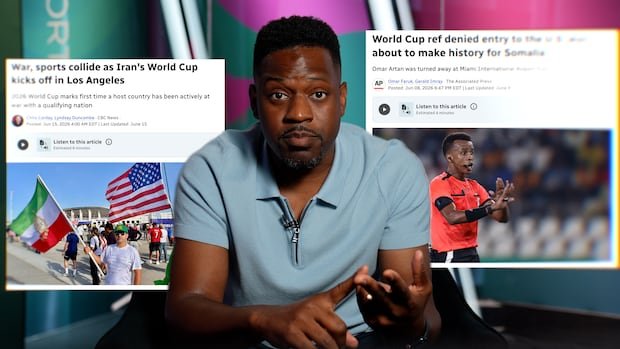
CBC Sports’ Donnovan Bennett writes this essay on the chaos that was the 2026 World Cup, and how despite all its shortcomings, brought people together.
“You’re walking out onto the pitch, and the whole world is watching,” Goodman said. “It’s just crazy. It feels like the start of a war.”
Now, the day after the biggest men’s World Cup in history reached its colourful, controversial conclusion, a new campaign for Canada begins.
Opening a new World Cup cycle
When Jesse Marsch was hired as head coach in May 2024, he had two years to build and prepare a team that could compete against the world’s best. He began recruiting pure athletes and dual nationals, including the towering Goodman. He ran them through training sessions that left them doubled over. He taught them to play vertically, aggressively, urgently.
With Marsch’s contract extended through 2030, he has an entire cycle to try to do something special.
His 2026 team earned its first World Cup point, its first group-stage win, and its first knockout-round win. His 2030 team will be harder pressed in some ways — it will have to qualify, and if it does, it won’t be as a top seed — but it should be a better, more complete, more cohesive Canada.
Marsch has already signalled his ground-up intentions by taking over coaching duties for the CONCACAF U-20 Championship, beginning Friday. He’ll try to qualify Canada’s younger men for their first Olympics since 1984, fighting to earn more big-game experience for potential future stars like Shola Jimoh, Richard Chukwu, and Sergei Kozlovskiy.

He will need to take a similarly future-minded approach to the senior side when it reunites in September in CONCACAF Nations League action. Soccer is a game of arguments and counterarguments, and Marsch will have to temper the desire to win a trophy today with the longer-range objective of a deep run in 2030.
There are limits to what’s possible, of course. The gap between Canada and Spain, the sport’s latest brilliant champion, couldn’t be closed in 20 years, let alone four.
But if there will always remain levels to the game, Canada’s men still have a chance to elevate theirs. Ranked 30th in the world, they might make a goal out of a spot in the top 20. They made the Round of 16 this time around. That puts the 2030 quarterfinals within their theoretical reach.
It won’t be easy or automatic. It will require ruthless forecasts and tougher choices, especially for someone like Marsch, who leads with his heart. He will need to start playing Ralph Priso over Richie Laryea, Niko Sigur over Stephen Eustàquio, Promise David over Cyle Larin.
He will also have to start Owen Goodman over Maxime Crépeau.
“They very much believe I have a massive future with the national team,” Goodman said. “I’m here to learn. I wake up and ask myself: What can I do to become an international goalkeeper for Canada?”

Succession is always hard. It’s doubly hard in times and places of limited opportunity. Crépeau has been a soldier for Canada and an ambassador for the game. He’s been brave, and loyal, and reliable. Nobody wants to see him go.
But after Canada’s World Cup run was ended by a dominant Morocco, Crépeau, among the team’s most accessible players, didn’t have it in him to talk to reporters. He knew he’d had his time in the sun, and it was over. That’s how sports, and the world, works.
“It’s a dream I don’t want to stop living,” Goodman said of his own World Cup experience, looking out at that shimmering pool.
He’s one of the lucky ones. He doesn’t have to stop living it. He will have every opportunity to play in the next one. He just needs to continue his education.
And then, in 2030, graduate.
Source link