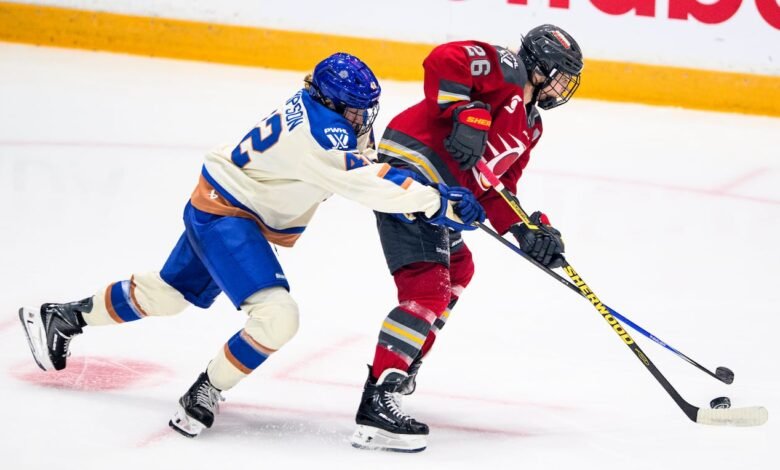
Marie-Philip Poulin’s trophy case now includes a Walter Cup championship and Ilana Kloss Playoff MVP award.
Arguably the best female hockey player in the world, they’ll be added to Poulin’s resumé, which is already full of accomplishments.
But being the best player in professional women’s hockey still pays less than one-seventh of the NHL’s minimum salary of $775,000 US, a sign of the vast disparity that remains between the best male and female athletes.
Poulin’s salary was $110,216 during the 2025-26 season, according to salary figures released by the PWHL Players Association on Tuesday. All PWHL salary amounts are in US dollars and don’t factor in any bonuses that players may receive.
The disclosure comes after players voted to release the information to the public. You can find a searchable database of player salaries below.
“This decision reflects our belief that greater salary transparency gives players clearer information and stronger context in individual negotiations, while also supporting a more transparent and credible marketplace for the league overall,” PWHLPA executive director Malaika Underwood said on Tuesday.
“Given that players had previously approved disclosure among players and agents, and that minimum and average salary figures are already public in the [collective bargaining agreement], this is a natural next step.”

Poulin was the fifth-highest paid player in the league last season, behind Ottawa’s Emily Clark ($126,090), New York’s Sarah Fillier ($125,000), Ottawa’s Brianne Jenner ($122,003) and Poulin’s Montreal teammate, Abby Roque ($116,699).
There’s a wide gulf between the top-paid players and a big chunk of the league. Ninety-seven players made less than $50,000 last season.
That includes 17 players on league-minimum contracts of $37,131.50, a figure that increases by three per cent each season, according to the collective bargaining agreement players signed with ownership back in 2023.
No salary cap
That collective bargaining agreement, which is in place until July 31, 2031, doesn’t assign a salary cap to individual PWHL teams, nor is there a maximum salary players can make.
Instead, each team as a whole must meet an average, annual base salary, which increases by three per cent each season — last season, the number to hit was $58,349.50. There is wiggle room of up to 10 per cent due to new signings and player movement, according to the CBA.
The figures released by the PWHLPA show one team, Ottawa, surpassed the average salary figure ($58,929.23), while New York had the lowest average salary ($54,892.06).
Each team in the PWHL is owned by the same entity, The Walter Group, meaning every team has the same resources. The salary figures shed clearer light on how teams are spending that money.

CBC Sports insider Karissa Donkin sets the scene for the Walter Cup final in Montreal and gives her insight on the PWHL expansion decisions.
The new data comes at a turning point for the PWHL. With a significant portion of the league on expiring contracts and four new teams set to enter the league next season, every roster is set to undergo a transformation.
But with the union locked into this salary structure until 2031, players aren’t likely to see bigger pay days any time soon, beyond the annual three per cent increase all players receive.
In an anonymous player poll conducted by The Athletic’s Hailey Salvian ahead of last season, nearly one-third of the players polled identified salaries as the biggest issue facing women’s hockey.
“I think there are people who think that we’re making millions,” Montreal Victoire forward Catherine Dubois told The Canadian Press earlier this season. “I think that maybe this will make people realize that we’re not doing this for the money, and maybe they’re going to understand our reality a little more.”
Victoire stars took pay cut this season
The PWHL launched in 2023 with the collective bargaining agreement in place.
For the first time, it gave players the right to things like maternity leave, meals and per diems, and a monthly housing stipend, which will go up to $1,800 per month per player next season.
The length of the agreement provided security for players signing on to play in a new league. But with the league’s success, it also means players are locked into low salaries as the league continues to grow. The PWHL started with six teams and will balloon to 12 next season.

Montreal Victoire players and staff say their fans helped propel them to their first PWHL title, despite a season filled with adversity.
“I think you have to remember that the goal here was to sort of set a bar,” Underwood said in an interview with CBC Sports last season, before the league officially expanded. “We’ve set that bar. And then as we continue to see success and have growth, we will then be in a position to raise that bar and that will always be a key priority for us.”
An example to look to could be the WNBA, which just signed a landmark CBA with players that has elevated average salaries up to $585,000 — though the ownership structure of the WNBA is different and the league has been around since 1997.
In the meantime, PWHL GMs must lean on creativity when building their teams.
Ahead of this past season, Poulin, Ann-Renée Desbiens and Laura Stacey all agreed to renegotiate their contracts to take less, so GM Danièle Sauvageau could add more depth. That included Roque’s contract, which was acquired in a trade with the New York Sirens during the draft last June.
Standing on the ice after her team won the Walter Cup, Stacey described the decision as “pretty damn worth it.”
“[Sauvageau] was on a mission last offseason to help us win the Cup,” said Stacey, who is also the president of the PWHLPA’s executive board. “We had been in first place, we had been to the playoffs, but we couldn’t find a way to get that Cup. She did whatever it took to find a way to do that. She talked to us and we were all in with her. I’m so, so happy that it paid off.”
Source link