Nic Sulsky, Rock League’s CEO, uses plenty of metaphors to describe the first season of his curling venture.
It’s a baby that was born and has begun to run, and now must go train, if you’re interested in some hilarious imagery. It’s a car that’s been taken for a test drive, and now needs some “real gas into the engine.”
Or, perhaps, it’s a curling match unto itself.
“We’re probably in like the fifth rock of the first end. We’re so early. For some of these people out there to say they know it’s going to work or know it’s not going to work, it’s like, ‘No, no, no.’ But we have something here and now let’s rally behind this thing and let’s build it to where we think we can get it to because that’s only going to benefit the sport of curling,” Sulsky said.
“And if you love curling, truly, how could you not like what we just pulled off? Because it was fun, man. And it ended on a draw-to-the-button shootout, like, come on. It was so fun. Holy moly.”
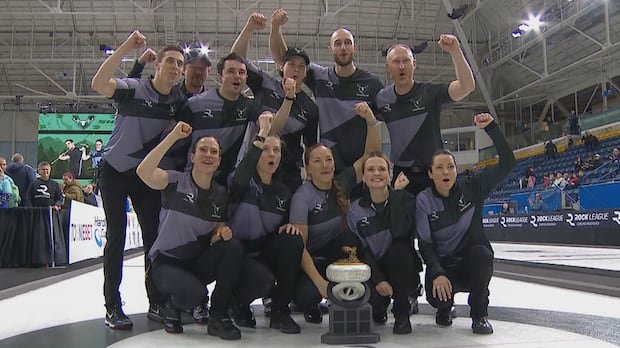
The Brad Jacobs-led Shield Curling Club won the inaugural championship in a match that came down to extra time in mixed doubles, with Switzerland’s Benoit Schwarz-van Berkel emerging as the hero.
Sulsky did not specify how many ends his metaphorical curling match would hold, whether it was 10 like tradition says, eight like mixed doubles or seven like Rock League.
But he did say he could envision the 2034 Olympics in Salt Lake City being curling’s “big moment,” and if we work backwards from there, then skip stones will be thrown in the fully realized five-week Rock League season next year, and one end per year after that would make 2034 the eighth end — a reasonable compromise between tradition and disruption.
“Do I think we’ve proved that curling has potential to be a bigger sport, a global professional sport? Absolutely, I think we’ve proved that. And I know that from the conversations I’ve been having with investors and brands and broadcasters,” he said.

Shield Curling Club wins the men’s match 8-6, Typhoon Curling Club takes the women’s match 7-5 and Shield secured the Rock League title with a victory in a shootout
Indeed, 1.13 million Canadians tuned into Rock League’s weekend broadcasts, including 690,000 for Sunday’s semifinals and championship. The semis held an average minute audience of 92,000 and the final garnered a minute audience of 70,000 on CBC TV.
Rock League also amassed over 1.3 million views across all CBC social platforms, while Rock League socials garnered over 10.1 million video views and 32.4 million impressions, per Sulsky.
“I can sell the story and the vision of what we’re doing. But at end of the day, what we’re doing is going to be sold by data, right? Sold by fact. The fact that we had 690,000 Canadians tune into the championship game on Sunday when we were in direct competition against one of the most historic Masters of all time, and a Blue Jays game, that’s telling,” Sulsky said.
Still, while Sulsky said Rock League achieved its goal of proof of concept in the one-week preview season held at Toronto’s Mattamy Athletic Centre earlier in April, he acknowledged it wasn’t perfect, and there is plenty still to be done.
To that end, Rock League sent curlers and certain viewers surveys to ask about their experiences.
Sulsky said around half of the athletes have already responded, with only one ticking off “maybe” instead of “yes” when asked whether they would return next season.
He added curlers, based on results so far, were fans of the format, playing just one game a day and having the ability to move between sheets. They weren’t bothered by the drone footage over the ice or the in-stadium music.
On the negative side, there were complaints about the uniform quality, mixed doubles being separated and the other two matches by a sheetside bar.
To the latter, Sulsky said the bar next season will likely wrap around the three sheets in a U shape, ensuring they are all side-by-side.

CBC Sports takes a closer look and explain exactly how curling’s first professional league called Rock League works.
Sulsky added attendance (around 500 people were in the stands for the championship game) was another weak spot, although one they foresaw.
“The attendance wasn’t what we had wanted, but I mean, Toronto, historically, has never been a great location for curling events. And candidly, it was a strategic decision to put it into Toronto for a number of reasons, primarily it’s our home city from a [league] perspective.
“Our ice makers, our operating team knew the building really, really well. And so, it was a way to kind of, I wouldn’t say de-risk, but de-stress the enormous task that launching Rock League was going to be,” he said.
The planned regular-season stops next year include Ottawa, Halifax, Moose Jaw, Sask. and Utica, N.Y. A venue for the championship week has yet to be announced.
Unlike Season 1, the fully realized five-week version of Rock League will be held Thursday through Sunday over the first four stops. Sulsky said the league is discussing an F1-style standings system, whereby there are weekly winners, with descending points handed out from first to worst.
There could also be a player draft for each team to add their own spares in order to avoid the somewhat awkward situation that Linda Stenlund found herself in when she played for both Frontier and Alpine over the course of the week.
Sulsky said other players have reached out with interest, too. Meanwhile, Germany’s Marc Muskatewitz, 30, and Switzerland’s Carole Howald, 33, have joined Japan’s Chinami Yoshida in leaving their traditional fours teams but staying in Rock League.
“I don’t think Marc and Carole and Chinami’s decision is going to be a majority of curlers by any stretch, because at the end of the day, I’ll be the last person to try and fool myself. Winning a Rock League championship will still not trump winning an Olympic gold medal, right?” Sulsky said.
“That is still the ultimate goal and I can appreciate that. But the great thing is [these] things can live side by side, right?”
Source link


