This is an excerpt from The Buzzer, CBC Sports’ daily email newsletter. Get up to speed on what’s happening in sports by subscribing here.
We’re now a few days into the NBA playoffs and, while things are not going well for the Toronto Raptors, it’s been great to finally see highly competitive basketball on a nightly basis after a tedious regular season marred by tanking and an annoying amount of blowouts.
Tanking — the practice of deliberately fielding a bad team in order to improve your draft position — is nothing new, of course. But it reached a crisis point this season. With a deep pool of prospects set to enter the NBA, an unusually large number of teams seemed to be trying to lose as many games as they could for a better shot at a top pick. As a result, the average margin of victory this season ballooned to a record 13.3 points while a whopping 96 games were decided by at least 30. That was 16 more than the previous high.
This turned off a lot of fans and media members, who spent much of the season complaining about tanking and coming up with ideas on how to stop it rather than focusing on the amazing play of superstars like Shai Gilgeous-Alexander, Nikola Jokic and Victor Wembanyama or other more fun topics. Tanking became such a drag that NBA commissioner Adam Silver vowed to “fix” it this summer by altering the draft process, and three anti-tanking concepts were leaked last month.
Each of the proposals is fairly complicated, and yet they share an obvious problem: even though they decrease the chances of the very worst teams landing the No. 1 pick, they still give these bottom-dwellers better lottery odds than the less-awful teams. So the incentive to lose games once you fall out of playoff contention remains in place.
But if tanking is really as big a threat to the NBA as everyone seems to believe it is, maybe it’s time to consider some more creative solutions. For example, the Gold Plan.
If you’re not familiar, this idea is the brainchild of Adam Gold, an American data scientist and hockey fan who devised it back in 2008 when NHL teams were tanking for top prospect Steven Stamkos. An academic journal published it in 2010, and Gold presented it at the MIT Sloan Sports Analytics Conference in 2012.
The Gold Plan is pretty simple: once a team is mathematically eliminated from the playoffs, they begin earning “draft-order points” for each win or overtime/shootout loss — just like they do in the normal standings. At the end of the season, the team with the most draft-order points gets the top pick.
In other words, you can no longer simply fail your way to the best prospect. At some point, you have to go out and earn that player, removing the incentive for bad teams to throw away games down the stretch. Or, as Gold puts it: “The biggest loser is no longer the biggest winner.”
Unlike the most radical anti-tanking ideas in the NBA — such as flat lottery odds for all 30 teams, or eliminating the draft altogether for an auction — the Gold Plan still favours the worst teams because the earlier you’re eliminated, the more games you have to rack up draft-order points. But it prevents those really embarrassing moments late in the season when certain teams are clearly not putting their best lineup out there and fans are sometimes openly rooting for the opposing team.
“I see the first overall selection as an asset to the league that they can use to generate interest and enthusiasm from fans for their favourite teams,” Gold says. “I think [the plan] is an opportunity to have a prize that can be won.”
Another nice thing about the plan is that, like Gold himself, it’s pretty flexible. He’s fine with leagues customizing it to their individual desires. They could use it to decide the entire draft order for all their non-playoff teams, or just the No. 1 pick, or the top three, or the top five — whatever they want, really. The possibilities are many.
The plan in practice
Granted, some ideas that sound great in theory don’t end up working. But another beauty of the Gold Plan is that it’s already being deployed in real life.
Back in 2024, the fledgling Professional Women’s Hockey League was looking for innovative ways to attract fans to its brand-new product in an increasingly crowded sports marketplace. A league executive suggested the Gold Plan, and the PWHL reached out to Gold, who helped them install the system during the league’s inaugural season. It remains in place today.
Partly because the PWHL is such a small league, the Gold Plan hasn’t actually altered the draft order yet. With only six teams in existence for the first two seasons, and four making the playoffs, the New York Sirens finished last in the standings by a pretty wide margin and beat out the fifth-place team both times in the Gold Plan chase.
But it could become more competitive now that the PWHL has expanded to eight teams. With two games left in the regular season, Seattle has a one-point lead over expansion cousin Vancouver, and New York will join them in the race if it loses to fifth-place Toronto tonight.
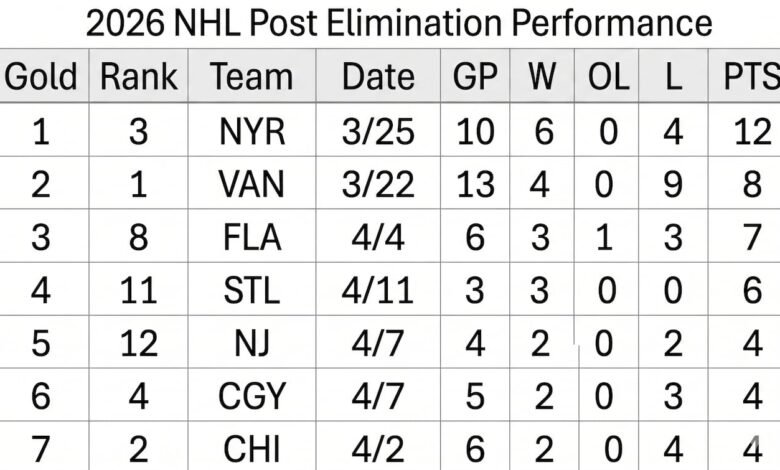
The Gold Plan could be a lot more impactful in a bigger league like the NHL, where 16 teams miss the playoffs. Just for fun, I asked Gold how this year’s NHL draft order would look under the plan. Here’s how the top seven shakes out:

That’s pretty dramatic. “Rank” refers to a team’s ranking in the actual lottery odds, so league-worst Vancouver goes from having the best chance of landing the No. 1 choice to picking second. The New York Rangers, who finished with the third-worst record in the league, earn the top selection due to their superior record after being eliminated from playoff contention. Florida, St. Louis and New Jersey jump up quite a bit too, while poor Chicago falls all the way from potentially picking No. 2 overall to seventh.
Maybe try it?
Gold hasn’t crunched the numbers for the NBA, but you have to think his plan would do more to disincentivize tanking than those three more complicated half measures the league is reportedly considering. And yet I haven’t seen the Gold Plan being floated as a possible solution, even though it’s already being used by another North American pro sports league.
I also think the NBA should look to hockey for a potential answer to the league’s other major crisis: the rise of injuries to star players, who are sitting out far too many games these days either because they’re actually hurt or their teams are practicing “load management” in a (failing) effort to keep them healthy. But is it possible that these guys are simply playing too much within each game?
For example, the leading scorer in the NBA this season, Luka Doncic, averaged close to 36 minutes per game, meaning he’s on the court for roughly 75 per cent of the standard 48-minute contest. He played in only 64 of the Lakers’ 82 games.
The NHL’s top scorer, Connor McDavid, averaged about 23 minutes of ice time. That’s less than 40 per cent of a regulation NHL game, which is 60 minutes. He played all 82 of the Oilers’ games.
And that’s the key. When fans buy a ticket to a game or tune in on TV, they want to see their favourite player out there. In the NHL, there’s just a much better chance of that happening than in the NBA. And you never hear NHL fans complaining that the best players are on the ice for far less than half the game.
Obviously, hockey and basketball are different sports with different physical demands and different roster sizes. But has anyone in the NBA seriously considered that maybe the players should just play fewer minutes each night and adjust things accordingly? If they have, I haven’t seen it enter the discourse.
I guess my broader point here is that it seems like solutions to the NBA’s biggest problems are out there. They just have to be willing to try them.
Source link