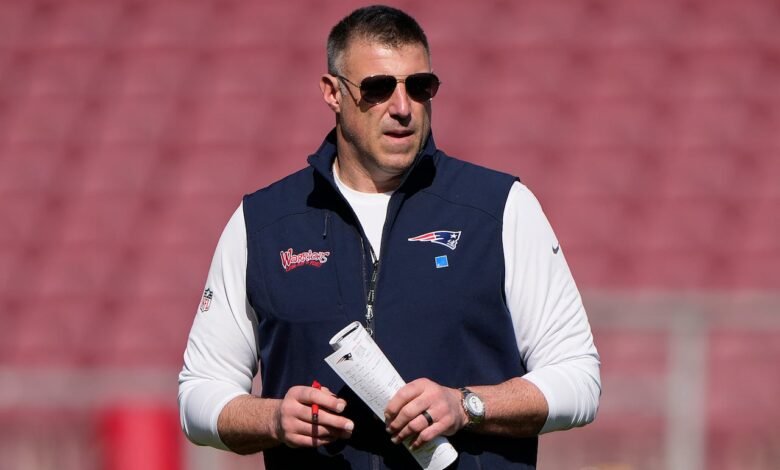
First, let’s extend every benefit of every doubt to Mike Vrabel, head coach of the New England Patriots, and Dianna Russini, the NFL insider, most recently employed by The Athletic, with whom he was spotted at an Arizona resort last week.
Vrabel and Russini are both married, but not to each other. Nevertheless, they were spotted in Sedona, hugging, holding hands with interlaced fingers, lounging in a pool, and then a hot-tub. I’m pretty sure the scientific term for that kind of carrying-on is “canoodling,” but that word also drips with the exact kind of judgement we just pledged to suspend.
When confronted with the photos, Vrabel said the idea they hinted at broader bad behaviour was “laughable.”
Russini, for her part, also denied any extracurricular shenanigans, and her bosses at The Athletic echoed her contention that the published pictures “lacked essential context.”
The Athletic also placed Russini, who came over from ESPN in 2023, on a de-facto suspension while it investigated the story behind the viral images. This past Tuesday, she quit, explaining in her resignation letter that leaks and speculation were imperiling the workplace investigation, and that she didn’t want the drama to define her career.
In his memo to employees at The Athletic, executive editor Steven Ginsberg stopped a long, long, long way short of vindicating Russini of any ethical breaches.
“As additional information emerged,” he wrote, “new questions were raised that became part of our investigation.”
As for Vrabel?
He hasn’t spoken to the media since last week but he’s still employed, and on the surface it looks like an egregious double standard. Two professionals, caught in the same set of question-raising photos, but the man keeps his job and the woman leaves hers under a fog of suspicion, with an investigation still ongoing.
Faux amis
It’s a reasonable first-level conclusion to draw. But it’s also, for reasons we’ll detail shortly, what language teachers call a False Friend – looks like it means one thing, but actually signals something very different.
Instead, we can also view this story as a rare peek at the way pro sports insider journalists operate, the ethical rules they’re permitted to bend, how those rules can be broken, and the lopsided risk a journalist assumes when they grow too close to a source on a personal level.
The New York Times, which owns The Athletic, has a detailed and unambiguous code of ethics, which is linked in its coverage of the photos and their fallout. Those rules can seem abstract and hypothetical, and staying on the right side of them in real life requires self-awareness and common sense and caution. We’re all expected to be friendly with people we interview often, but not to become so close to them that it clouds our judgment or slants our coverage of them.
How close is too close?
I’m not sure exactly where that boundary is, but even a platonic play date at an adults-only resort seems to cross it.
The challenge for sports insider journalists?
Figuring out where you draw your lines, where your employer draws theirs, and how to stay within them without shutting off the flow of information that keeps you employed and relevant.
To clarify: I’m not judging insiders. We all have a bottomless appetite for the scoops, transactions and informed speculation they provide us year-round. The only reason they keep the information spigot open is that we keep drinking from it. When you watch the NFL Draft next week, notice how quickly the insiders sprint to social media to post picks before teams can even announce them on TV. Then watch how quickly people like, reply to and re-share those posts.
In the current sports media environment, it’s a good way to build a name and a personal brand, and a following you can port between employers. Being a great writer can still get you hired. Bringing your own audience to publication will get you hired faster.
The tradeoff?
It’s exhausting.
In a past journalistic life, I was a beat writer, which means that in addition to covering games and practices, I constantly monitored multiple mobile phones for messages and updates. I felt the adrenaline rush that accompanied a big scoop, along the paranoia that I might get scooped myself. It’s a tense, anxious, exhausting way to live. Put that feeling on steroids and multiply it by 10, and you have the stress your favourite insider deals with daily.
Plus, getting that deep into inner circles of that many important people means giving a lot of yourself to the job. Maybe it’s time spent socializing to curry favour – coffee shop, bar, golf course. Could be all that, plus holiday gift exchanges. Close observers of sports media will remember that old Washington Post profile on ESPN’s NFL insider Adam Schefter, detailing the five-figure bill he ran up buying gifts for sources and co-workers.
If you think that last sentence sounds a little too much like quid pro quo, you might not be wrong. What’s out of bounds is between the insider, their employer, and anybody else’s ability to find out.

That dynamic also helps explain why Vrabel hasn’t faced any on-the-job sanctions yet.
First, he coaches the Patriots, whose owner can’t wag his finger at anybody over shenanigans like the photos in question. Google: Robert Kraft Arrest and you’ll know why.
Second, Vrabel’s not a journalist or Russini’s co-worker. He’s a football coach. Russini’s ethical rulebook says she can’t show unfair bias to people she writes about; coaches can, and do, play media favourites. If he coughs up secrets that could get his team beaten on Sunday, he’d better call a lawyer and negotiate a severance deal. But unless his contract forbids it, he can offer all kinds of inducements in exchange for favourable coverage. And unless their employer approves it, journalists can’t accept.
Otherwise you’re courting an old-fashioned conflict of interest, which is the cloud threatening to rain on every story Russini has ever written about Vrabel, and any team he has coached. Aren’t they, in the most charitable possible reading of those photos, super friendly outside of work? How can readers be sure she’s telling a neutral truth instead of spinning the facts in Vrabel’s favour? If the audience needs the most informative story possible, but your friend would appreciate you publishing something that advances his goals, whose interests win out?
If there’s any question, there’s no question. If the audience can no longer trust your coverage, everybody loses.
Source link


