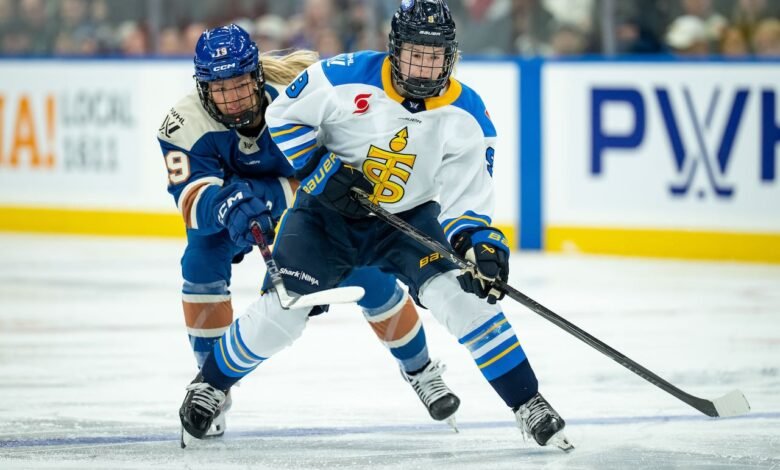
Twenty-four hours before she had to submit her team’s three-player protection list to the league, Toronto Sceptres GM Gina Kingsbury had to change course.
The league is in the midst of a complicated, six-phase expansion player distribution process, aimed at filling out new teams in Hamilton, Detroit, Las Vegas and San Jose.
Kingsbury said she went into the process planning to prioritize re-signing Daryl Watts, the Sceptres’ leading scorer over the past two seasons.
It looked like the team was close to an agreement with Watts. But things fell apart on Monday, and Kingsbury had to pivot when deciding who to protect.
The team ultimately protected defenders Renata Fast and Ella Shelton, plus goaltender Raygan Kirk.
“[Watts] felt that another market was better for her,” Kingsbury told reporters on Thursday. “From that moment, we had to somewhat change the strategy a bit and at that point, it’s definitely trying to protect what we felt were our best assets.”

It’s a peek inside the chaos and negotiating underway in the PWHL this week, as GMs make decisions that will determine the future of their teams.
Watts will be a prime candidate for one of the four expansion teams, which can offer her an expansion foundational offer worth at least $100,000 US per season. Watts made $59,000 last season with the Sceptres.
Meanwhile, Toronto will have to look elsewhere to replace the team’s leading scorer.
“All these phases will make us re-evaluate where we are, what we’re going to need and how we attack that for the future,” Kingsbury said. “So it’s a little bit of a you don’t have information until you know what you see, and then you’ve got to make a decision there on the direction you go.”
The next step comes on Friday, when the four expansion teams can begin signing players. The expansion teams will be looking to sign five players each between Friday afternoon and Monday afternoon, when the second signing window closes.
Here are three key takeaways on the first phase of the PWHL’s expansion process.
Goaltending at a premium
Seven of the eight teams opted to protect a goaltender. The sentiment across the league is that it’s a premium position that could be harder to fill through the draft or free agency, especially with four new teams looking for starters.
“If you can have a good goalie in this league, we’ve seen throughout [that] you’re typically in a good position,” Kingsbury said.
Goals were few and far between during the playoffs this year, and you can trace that back to having four strong goaltenders leading the way: Aerin Frankel (Boston Fleet), Ann-Renée Desbiens (Montreal Victoire), Gwyneth Philips (Ottawa Charge) and Maddie Rooney (Minnesota Frost).

No doubt the rest of the league took note of what role those goaltenders played in keeping their teams playing far into May, including Desbiens’ role in bringing a championship to Montreal.
All four of the goaltenders listed above were protected, as were Kirk (Toronto Sceptres), Emerance Maschmeyer (Vancouver Goldeneyes) and Hannah Murphy (Seattle Torrent).
In the case of Toronto and Seattle, GMs opted to protect a young, goaltender of the future over more established offensive stars. The bet is that it will be easier to fill in the other holes.
“There are a lot of teams that need good starting goaltenders and it’s probably difficult to wait for the draft where you don’t exactly know what’s going to fall where,” Seattle Torrent GM Meghan Turner said. “We felt good about Murphy’s potential and what we saw in [her] this year.”
Young talent
For the last two seasons, PWHL teams have been in win-now mode. With expansion on the horizon, every GM knew their roster was temporary.
With the league now at 12 teams and expected to stay there for a while, GMs can think a bit more about developing young players over the longer term.
“Now we all get to get excited about building for the future,” Vancouver Goldeneyes GM Cara Gardner Morey said. “I think we also realize that it takes a long time to build culture.”

New York prioritized three of its elite, young forwards — Casey O’Brien, Sarah Fillier and Kristýna Kaltounková — while leaving captain Micah Zandee-Hart available.
In Seattle, Turner opted to protect Murphy and defender Anna Wilgren over veteran players like captain Hilary Knight.
At the heart of that decision was the identity Turner is trying to build in Seattle’s second season: a team that plays heavy defensively and is relentless in the offensive zone.
“In a world where we just expanded to 12 teams here, I think we wanted to make sure that we had a good core group that could have some longevity,” Turner said. “I think everyone feels the same way that it’s important to have a good balance of experience, but also some young potential.”
Hedging bets
Just because your favourite player didn’t appear on the team’s protection list doesn’t automatically mean they’re gone.
In some cases, GMs left players unprotected with the faith that they’ll make it through expansion and be able to re-sign with their team.

That’s the case for Toronto captain Blayre Turnbull, whose contract is expiring.
“Blayre wants to be in Toronto at all costs and together mutually, we felt that this was the best place to be as an organization and we feel confident that she will be a Toronto Sceptre here moving forward,” Kingsbury said. “She’s been involved in this process of making this decision, so we’re looking forward to keeping her in Toronto.”
Expansion teams must sign five players by the end of phase two on Monday afternoon. If a team doesn’t reach five players, they’ll go through an expansion draft-style of process to reach that number.
In a summer full of change and growth for the PWHL, this may be one of the most important weeks for GMs.
It’s strategizing and also a bit of guessing what things could look like when the dust settles in a few days.
“We have to accept that we will lose players — that’s the hard reality of this,” Turner said. “So it’s looking at, again, coming all the way back to the identity and playing a heavy game and being punishing in that respect, we want to balance, if we can, retaining players through this process that we feel will fit that going forward, and that we feel will play well within this group.”
Source link