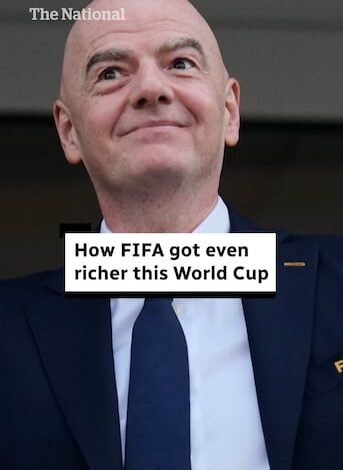
Less than two weeks since the conclusion of the 2026 World Cup, soccer is once again front-page news thanks to a new proposal by FIFA president Gianni Infantino.
Not one to shy away from big announcements, Infantino caught many in the soccer world unaware with a plan to sell off part of FIFA’s commercial interests to private investors.
It’s caused significant backlash in the soccer world, including the prospect of European nations boycotting future editions of the World Cup.
Here’s what you need to know.

CBC’s Jonathon Gatehouse breaks down how Gianni Infantino doubled profits for the 2026 World Cup, and how much of that money ends up in the hands of organizations like Soccer Canada.
What are FIFA, UEFA and the other soccer confederations?
The Fédération Internationale de Football Association is the international governing body of association football, also known as soccer. Founded in 1904 and headquartered in Switzerland, FIFA today has many stated objectives, including overseeing the development and innovation in the sport, conducting disciplinary matters and organizing international tournaments, including the men’s and women’s World Cup.
FIFA’s membership is currently comprised of 211 national soccer federations (such as Canada Soccer), which are the effective owners of FIFA as a non-profit association under Swiss law.
Each national federation is also a member of six continental confederations that oversee the sport in their respective regions:
- The Asian Football Confederation (AFC).
- Confederación Sudamericana de Fútbol (CONMEBOL).
- Confederation of African Football (CAF).
- Confederation of North, Central America and Caribbean Association Football (CONCACAF).
- Oceania Football Confederation (OFC).
- Union of European Football Associations (UEFA).
UEFA is arguably the most powerful of the six, as it counts many of the sport’s most successful countries among its 55 members — including France, Germany, Italy and current world champion Spain — as well as the four “home nations” of the United Kingdom, where the sport was formalized.

What is the FIFA plan causing the latest furor?
On Tuesday, FIFA president Gianni Infantino announced plans to form a commercial subsidiary called FIFA Forward Enterprise (FFE) that would run competitions like the World Cup and Club World Cup.
Under FIFA’s plan, which was pitched as a way to boost the development of soccer around the world, 20 per cent of FFE would be sold off to private investors, including a New York investment firm created by Joshua Kushner, brother of U.S. President Donald Trump’s son-in-law Jared Kushner.
National federations that approve FFE would see their promised $8 million US development funds from FIFA more than doubled to $20 million US for the next four years. It would then increase to $22 million US and $24 million US in the following cycles through 2038, FIFA said.
What was UEFA’s reaction?
The continental confederations appear to have been blindsided by Infantino’s announcement.
Almost immediately, UEFA called an emergency meeting of its member federations. On Thursday, it released a strongly worded statement saying its members would boycott all the global soccer body’s competitions as long as the FEE proposal remains on the table.
UEFA delivered a stinging rebuke of Infantino’s plan, saying “the World Cup is not for sale.”
“The World Cup cannot be treated as an investment product. It is one of football’s greatest sporting legacies. It has been built over generations by players, national teams and supporters across every continent. No part of it should ever be surrendered to private investors.”
It added that FIFA’s plan, under which “commercial return becomes a permanent obligation” and “investor expectations become a daily pressure,” would upend the way soccer is governed.
“You’re giving undue influence to people that are not going to necessarily be motivated by what’s best for soccer but what’s best for their bank accounts,” said Moshe Lander, a sports economist at Concordia University in Montreal.

Which competitions would be affected by a boycott?
Three FIFA World Cup tournaments are still to be played this year:
- The U-20 Women’s World Cup in Poland is set to kick off on Sept. 5.
- The U-17 Women’s World Cup in Morocco is due to get underway on Oct. 17.
- The U-17 Men’s World Cup in Qatar gets underway in mid-November.
The next senior World Cup, the women’s tournament, is scheduled for next summer in Brazil.
UEFA has sent a “powerful message” in threatening to boycott future FIFA events, said Graham Scott, a former English Premier League referee and now a correspondent with The Athletic.
“The withdrawal of UEFA countries from any FIFA tournament effectively renders it worthless,” he said.
What about the other confederations?
UEFA’s statement blasts FIFA for its lack of consultation with member federations about the FFE plan, a sentiment echoed by both the confederations covering Asia, and North and Central America and the Caribbean.
On Wednesday, a statement by the AFC voiced disappointment “that a matter of such significance entered the public domain before the AFC family had been afforded the opportunity to examine and discuss it.”
AFC president Sheikh Salman bin Ibrahim Al Khalifa went further in a letter to member federations, saying “FIFA’s unilateral actions appear to undermine the very foundations of continental football” and warned of risks to their own competitions.
Several hours after UEFA’s statement was released Thursday, CONCACAF said its member federations had rejected the proposal to create FFE.
While it didn’t go as far as threatening a boycott, a CONCACAF statement called for “greater transparency and proper governance” and raised concerns about “the lack of due process surrounding the proposal.”
It also questioned why FIFA deemed that private equity was necessary after what was the most profitable World Cup in history.
The CAF says it will discuss the proposal at a meeting next week, while the OFC said it had begun a consultation process with its members about the proposal. As of late Thursday, CONMEBOL, which covers South America, had not released a statement about the proposal.
The combined votes of the AFC, CONCACAF and UEFA would be enough to defeat the proposal, which requires a majority from member federations to pass.

Has Infantino put his position in jeopardy?
Prior to the FFE announcement, it looked as if Infantino would easily win re-election for a fourth term as FIFA president when a vote of member federations is held next March.
That’s perhaps less of a certainty now, especially considering the comments from AFC president Sheikh Salman, who has been a staunch ally of Infantino.
It also follows concern over some aspects of the recent World Cup hosted by Canada, Mexico and the U.S., including the high price of tickets, controversies over the video assistant referee, the introduction of hydration breaks during games, and a red card for an American player that was rescinded after the intervention of U.S. President Donald Trump.
FIFA has set a Nov. 18 deadline for potential candidates to declare in the vote for the association’s next president.
Source link